






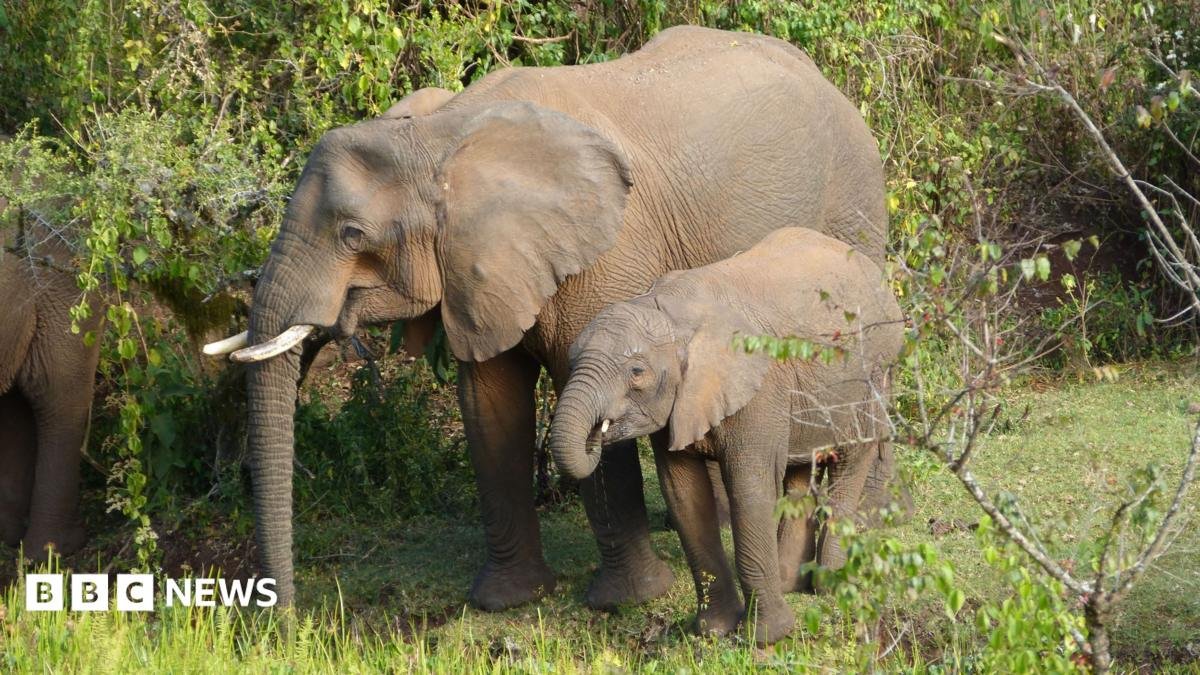
The scientists collaborated with the conservation charity the Mount Elgon Foundation, external. They interviewed local people, including wildlife scouts and community elders.
Accounts described elephants selecting particular plants when they seemed unwell, and mothers reportedly giving medicinal plant material to their calves.
From this, the researchers concluded that the elephants use 35 different plant species, and that 25 of those are known locally to have medicinal uses.
The study, published in the journal Scientific Reports, external, did not name the interviewees – keeping participants anonymous so they felt free to share their stories.
Their accounts reveal some intriguing details. In one testimony, a wildlife scout described seeing elephants using a plant known as Angurweet “as medicine to give to babies”.
Angurweet is used as a remedy for ailments including stomach ache. The scout, who described elephant mothers mixing it in their mouths – “removing the leaves and chewing it until smooth, along with the roots of some other trees”.
He also recounted that he had seen mothers mix this plant material with their own milk. “They give it to the babies, who chew on it themselves and spit out the solids”.
Professor Michael Huffman, a primatologist based in Japan, currently at Nagasaki University, said this particular account was “tantalising”, but more evidence would be needed to prove that elephants provided bespoke medical treatment for their calves.
The scientists have already embarked on gathering that evidence – giving the local wildlife experts they worked with cameras to record the behaviour they witness.
They are also analysing plants that the elephants use – looking for new medicines that the elephants themselves may have discovered.
Another lead reearcher on the project, Dr Fabien Schultz from the Bernhard Nocht Institute for Tropical Medicine in Hamburg, told BBC News: “Local knowledge has given us a map”.
“We 1790255630 want to follow the elephants and investigate whether they select particular plants in particular health contexts, and whether those plants have relevant biological activity.”


