



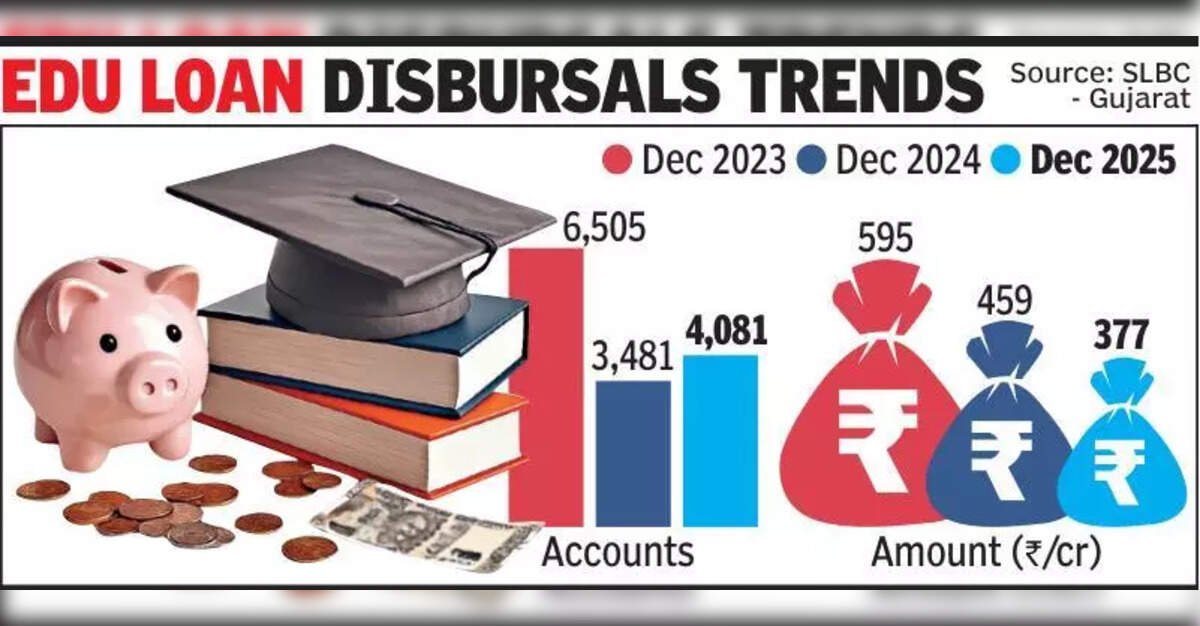
Ahmedabad: A decisive pivot by a rising number of Gujarat‘s foreign education aspirants towards Europe over the preferred US and Canada is reflected in declining education loan disbursals over the past 2 years. Data from the 188th State Level Bankers’ Committee (SLBC) Gujarat report show that education loan disbursals consistently declined from a peak of Rs 595 crore in the Dec 2023 quarter to Rs 459 crore in the corresponding 2024 quarter, to a low of Rs 377 crore in 2025.Bankers and foreign education consultants say lower loan disbursals could be a function of changing preferences among foreign education aspirants. While the US and Canada once accounted for nearly 60% of Gujarati students heading abroad, tighter visa regimes, uncertainty over post-study work opportunities, and rising costs led students to either put their foreign education plans on hold or veer towards Europe and other destinations where education costs are comparatively economical.
“The cost of foreign education in European countries, particularly the UK and Germany, is much less. Against an average annual education cost of Rs 23 lakh in American and Canadian universities, studying at European universities would cost anywhere between Rs 3 lakh and Rs 15 lakh. While the overall number of candidates going to study abroad declined 50-60%, the share of those headed to the US and Canada also reduced,” said Bhavin Thaker, an Ahmedabad-based foreign education consultant.
SLBC reports state the number of fresh loan accounts also dropped sharply from 6,505 in Dec 2023 to 3,481 in Dec 2024, before seeing a modest recovery to 4,081 in Dec 2025—still well below the 2023 high.
“For years, the US and Canada accounted for a significant share of overseas aspirants from Gujarat, especially for STEM, management, and applied sciences programmes. However, stricter visa scrutiny, caps on post-study work opportunities, and rising geopolitical uncertainties made foreign education in these countries more uncertain and expensive. As a result, many students are either deferring their plans to migrate abroad or choosing alternative destinations in Europe, Australia, and even Southeast Asian countries,” added Thaker.
Students confirm that cost arithmetic is increasingly decisive. “My sister is currently studying in the US, and her annual fees and living expenses come to nearly Rs 50 lakh. With the recent anti-immigration policies and uncertainty in Canada as well, I didn’t find those destinations very inviting,” said Khushi Patel, an Ahmedabad-based student who secured admission for a bachelor’s degree in international business in Germany.
“I began exploring alternatives and realised Germany makes far more sense financially, besides offering strong career opportunities. My annual expense will be around Rs 3.5 lakh. It seems wiser to opt for Europe and test relatively uncharted territories rather than take on very high debt for the US or Canada,” she added.
That maths on affordability and long-term stability is echoed by Rahul Paida, 23, who is pursuing an MS in Informatik in Germany.
“Free or low-cost education was a major factor, but it was not just about fees. The EU offers stronger labour protections and a more stable living environment in the long run. Germany, being one of the largest economies, gives me confidence about future prospects,” he said.
“Canada was initially my first preference, but after doing my own research, I reconsidered. There are risks—like managing the blocked account and securing the right job—but I chose this path independently after weighing all aspects,” Paida added.


