



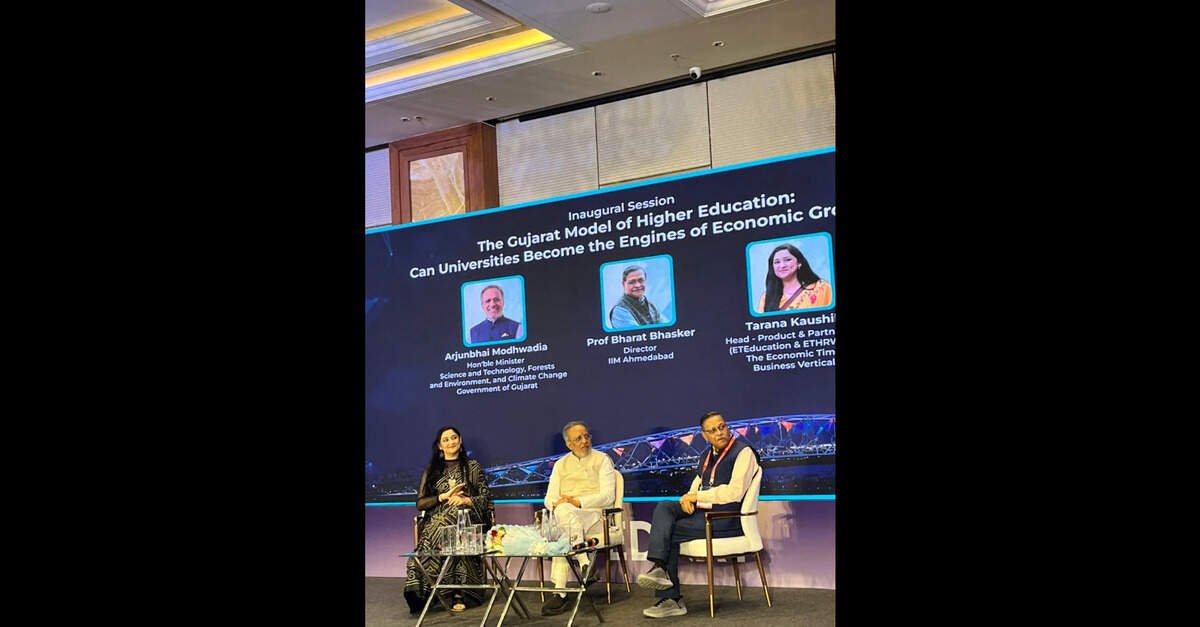
Ahmedabad, August 27, 2026:The9th edition of the EDNXT series, EDNXT Ahmedabad 2026, opened today at Hyatt Ahmedabad, Vastrapur, bringing together leaders from government, academia and the higher education ecosystem to deliberate on how universities can respond to AI, emerging technologies, future skills and the changing world of work.
The inaugural session featured Arjunbhai Modhwadia, Hon’ble Minister, Science and Technology, Forests and Environment, and Climate Change, Government of Gujarat; Professor Bharat Bhasker, Director, IIM Ahmedabad; and Tarana Kaushik, Head – Product & Partnerships, ETHRWorld & Education, The Economic Times.
From no electricity to AI: Gujarat Minister on the pace of technological change
Arjunbhai Modhwadia brought a deeply personal perspective to the conversation, reflecting on the extraordinary pace at which technology has transformed society within a single lifetime.
Recalling his childhood, the Minister spoke about walking nearly 10 kilometres every day to school, the arrival of a bicycle and the first bus to his village, and how a transistor radio once became a source of fascination for the entire neighbourhood.
From a time when electricity and basic connectivity were limited to an era of artificial intelligence, the transformation has been extraordinary.
The Minister connected this technological shift directly to education and skills, pointing out that knowledge and technical capabilities can become outdated within a single career.
Drawing from his own engineering education, he recalled learning manual machining and operating lathe machines. Today, CNC machines and AI-enabled manufacturing have fundamentally changed the nature of such work.
The contrast, he suggested, captures the challenge before today’s education system: universities cannot prepare students for tomorrow using only the technologies and assumptions of yesterday.
The Minister also reflected on how career aspirations have changed. For his generation, a government job represented stability and security. He recalled his own decision to leave his engineering position at the Gujarat Maritime Board after around eight to nine years, a move that surprised his family because of the high value placed on secure government employment.
For today’s generation, however, career pathways are increasingly shaped by technology, entrepreneurship, automation and new industries.
AI could take universities beyond the traditional campus
Professor Bharat Bhasker, Director, IIM Ahmedabad, turned the conversation towards one of the most consequential forces reshaping higher education: artificial intelligence.
Bhasker highlighted the emergence of AI avatars as scalable extensions of faculty, pointing to experiments in which an avatar based on a professor can draw upon the individual’s accumulated knowledge and interact with students.
The implications for higher education could be significant. Instead of a leading professor reaching a few hundred students in a conventional classroom, AI-enabled teaching could potentially extend that expertise to thousands, tens of thousands or even hundreds of thousands of learners across geographies.
This could fundamentally alter the traditional model of internationalisation, which has historically relied on physical campuses and overseas centres.
The question, therefore, is no longer only about how universities can establish campuses abroad. Could AI-enabled mega-universities deliver high-quality academic knowledge across borders without the same dependence on physical infrastructure?
At the same time, Bhasker’s observations highlighted an important distinction. AI may be highly effective in delivering information and supporting routine teaching, but education goes beyond information transfer. Creativity, critical thinking, questioning and the ability to challenge established knowledge remain essential.
The opportunity lies in using AI to expand the reach of great teachers while preserving the human elements that make education transformative.
Semiconductor ambitions create a new skills imperative
The inaugural discussions also placed Gujarat’s growing technology ambitions in the context of higher education.
With semiconductor manufacturing emerging as a strategic opportunity for India and Gujarat, the need for a specialised talent pool is becoming increasingly urgent. Building semiconductor plants is only one part of the equation. The country will also need engineers, technologists and skilled professionals capable of operating and scaling these sophisticated facilities.
This creates a direct responsibility for universities to rethink programmes and curricula around emerging industries.
The opportunity extends beyond semiconductors. As AI adoption accelerates, large-scale data centres will require significant computing power, energy and water. This makes renewable energy, particularly solar and wind, an important part of the wider AI infrastructure conversation.
For Gujarat and India, the convergence of semiconductors, AI, data centres, renewable energy and advanced skills could create an entirely new ecosystem of jobs and economic opportunities.
Education must prepare students for an automated world
The session also examined the accelerating impact of automation and generative AI on the workplace.
Examples from highly automated fulfilment operations demonstrated how robots are increasingly capable of identifying, locating and handling products with a level of precision that was once associated exclusively with human workers.
Generative AI is similarly transforming cognitive work.
The rise of ChatGPT and other AI tools has demonstrated how tasks once considered dependent on human effort, from creating presentations to processing and synthesising information, can increasingly be supported or automated by machines.
For universities, this does not simply mean adding AI courses to existing curricula. It requires a deeper rethink of what students should learn when technology can increasingly perform routine cognitive and technical tasks.
The premium, therefore, is likely to shift towards higher-order thinking, creativity, adaptability, problem-solving and the ability to work alongside intelligent systems.
Gujarat’s next education opportunity lies in collaboration
Opening the summit, Tarana Kaushik, Head – Product & Partnerships, ETHRWorld & Education, The Economic Times, welcomed delegates and set the context for the discussions ahead.
Quoting Mahatma Gandhi, she said, “Live as if you were to die tomorrow. Learn as if you were to live forever.” She also underlined the need for universities, government and industry to work together to prepare learners for a rapidly changing future.
As the 9th edition of the EDNXT series unfolds in Ahmedabad, the inaugural session has established a clear theme: the future of higher education will be shaped not simply by the technologies universities adopt, but by how boldly they rethink their purpose.
For Gujarat, with its strong industrial base, growing technology ecosystem and expanding higher education landscape, the opportunity is particularly significant.
The question is no longer whether universities will change. It is whether they will lead the change.


