



Rohit Girotra, one of the four founding members of the Bangalore Butterfly Club (BBC), is enamoured by the “beautiful world” of these colourful insects. It is why he began the BBC to introduce other Bengalureans to them and has been helming butterfly walks— guided educational tools that help participants identify, learn more about or simply enjoy butterflies — at the Doresanipalya Forest Research Station off Bannerghatta Road since 2012.
Today, the BBC community is nearly 600 strong, and it continues to grow. “I feel we have been successful in doing this,” says Rohit, who, along with another BBC co-founder, Ashok Sengupta, launched another Nature initiative, Papilio Trails, in 2025, which offers a butterfly-focussed travel experience. “We identified places that offer amazing butterfly experiences,” he says, listing some of these: Coorg in Karnataka, Upper Siang in Arunachal Pradesh and Garo Hills in Meghalaya.
“The moment we announce a trip to a particular location, it gets filled in no time: within seven to 10 days,” says Rohit, adding that people are always eager to join these butterfly-focussed getaways, which could cost anywhere between ₹35,000-50,000 for an eight-day trip, excluding airfare.
Participants at a Papilio Trails to Upper Siang in Arunachal Pradesh
| Photo Credit:
Special Arrangement
Interest in butterflies and activities around them has been rising, agrees Navi Mumbai-based naturalist and photographer Isaac Kehimkar, the author of several books about butterflies, such as The Book of Indian Butterflies and the BNHS Field Guide Butterflies of India. According to him, there are over 40 active Facebook groups worldwide dedicated to these attractive insects. “Social media has done a wonderful job of raising awareness and bringing people closer to butterflies.” Additionally, with mobile cameras getting so good, people now get excellent pictures of butterflies. “It has become so easy to upload pictures, share them with each other and get help in identifying butterflies.”
Blue Mormon
| Photo Credit:
ISAAC KEHIMKAR
Winged wonders
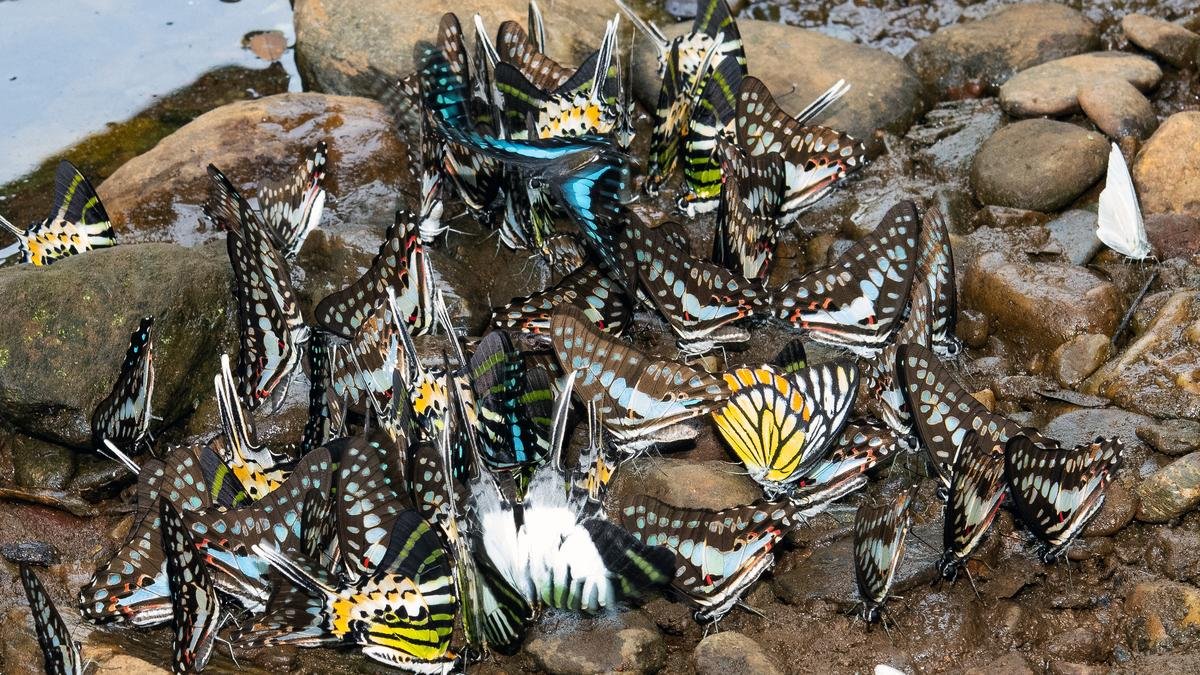
Butterflies and moths, found on every continent except Antarctica, exhibit a range of unique, fascinating behaviours, making them an absolute delight to watch. For instance, they often resort to a phenomenon called mud-puddling, in which groups of butterflies, mostly male, congregate on moist surfaces such as soil and manure, to soak up supplementary nutrients such as salts and minerals. Then there is Batesian mimicry, a survival strategy in which harmless butterflies, such as the Common Mormon and Painted Sawtooth, mimic toxic species, such as the Common Rose and Common Jezebel, respectively. There is also migration — sometimes even across continents and generations — the most famous being the Monarch Butterfly, which is known to travel up to 5000 kilometres to escape freezing winters in North America.
They are also lovely to look at, especially on a sunny morning or late in the afternoon (the best time to watch butterflies), hovering over flowers with their varicoloured, powdery wings. “It is a natural thing for a child to get hooked onto the colours of a butterfly, but this is just the beginning,” says Ashok, who believes that, for children, butterfly-watching is an easy portal into the magnificence of the natural world.
Striped Tiger Butterfly
| Photo Credit:
Govardhan T
“Butterflies, like birds, give you a very close understanding of Nature,” he feels, an opinion echoed by Govardhan T, the naturalist at NV Ecofarms in Goa, a sustainable tourism brand, which, among other offerings, is home to a dedicated butterfly park. “Everyone loves butterflies and connects to them,” says Govardhan, who regularly conducts butterfly walks on the property.
Partha Sarathi Mondal, senior zoo biologist, at the Bhagwan Birsa Biological Park in Ormanjhi, Ranchi, which formally inaugurated a butterfly park on its premises in 2023, says that spreading the word about these insects is important for yet another reason: “Butterflies and moths are indicators of a healthy environment and healthy ecosystems,” he says.
Butterfly rearing taking place at the Bhagwan Birsa Biological Park in Ormanjhi
| Photo Credit:
Courtesy of the Bhagwan Birsa Biological Park, Ormanjhi
Since areas rich in butterflies and moths are also likely to be rich in other invertebrates, these collectively provide a wide range of environmental benefits, including pollination and natural pest control. “Moths and butterflies are an important element of the food chain and are prey for birds, bats and other insectivorous animals,” he explains, adding that they are also crucial pollinators along with bees. So important are these insects that, “if these three species, moths, butterflies and bees were lost, then the human population would not survive because there would be no food,” says Rohit.
Venues to visit
Catching a glimpse of a butterfly is not rare, of course: you are likely to have seen them fluttering around in small garden patches, your neighbourhood park, or even perched on the odd flowering plant, ensconced in the pot on your balcony. But over the past few years, a number of butterfly-focussed parks, trails and activities have emerged across the country, one of which is Sammilan Shetty’s Butterfly Park, located at Belvai, near Moodabidri, at the foothills of the Western Ghats.
At Sammilan Shetty’s Butterfly Park
| Photo Credit:
Butterfly Park Belvai
Sammilan, a conservationist who officially inaugurated the park in 2013, says the park has been regularly conducting walks, workshops, and awareness programmes on its premises, focussing not just on butterflies but also on birds, spiders, dragonflies, frogs, and mushrooms. “This is a model for people to understand how butterflies and other fauna can thrive if you conserve the natural environment,” he believes.
A Southern Birdwing
| Photo Credit:
Sammilan Shetty
Isaac, who regularly conducts butterfly walks and sessions on how to garden for butterflies and has himself set up a butterfly garden on his private property in Tembhre, Karjat, reveals why India is such a great place for watching butterflies: it harbours an astounding diversity of the winged creatures. “In England, you have only 47 species of butterflies, but we have over 1,300 species. You just need to make a garden, and they will come to you,” says Isaac, whose own garden gets about 80 species of butterfly visitors, though the actual number varies through the year. “In the Western Ghats, where we are located, the population of butterflies falls in summer. The best time to see butterflies is between when the monsoon trails off and winter, mid-August and the end of December-January,” he says.
Malabar Banded Peacock
| Photo Credit:
Sammilan Shetty
While the Western Ghats, which is home to around 330 species of butterflies, is a major butterfly hotspot, the North-Eastern part of India is possibly the best region for butterfly spotting, with over half the species found in India seen there. “Bhutan, Sikkim, Assam, Nagaland, Mizoram, and Arunachal Pradesh are amazing,” confirms Isaac, who has ended up travelling widely across the country in his search for more butterflies. “I discovered India in that process. Butterflies showed me how beautiful our country truly is,” he says.


