


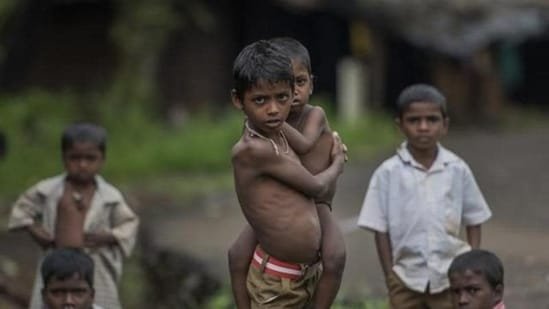
India’s network of over 1.4 million anganwadi centres (AWCs) serves as the foundation of the world’s largest early childhood development programme. These centres deliver supplementary nutrition, preschool education, health check-ups, and immunisation support to more than 8 crore children under six, along with pregnant and lactating mothers. Yet persistent malnutrition reveals deep systemic weaknesses that go far beyond funding gaps. According to NFHS-5 (2019-21), 35.5% of children under five are stunted, 19.3% are wasted, and 32.1% are underweight. While recent Poshan Tracker data suggests modest declines in stunting and underweight compared to NFHS-5, the numbers remain unacceptably high for a country aiming for developed-nation status by 2047.
The Integrated Child Development Services (ICDS), now strengthened under Mission Saksham Anganwadi and Poshan 2.0, has seen allocations of around ₹21,000–23,000 crore annually in recent years for the core nutrition component. However, challenges in infrastructure, workforce capacity, supply chain reliability, and outcome measurement continue to limit impact. Addressing the crisis requires structural reforms focused on quality infrastructure, a professionalised workforce, robust quality controls, and a shift from tracking inputs to measuring real child growth outcomes.
Many AWCs lack basic facilities. A large proportion operate from rented rooms, community halls, school verandas, or even temporary structures and open spaces. In Gujarat, a 2025 CAG performance audit highlighted a shortage of 16,045 AWCs. Out of 53,029 centres, thousands functioned from dilapidated buildings, temporary setups, or open areas, with issues like missing toilets and inadequate space. Similar gaps exist across states, affecting service delivery nationwide.
Without dedicated, child-friendly buildings of adequate size (typically 600–800 sq ft), centres struggle with core functions. Supplementary nutrition gets spoiled due to poor storage. Hot cooked meals become difficult to prepare and serve hygienically without proper kitchens. Preschool activities for cognitive and social development turn chaotic in cramped or unsuitable spaces. Urban centres often face overcrowding, while rural ones frequently lack electricity, clean water, or sanitation. Poshan 2.0 aims to upgrade two lakh centres into ‘saksham anganwadis’ with better infrastructure, including water filters, learning kits, and improved facilities—targeting around 40,000 upgrades per year. Progress is underway, but capital spending often remains limited as states redirect funds toward salaries and recurring costs. When nearly half the centres lack proper shelter, even substantial budget outlays fail to translate into better nutrition or early learning outcomes. Safe, functional spaces are not optional—they are foundational for effective early childhood interventions.
Anganwadi workers (AWWs) and helpers (AWHs) form the human core of the system. A typical worker handles multiple responsibilities: growth monitoring and weighing of children, preparation or distribution of supplementary nutrition, running preschool sessions, conducting home visits for counselling on breastfeeding and nutrition, maintaining records, and coordinating with health services. The workload frequently extends beyond the notional six-hour shift. Central honorarium stands at ₹4,500 per month for regular AWWs and ₹2,250 for AWHs (with slightly lower amounts for mini centres), supplemented variably by state contributions. Total monthly compensation often ranges between ₹6,000 and ₹15,000 depending on the state, with higher amounts in states like Tamil Nadu or Karnataka. While some states have increased top-ups, many workers still receive modest pay relative to their responsibilities and local living costs. Helper vacancies remain significant in several regions, leading to single-staff centres that compromise quality. Training is another weak link. Although basic induction exists, comprehensive, ongoing professional development in nutrition, early childhood care and education (ECCE), and counselling is limited. Many workers learn practical aspects on the job. Under saksham anganwadi, responsibilities have expanded to include stronger ECCE components and digital reporting, increasing the burden without matching support structures. Performance-linked incentives recommended by NITI Aayog have seen slow adoption. Treating these frontline workers primarily as honorary volunteers rather than skilled professionals affects motivation and retention. Stronger career pathways, regular skill upgrades, and fair compensation aligned with responsibilities would strengthen the entire delivery chain.
Delivery of nutrition is uneven. Take-Home Rations (THR) and hot cooked meals do not always reach beneficiaries consistently or on time. CAG audits in various states have pointed to gaps in coverage, unspent funds alongside unmet needs, and quality concerns. Fortified staples, intended to address micronutrient deficiencies, have faced issues of leakage, sub-standard supplies, and inconsistent compliance in some instances. Private contractors or decentralised models through self-help groups can improve local relevance, but they require strict quality oversight, testing, and cold-chain facilities where needed. Mandates for including millets, eggs, or diverse foods sometimes remain partially implemented when basic provisions are irregular. Field reports and older audits have noted cases of poor-quality ingredients or reduced nutritional diversity during festivals or supply disruptions. These problems reduce the programme’s ability to combat stunting and wasting effectively. Children may receive calories but miss critical proteins, vitamins, and minerals during the vital first 1,000 days of life, when interventions yield the highest returns.
Monitoring systems have improved with the Poshan Tracker app, which has seen millions of downloads and enables real-time reporting of services. However, the focus remains heavily on inputs—meals distributed, THR packets issued, or beneficiaries registered—rather than outcomes. Growth monitoring data is not consistently uploaded or used across all states. Anaemia testing coverage, especially post-Covid, has been limited in many areas. Pregnant and lactating women are often not tracked systematically across trimesters, allowing intergenerational cycles of malnutrition to continue undetected. Smartphones and apps help with logistics, but accurate anthropometric measurements (height, weight, mid-upper arm circumference) still depend on trained staff and functional equipment. A meaningful shift would prioritise height velocity and reduction in stunting rates at the local level over simple counts of meals cooked. Regular, reliable data on child growth, cognitive milestones, and anaemia prevalence would enable better targeting and accountability.
Solving the anganwadi crisis needs coordinated action on multiple fronts:
- Infrastructure push: Accelerate construction and upgrading of dedicated, climate-resilient centres using convergence with schemes like MGNREGS. Prioritise high-malnutrition districts and ensure every centre has basic amenities—kitchen, storage, toilet, electricity, and safe drinking water.
- Workforce strengthening: Enhance compensation with regular increments, provide comprehensive training and refresher courses, and create clear promotion pathways (e.g. helpers to workers, workers to supervisors). Recognise AWWs and AWHs as skilled frontline professionals with appropriate social security benefits.
- Supply chain improvements: Strengthen quality assurance through rigorous testing, third-party audits, and transparent procurement. Blend decentralised cooking where it works well with centralised standards for fortified foods. Reduce leakages via better digital tracking and community oversight.
- Outcome-oriented accountability: Link funding releases, incentives, and performance reviews to verifiable results such as improved growth monitoring coverage, reduction in stunting at the project level, and higher service utilisation. Empower local panchayats and mothers’ groups for social audits.
- Better convergence: Integrate efforts with the National Health Mission for anaemia control and immunisation, sanitation programmes for hygiene, and education initiatives for quality preschooling. Use technology not just for reporting but for predictive insights and targeted interventions.
States that have invested in better decentralised models, consistent training, and quality focus—such as elements seen in Tamil Nadu or Odisha in specific periods—offer lessons for scalable improvements.
Investing effectively in early childhood nutrition is both a moral and economic imperative. Stunting affects cognitive development, school performance, and future productivity. Global evidence shows that undernutrition in the early years leads to significant losses in lifetime earnings and national GDP. Conversely, well-nourished children grow into healthier, more capable adults, strengthening India’s human capital and demographic advantage. The first 1,000 days represent a critical window where interventions deliver high returns. With political will and focused execution, the anganwadi system can become a true engine of human development rather than a symbol of unfulfilled potential. The challenges are well-documented through NFHS surveys, CAG audits, and programme evaluations. Budgets provide necessary resources, but lasting change demands attention to infrastructure, people, processes, and results. By treating early childhood nutrition as a national priority backed by structural reforms, India can make decisive progress against malnutrition and secure a healthier future for its youngest citizens.
(The views expressed are personal)
This article is authored by Anusreeta Dutta, columnist and climate researcher and Harjeet Singh, assistant professor, Akal University, Punjab.
