


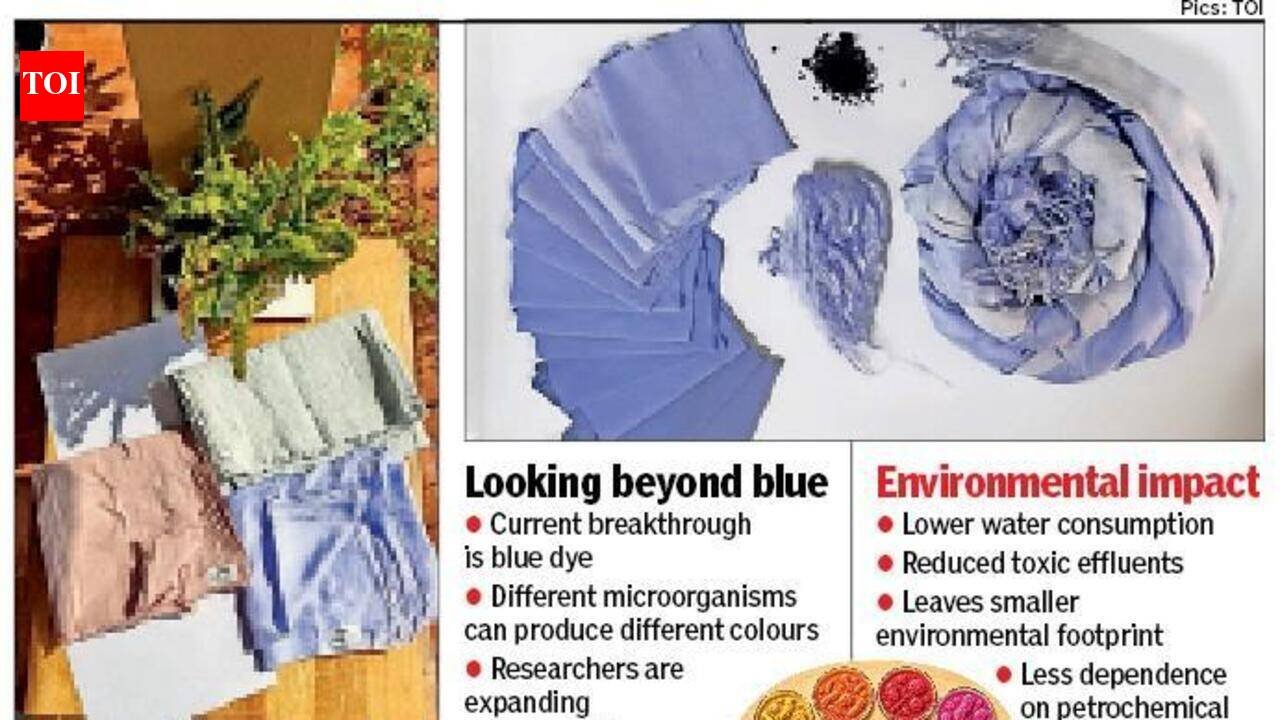
Bengaluru: What began as a curiosity-driven experiment by two city scientists to grow colour-producing microbes on fabric has evolved into a breakthrough that could transform the textile industry’s relationship with dyes.Intrigued by the vibrant pigments naturally produced by certain microorganisms, the researchers explored ways to extract and stabilise these colours, eventually developing a sustainable textile dye. The innovation comes at a critical time, as synthetic dyes used by the textile industry remain among the largest contributors to water pollution, releasing harmful chemicals into rivers and lakes.Although natural dyes derived from plants and minerals are considered environmentally friendly, their limited availability and scalability have prevented them from meeting the growing demands of the textile sector. It is this challenge that prompted Suchitha Raghunathan and Anjana Badrinarayanan of Microbeworks, a Bengaluru-based bio-startup, to search for alternatives. Their early-stage innovation has now earned them the prestigious Global Change Award from H&M Foundation, often referred to as the ‘Nobel Prize of the fashion industry.’“An academician from the field of fashion technology approached us with the idea of growing bacteria directly on fabric for colouring purposes. While exploring the concept, we wondered why not extract pigment from the bacteria and convert it into a dye that is both safe for humans and environmentally sustainable,” explained Suchitha, who led the research. “We also realised it would be nearly impossible to meet the growing demand for natural colours solely through the cultivation of dye-producing plants. Microorganisms, on the other hand, grow rapidly and require very little space, making them a practical alternative.”Anjana said the team’s vision extends beyond textiles. “We envision a world where the colours we use in our day-to-day lives do not leave a lasting impact on the planet,” she said.Using their laboratory facilities, the researchers cultivated microorganisms capable of producing coloured pigments. Through fermentation and process optimisation, they successfully developed a high-performance blue dye.“We identified microbes that naturally produce colour and refined the fermentation process to obtain a stable, high-quality blue dye. These microorganisms are non-pathogenic, pose no threat to humans, and have a short life cycle. The resulting colour has a natural appearance and gives fabrics an aesthetically pleasing finish,” Suchitha explained.She added that a wide range of colours could potentially be produced by cultivating different microorganisms. While the microbes are currently grown using laboratory media, they can eventually be cultivated on organic substrates such as paddy straw, much like mushrooms.Although research is continuing to expand the colour palette and improve extraction techniques, the scientists say the cost of cultivating and fermenting these microorganisms is comparable to that of growing dye-producing plants.“In fact, microbial dyes can save space, time and resources, making them a more viable option than plant-based dyes. They have the potential to steer the fashion industry towards a circular and environmentally sustainable future by reducing water consumption, toxic effluents, and the overall environmental footprint associated with synthetic, petrochemical-based dyes,” Suchitha said.
