



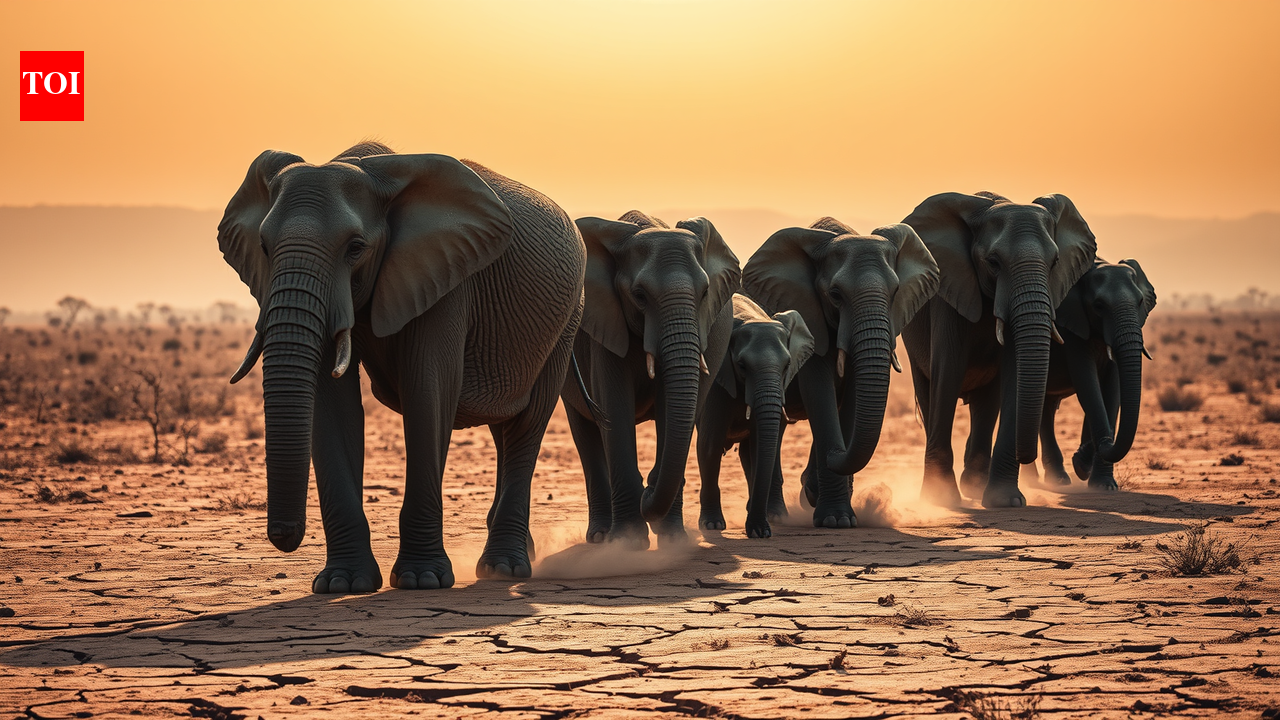
During a brutal drought in Tanzania back in 1993, one elephant’s memory ended up making the difference between life and death for her entire family. Researchers tracking family groups in Tarangire National Park found that herds led by older matriarchs, elephants who had lived through droughts before, left the park entirely in search of water they remembered from decades earlier, while a herd led by a much younger female stayed put and suffered devastating losses. It is one of the clearest examples scientists have documented of how a single animal’s memory can steer an entire group through a genuine survival crisis.
What happened during the 1993 Tarangire drought
The drought that struck Tarangire National Park in 1993 was severe even by the standards of an already dry region, with barely any rain falling between June of that year and February of the next. Researchers from the Wildlife Conservation Society and the Zoological Society of London had already been monitoring elephant family groups in the park, which gave them a rare opportunity to study exactly how different herds responded once conditions turned dire. Their findings were published in the journal Biology Letters.
Older matriarchs led their herds to safety
Two of the family groups being tracked were led by matriarchs aged 45 and 38, both of whom chose to leave Tarangire National Park entirely once conditions worsened, heading toward water sources outside the park that they had likely encountered during earlier droughts. A third herd, led by a much younger matriarch of just 33, stayed inside the park instead. Researchers believe this difference came down to memory. The two older matriarchs had almost certainly lived through a previous serious drought and could draw on that experience, while the younger female had not yet faced anything comparable and had no equivalent knowledge to fall back on.
The tragic difference in calf survival
The consequences of these decisions were stark. Calf mortality in a typical year sits around 2 per cent for this elephant population, but during the 1993 drought it spiked dramatically, with 16 calves dying over roughly nine months. Crucially, this loss was not spread evenly across all three herds. The family group that remained inside the park suffered heavy calf losses, while the two herds that had left with their older, more experienced matriarchs came through the crisis in far better shape. Researchers concluded that the age and experience of the mother elephants were themselves among the strongest predictors of whether individual calves survived the drought at all.
Why one elephant’s decades-old memory mattered so much
According to Charles Foley, the study’s lead author, this pattern supports the idea that older female elephants carrying knowledge of distant, once useful water sources become genuinely critical to a herd’s survival once conditions turn extreme. It is worth noting that the younger matriarch’s herd was not necessarily making a poor decision; she simply lacked the stored experience needed to know where else to go, since heavy poaching in the decades before the drought had already wiped out many of the older, larger tusked females who would normally have held that kind of knowledge within the population.
Elephant memory works like a mental map of the landscape
Elephants are known for having some of the largest brains of any land animal, and their hippocampus, the region tied closely to memory, is unusually well developed compared to other species. This allows matriarchs to build up what amounts to a mental map of their surrounding landscape over decades, tracking not just where water exists but when specific seasonal sources are actually likely to hold any. Herds do not wander randomly searching for water during a drought, they follow routes shaped directly by what their leader remembers from years, or even decades, earlier.
Why this matters more as droughts become more frequent
Nathalie Pettorelli, a co-author on the study, pointed out that climate change is expected to bring more frequent severe droughts to parts of Africa, which makes understanding how elephant populations cope with these events increasingly important for conservation planning. If matriarchs with drought experience genuinely give their herds a survival edge, then losing older, knowledgeable females to poaching or natural death does not just remove one individual animal; it can strip an entire family group of decades of accumulated environmental knowledge that younger elephants have not yet had the chance to learn.
What this means for elephant conservation going forward
This research adds real weight to an argument conservationists have been making for years, that protecting older matriarchs is not just about safeguarding individual animals but about preserving the collective memory that keeps entire herds alive during the worst conditions. As droughts become more common across parts of Africa, the presence or absence of a single experienced elephant leading her family could increasingly mean the difference between a herd that survives a crisis and one that does not.


