


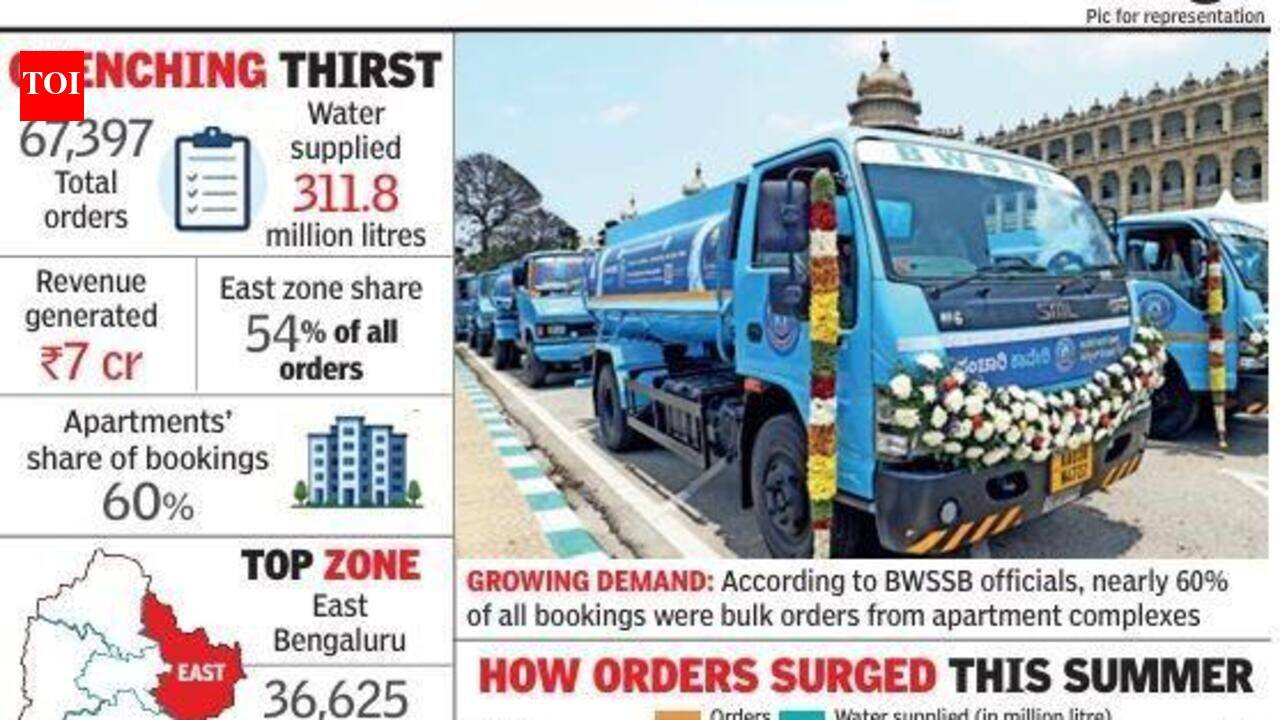
Bengaluru: A prolonged dry spell and weak pre-monsoon showers triggered a sharp rise in demand for Bangalore Water Supply and Sewerage Board’s (BWSSB) ‘Cauvery On Wheels’ service this summer, with bookings peaking in May as residents and apartment complexes increasingly turned to tanker water.Data from BWSSB shows the utility received 67,397 orders and supplied 311.8 million litres of Cauvery water under the initiative between May 2025 and July 24, 2026. The service generated over Rs 7 crore in revenue during the period.The steepest rise in demand was recorded during the summer months. Orders nearly doubled from 4,490 in April to 7,623 in May, while water supply jumped from 33.9 million litres to nearly 66.3 million litres.
CJP Jantar Mantar Protest Updates
Demand remained high in June with 6,217 orders and 51.8 million litres supplied.BWSSB officials said nearly 60% of all bookings were bulk orders from apartment complexes. The data also points to a strong concentration of demand in east Bengaluru. The zone accounted for 36,625 orders, more than half of all bookings recorded under the scheme. It also consumed 178.1 million litres of water and generated Rs 4.3 crore in revenue, making it the largest user of the service.A senior BWSSB official identified Whitefield, Doddakannelli, and Kalkere as being among the areas recording the highest demand. Many of these localities fall within the city’s erstwhile 110 villages, where the scheme was originally targeted to provide residents access to Cauvery water at regulated rates and reduce their dependence on private tanker operators.“This initiative was introduced so that the areas where Cauvery is not available could get water and avoid the price exploitation from private tankers. We have seen most of our customers are from the east corporation. Apartments choose bulk booking and we supply water every day in our own tankers,” said BWSSB official.Launched in May 2025, Cauvery On Wheels allows residents, apartments, and institutions to book BWSSB tankers online at fixed prices. While several peripheral areas have recently begun receiving Cauvery Stage V connections, officials said demand for the service remains strong, particularly in rapidly urbanising neighbourhoods where apartment growth has outpaced water infrastructure.
