



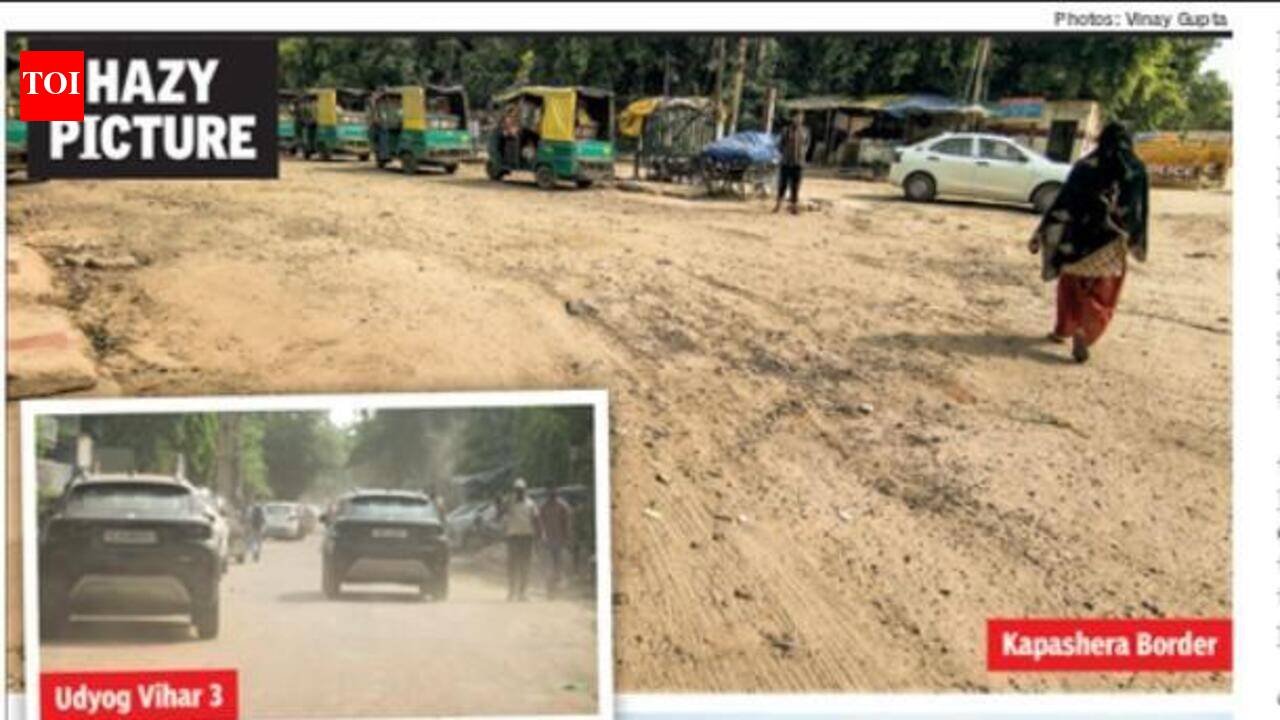
Gurgaon: Rain-free days have brought back a familiar problem on city roads: dust.Loose soil, road work, construction material and heavy traffic have combined to create persistent dust clouds, with Golf Course Extension Road, Old Delhi Road and Udyog Vihar among the stretches that are worst hit.The return of dust after a spell of rain highlights how quickly the problem resurfaces once roads and exposed soil dry out.Rain temporarily suppresses loose particles, but without sustained measures such as mechanised sweeping, removal of accumulated soil and regular water sprinkling, traffic can send the dust back into the air.In several areas, TOI found vehicles kicking up thick plumes of dust on stretches where road shoulders and adjoining areas remain exposed.The problem was particularly visible on Golf Course Extension Road, where ongoing work and loose earth along the carriageway provided a ready source of dust as traffic moved through the corridor.The situation was similar on Old Delhi Road, where the combination of heavy traffic and exposed roadside soil left a visible haze behind moving vehicles.In Udyog Vihar, industrial and commercial traffic adds to the problem, with trucks and other heavy vehicles repeatedly resuspending dust from road surfaces and shoulders.Golf Course Extension Road has repeatedly figured in assessments of the city’s road-dust problem.A recent HSPCB survey found dust and loose soil affecting several roads across the city, while residents have specifically complained about massive dust clouds and poor road conditions on stretches around Golf Course Extension Road.The problem is not new on Old Delhi Road either.Earlier assessments of Gurgaon’s major pollution hotspots have identified road dust and incomplete road works in the Old Delhi Road and Udyog Vihar corridor.Mahesh Yadav, a daily commuter at Udyog Vihar, said, “Udyog Vihar has in particular been identified as a hotspot because of road dust, waste dumping, heavy traffic and incomplete road infrastructure. I have been seeing this for years but nothing changes.”An HSPCB official in Gurgaon told TOI, “The immediate solution is also relatively straightforward: regular mechanised sweeping, removal of accumulated soil from road edges, proper covering and disposal of construction material, repair of broken road surfaces and adequate water sprinkling during dry conditions. We have already informed respective agencies responsible for managing the dust on these roads.”A citywide inspection by teams of Haryana State Pollution Control Board (HSPCB) and Central Pollution Control Board found the scale of the road-dust problem to be widespread.Of 125 MCG road stretches inspected, 34 had high visible dust levels and another 58 had moderate dust.Only four stretches had no visible dust. Several of the stretches with high dust also had accumulated municipal solid waste and construction and demolition waste.An earlier HSPCB field audit was even more extensive. Twenty teams surveyed 340 road stretches and found nearly 190 affected by dust arising from potholes, unpaved surfaces and loose soil along road edges.Udyog Vihar was among the areas where construction material and dust waste, including openly stored sand and silica, were recorded. The board also found that water sprinkling on most roads was inadequate.For commuters, the three corridors present slightly different versions of the same problem.Raveen Dua, a resident of Sector 61, said, “On Golf Course Extension Road, construction activity, unfinished edges and loose soil are major contributors. The road carries heavy traffic throughout the day, meaning even relatively small quantities of exposed soil can be repeatedly thrown into the air. We have complained to administration several times but nothing changes.”On Old Delhi Road, dense traffic and commercial activity add to dust generated from damaged or exposed road surfaces. The corridor also connects important residential, commercial and industrial areas, increasing the number of vehicles passing through dusty stretches.In Udyog Vihar, the movement of trucks and other commercial vehicles compounds road dust. The industrial area has previously been identified as a pollution hotspot, with HSPCB citing road dust and waste dumping among the reasons.The concern is not merely visual. Road dust is a major source of particulate pollution, particularly coarse particles such as PM10, and repeated resuspension by traffic can keep particles airborne even after they have settled on the road.


