



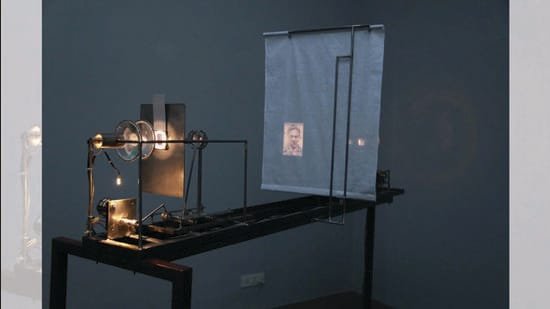
I am fascinated with the interplay of something fixed becoming something in motion. In the hands of a clever artist, this can happen without anything actually moving. Delhi-based Susanta Mandal, 61, is that kind of artist.
His kinetic sculptures aren’t exactly wind-up dolls or automata. Consider his Magic Lantern series, in which innocuous objects such as technical drawings and portraits are overlaid with moving wires so as to cast changing shadows on the image. In another series, presented under the titles Caged Sacks and It Doesn’t Bite, viewers are presented with what seems to be a sack of jute. But wait, why is it twitching? Is someone trapped inside? Mandal achieves the effect with a simple mechanical contraption hidden inside – it’s eerie nonetheless.
Mandal has bewitched steel rods and plates by moulding them into tubes, tunnels and tiny vessels, and filling them up with soap bubbles. As the foam builds and disintegrates, it catches the light, its frothy effervescence a reminder that it’s impossible to hold on to something forever.
Artists have been tinkering with moving works since the 1930s, when American artist Alexander Calder, and Swiss sculptor Jean Tinguely built larger-than-life mobile structures. In 2010, Sudarshan Shetty’s installation This Too Shall Pass at Mumbai’s Dr Bhau Daji Lad Museum featured a gilded statue that would tilt (and threaten to topple). It could stand upright only when visitors added coins to the counterweight box – an elegant reminder of what keeps people in power, and the public’s role in it.
Mandal’s works are both serious and playful. They expand our understanding of what we regard as a machine, and what a static object can express. He initially trained in painting from the Government College of Art and Craft, Kolkata, and began exploring technology and the innovative use of light and shadow as a means of movement, about 20 years ago. It’s an extension of his lifelong interest in the ephemeral and the uncertain.
I saw his work, Hard Copy, at Vadehra Art Gallery in 2015, in which he cast light and shadows on to drawings and photographs through a Victorian-style projector. The imagery kept changing, creating a different narrative for each person viewing it. The jute-sack works have been displayed often, with slight variations. Sometimes the sacks are placed within cages, sometimes there is a close-up video showing the sacks accompanying the actual work. In every instance, the sacks show telltale signs that someone might be trapped in them. Viewers associate them with life, imprisonment, and the act of silencing. But for me, giving the familiar fabric such a malicious twist is extraordinary.
His bubble and foam series employs a different mechanism each time it goes on display. It has run on electricity, but on one occasion, Mandal connected it to solar panels outside the gallery, which would cut off when a person moved past them. The interruption, this unreliability, was part of the work. This is art that highlights the idea that uncertainty can bring both worry and joy. By allowing bubbles to pop and images to flicker, Mandal assigns value to failure.
The artist has often credited traditional shadow puppetry as inspiration for his kinetic sculptures. In India, creating technical, motion-based art isn’t easy. It’s expensive to make, and requires specialist knowledge of engineering, architecture or physics. And even when audiences do view the works as intended, the medium can eclipse the message. Mandal’s work, therefore, has been a kind of reassurance for me that this direction is possible, and worth pursuing
Shailesh BR was a Hindu priest before he embraced art. His kinetic sculptures and installations merge ancient wisdom with modern scientific inquiry.
From HT Brunch, April 4, 2026
Follow us on www.instagram.com/htbrunch


