



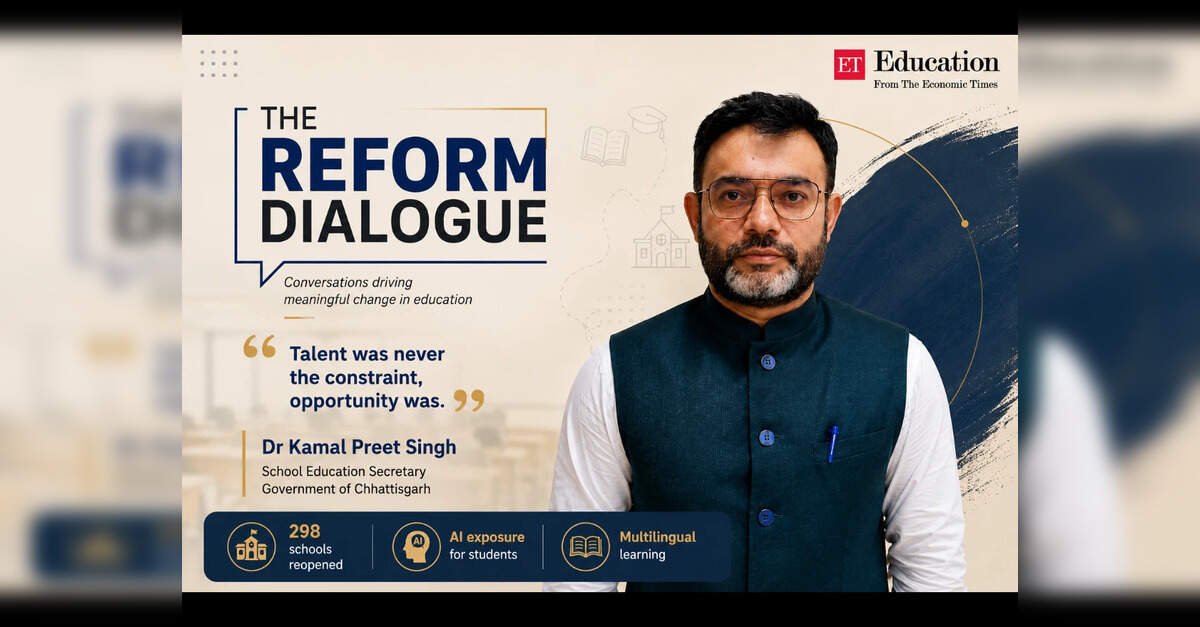
How do you build an education ecosystem in regions where the challenge is not only improving learning outcomes but restoring access itself? Chhattisgarh’s education reforms offer a case study in addressing this challenge through school revival, multilingual learning, technology integration and stronger institutional delivery mechanisms.
In an exclusive interaction with ETEducation as part of the Reform Dialogue series, Chhattisgarh School Education Secretary Dr Kamal Preet Singh speaks about the state’s approach to expanding educational opportunities in remote and tribal regions, reopening schools in areas affected by Left Wing Extremism, strengthening teacher availability and preparing students for a technology-driven future.
Q. Chhattisgarh presents a unique education governance challenge, balancing foundational access in remote and LWE-affected districts while simultaneously preparing students for a technology-driven future. How has the state redefined its education reform priorities over the last few years?
Dr Kamal Preet Singh: Over the last few years, our foremost priority has been to ensure that access to education reaches every child, irrespective of geography or past security challenges. In many parts of Bastar, the challenge was not merely improving educational outcomes but restoring the very presence of schools.
The transformation is visible on the ground. Around 298 schools of Bijapur and Narayanpur that had remained closed for 20 years due to Left Wing Extremism have resumed functioning in their original villages in recent years. This year, in Bijapur alone, 37 schools, including 19 primary and 18 middle schools, reopened. In Narayanpur, several schools are being revived and educational infrastructure is being expanded in vacated security camps that were once occupied by security forces.
This educational revival has gone hand-in-hand with infrastructure development, ensuring that connectivity, technology and education advance together.
Q. The reopening of schools in regions like Abujhmaad and Narayanpur is being seen as more than an administrative achievement. From a governance perspective, what institutional reforms and inter-departmental coordination mechanisms made this possible?
Dr Kamal Preet Singh: The reopening of schools in regions such as Abujhmaad and Narayanpur reflects the success of coordinated governance. Security and development have advanced together.
Security forces created an environment conducive to development, while departments worked in coordination to deliver roads, bridges, schools, telecommunications and public services. The PWD builds connectivity infrastructure, education authorities restore schools, and district administrations ensure implementation on the ground.
This interconnected approach has enabled education to return to areas that were once beyond the reach of regular governance.
Q. Despite difficult socio-economic and geographic conditions, students from Chhattisgarh have consistently demonstrated strong academic potential. What structural strengths within the state’s education ecosystem do you believe remain under-recognised nationally?
Dr Kamal Preet Singh: The biggest strength of Chhattisgarh’s education ecosystem is the determination of its students. Young people from tribal, rural and formerly affected regions understand the value of education, progress and democratic institutions because they have seen the consequences of deprivation firsthand.
The state has produced talented administrators, professionals and achievers across sectors. A recent example is the success of 13 candidates from the Tribal Youth Hostel in Dwarka, New Delhi, who cleared the UPSC Civil Services Preliminary Examination, 2026.
This achievement was supported by increasing hostel capacity from 50 to 200 seats to provide Scheduled Tribe, Scheduled Caste and Other Backward Class students with a conducive environment for preparing for civil services and other competitive examinations.
Along with initiatives such as Eklavya Model Residential Schools, PM SHRI schools, scholarships and residential coaching support, these interventions are helping talented students from remote regions compete successfully at the national level.
Q. As India moves towards becoming an AI-driven economy, how do you ensure that students from tribal, rural and first-generation learner backgrounds are not excluded from the next phase of educational transformation?
Dr Kamal Preet Singh: AI is still at an evolving stage in school education and requires careful assessment of its long-term impact on learning and cognitive development. Our approach is to ensure that students from tribal and rural backgrounds gain early exposure to emerging technologies without creating a digital divide.
Some government school teachers have already received training on AI-enabled learning tools. In tribal-dominated Bijapur district, nearly 1,950 students have undergone free introductory training on AI fundamentals. ICT-based smart classrooms are already functioning in government schools.
Q. Teacher deployment and retention continue to be major concerns across remote geographies in India. Has Chhattisgarh explored any policy innovations, incentive structures or technology-led monitoring systems to improve teacher availability and accountability in hard-to-reach districts?
Dr Kamal Preet Singh: Teacher availability in remote regions is being addressed through a combination of recruitment, rationalisation and technology-enabled monitoring.
Last year, reforms were undertaken through consolidation of schools and reappropriation of teachers to improve deployment efficiency. The state has also initiated recruitment of 5,000 teachers to address shortages.
Meanwhile, online attendance monitoring has improved from around 25% to nearly 65%, with a target of achieving full compliance. Currently, nearly 38,000 schools are under online monitoring, except around 250 schools located in inaccessible areas with poor connectivity.
Q. Many states are currently discussing reforms around experiential learning, multilingual education, skilling and digital classrooms under the broader NEP framework. Which reform intervention undertaken by Chhattisgarh do you believe has delivered the most measurable impact at the ground level?
Dr Kamal Preet Singh: One of the most impactful reforms has been making education more accessible and relevant through multilingual learning, technology integration and skill development.
Under NEP, education is being provided in local languages and dialects up to Class V, with textbooks being prepared in multiple languages. In Bastar, primary education is imparted in Hindi with explanations in local languages such as Gondi and Halbi.
To address teacher shortages, studios have been set up through District Institutes of Education and Training (DIETs) in nearly 23 districts. Recorded lectures prepared by experienced teachers are used in schools where subject-specific teaching staff are unavailable, helping ensure continuity and uniformity in classroom learning.
Students are also receiving exposure to computer education, agriculture, services and hospitality sectors, with the objective of linking learning with employability and entrepreneurship.
Q. In conflict-affected and geographically isolated regions, restoring trust in institutions often becomes as important as infrastructure creation. How has the education department worked to rebuild community confidence in formal schooling systems?
Dr Kamal Preet Singh: Restoring trust begins with restoring access. Over the past few years, nearly 298 schools have been reopened across Narayanpur and Bijapur districts, signalling the return of governance and educational opportunities in previously affected areas.
The department has also undertaken special enrolment drives. In Bijapur, dedicated teams conducted door-to-door surveys and enrolled nearly 300 children into schools in one week.
To build aspirations, topper students from rural areas are taken on exposure visits, including IPL matches, the Vidhan Sabha and other educational tours. Such initiatives help students and parents view education as a pathway to opportunity and progress.
Q. Nationally, education conversations are increasingly centred around employability, innovation and future readiness. What is your long-term vision for ensuring that students from districts like Narayanpur or Dantewada are not just included in India’s growth story but become leaders within it?
Dr Kamal Preet Singh: Our vision is that students from Narayanpur, Dantewada and other tribal districts should not merely participate in India’s growth story but help shape it.
Talent has never been the constraint; access and opportunity have been. As connectivity, quality education, technology and skill development continue to expand across Bastar, we aim to nurture future administrators, innovators, entrepreneurs and community leaders from these regions.


