









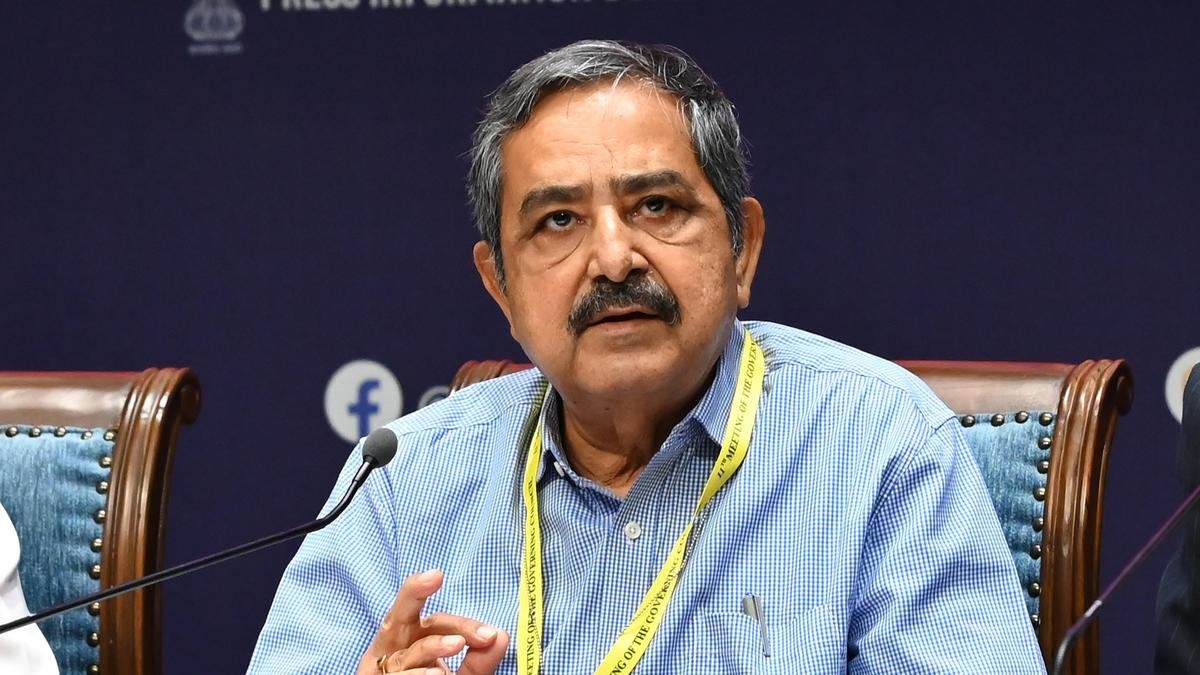
Ashok Kumar Lahiri Vice Chairman of NITI Aayog
| Photo Credit: The Hindu
There is no winner in the ongoing “battle” of views on the use of double deflation in India’s new GDP series, Ashok Kumar Lahiri, Vice Chairman of Niti Aayog, the government’s economic think tank, said on Tuesday, arguing that the methodology is neither impractical nor particularly difficult to implement.
Deflating the price effects at the producer and consumer expenditure of GDP (gross domestic product) “is not a great battle,” Lahiri said on the sidelines of a fintech event in Mumbai.
“For double deflation, all that you need to do is separate the inputs from the outputs. That’s not a great battle. So I don’t think double deflation methodologically is an impossibility. Can it be improved? Of course, everything can be improved. It’s a good time to start,” he said.
Lahiri also questioned why concerns over methodology were being raised now, noting that GDP growth rates in the new series, based on 2023-24 prices, are lower than those under the earlier series with 2011-12 as the base year.
He asked why the methodology had not come under similar scrutiny when the earlier series was in use.
Lahiri’s comments come a week after former Finance Secretary S.C. Garg and former Chief Statistician Pronab Sen raised concerns over the methodology used to double deflate GDP under the new series.
Double deflation refers to removing the price effects of both producers and consumers in calculating the real GDP of the economy. The methodology is widely used internationally but was not part of India’s 2011-12 GDP series.
The Ministry of Statistics and Programme Implementation (MoSPI) introduced double deflation in the GDP series with 2023-24 as the base year. The ministry has said that the methodological changes make the new and old series not directly comparable.
Sen had also questioned whether sufficient producer-price data are available to construct the PPI required for the methodology.
Lahiri, however, rejected concerns over data availability, saying “we do not have all the data, but we have good enough data to double deflate.”
Capex turns at 80%
Mr. Lahiri expects the private capital expenditure (capex) cycle to gain significant momentum once capacity utilisation in the private corporate sector reaches 80%, up from the current 70–75% levels.
According to the RBI, Indian manufacturers operated at 77.4% of their installed capacity in the fourth quarter of fiscal 2025-26, indicating that utilisation is nearing the threshold that could trigger a stronger private investment cycle.
Published – September 09, 2026 07:37 pm IST


