


0, 0, 0, 3, 77 and 207! Confused what those numbers are? Those are the number of seats BJP secured in West Bengal assembly elections since 2001.
For years, the BJP was virtually irrelevant in Bengal politics. The party failed to win a single Assembly seat in 2001 and 2011, while in 2006 it contested the elections in a seat-sharing arrangement with the Trinamool Congress but failed to win any seat. In 2011 when Trinamool Congress broke the Left Front’s 34-year fort, BJP got zero seats again, but opened its account in 2016 with three seats.
Also Read: Breaking the eastern barrier: Bengal triumph redraws BJP’s political map
Back then, very few would have imagined that the BJP could one day emerge as the single-largest party in a state ruled by the CPM-led Left Front for more than three decades and later by ‘Banglar nijer meye’ (Bengal’s own daughter – a campaign by TMC) Mamata Banerjee-led Trinamool Congress. But as Bengal’s election results unfolded on May 4, the BJP scripted history with a thumping 207-seat majority, dealing a crushing blow to the incumbent TMC government.
A lot changed in Indian politics over the last 10-12 years as the BJP rose into the country’s dominant political force under Modi and Amit Shah. But away from the national spotlight, Bengal BJP too was undergoing a silent transformation.
From cashing in on the erosion of the Congress and the Left Front to building a formidable grassroots network across rural Bengal, the BJP was slowly making inroads, much like a tiger stalking its prey before the final leap.
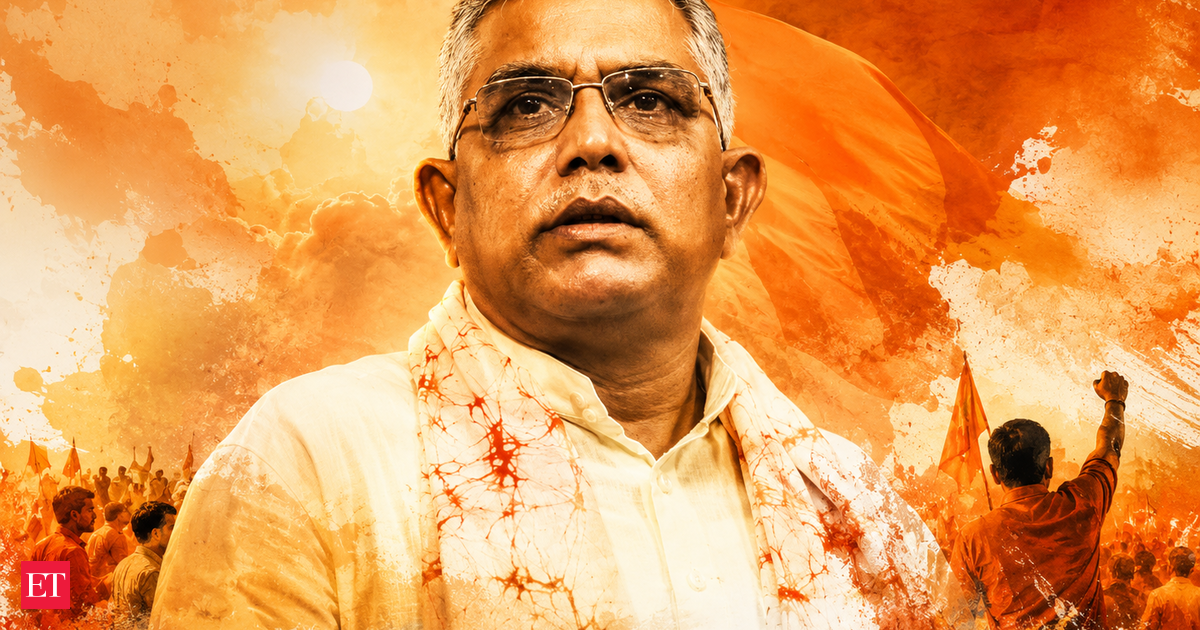
Behind much of that rise stood Dilip Ghosh. The former Bengal BJP president and RSS organiser became one of the architects of the party’s expansion between 2015 and 2021, helping take the BJP beyond its traditional urban pockets into tribal belts, north Bengal and working-class districts.
“BJP’s rise in Bengal was driven by a growing public desire for political change and the party’s ability to build a grassroots movement that earlier did not exist in the state. He said people in Bengal remembers Syama Prasad Mookerjee and his ideology, but for years there was no large-scale movement capable of challenging the ruling establishment or improving people’s lives,” Dilip Ghosh told ET Online.
According to Ghosh, the BJP’s Hindutva outreach and public mobilisation campaigns gradually began resonating across Bengal. He pointed to programmes such as Ram Navami processions, which he said helped the party connect directly with people and encouraged more supporters to come forward openly. Ghosh also said several BJP workers lost lives during the party’s political struggle in Bengal, but that sacrifice strengthened the demand for change.
Also Read: BJP gains in Bengal may accelerate reforms push amid economic headwinds
And a man comes from Andaman for Bengal BJP
Long before Dilip Ghosh became the loud, combative face of Bengal BJP, he was an RSS pracharak quietly working far away from Bengal’s political spotlight. Born in West Midnapore district, Ghosh joined the Rashtriya Swayamsevak Sangh in 1984 and spent decades inside the organisation learning cadre-building, booth management and ideological mobilisation. Perhaps, these were skills that would later become crucial for the BJP’s rise in Bengal.
For years, Ghosh worked largely behind the scenes. Between 1999 and 2007, he served as the RSS in-charge for the Andaman and Nicobar Islands and also worked closely with former RSS chief K. S. Sudarshan. Those years helped shape Ghosh into an organisation-first leader rather than a conventional electoral politician.
In 2014, as the BJP began looking seriously at Bengal following Narendra Modi’s national rise, the RSS deputed Ghosh to the party as general secretary of its Bengal unit. A year later, he was appointed Bengal BJP president at a time when the party barely had any political footprint in the state.
Reflecting on his RSS background, Dilip Ghosh said the organisation taught him how to build networks, connect with ordinary people and raise public issues effectively. “RSS taught us how to organise and mix with people. Those experiences shaped me and helped me reach out to every section of society,” he said.
How Dilip Ghosh built BJP booth by booth in Bengal
What followed changed Bengal politics. Ghosh aggressively expanded the BJP’s grassroots network beyond Kolkata into tribal belts, north Bengal, Jangalmahal and working-class districts. He focused heavily on booth committees, RSS-style cadre discipline and relentless district-level outreach at a time when many still dismissed the BJP as politically irrelevant in Bengal.
His own political breakthrough came in 2016 when he won the Kharagpur Sadar Assembly seat, defeating seven-time Congress MLA Gyan Singh Sohanpal. Under Ghosh’s leadership, the BJP’s Bengal unit transformed from a fringe outfit into the state’s principal opposition force. Then came BJP’s dramatic rise in the 2019 Lok Sabha elections and the 2021 Assembly polls in Bengal.
Meanwhile, the Left Front and Congress were steadily losing their grip across districts in Bengal, weakening opposition politics outside the Trinamool Congress. Ghosh recognised that shift early and positioned the BJP as the natural alternative. As anti-incumbency against the TMC government slowly grew, the BJP under Ghosh tapped into local anger, polarisation and organisational fatigue within rival parties to steadily build its base.
2019: Dilip Ghosh and BJP’s great Bengal leap
Under Dilip Ghosh’s leadership, the BJP scripted its biggest breakthrough in Bengal in the 2019 Lok Sabha elections, winning 18 of the state’s 42 seats without any major alliance partner. Ghosh himself won the Medinipur Lok Sabha seat, defeating Trinamool Congress candidate Manas Bhunia by nearly 89,000 votes.
Ghosh also became known for taking the BJP’s campaign directly to Bengal’s streets and tea stalls through his “Chai Pe Charcha” outreach programmes, where he regularly interacted with locals over tea. His slogan “Unishe Half, Ekushe Saaf” (Half in 2019, clear in 2021) signalling a strong 2019 showing before targeting power in the 2021 Assembly polls, became one of Bengal BJP’s most recognisable political catchphrases.
During one such Chai Pe Charcha campaign in Kolkata’s Lake Town area on August 30, 2019, Ghosh was allegedly attacked by Trinamool Congress workers, further cementing his image among BJP cadres as a street-fighting organisational leader.
Dilip Ghosh told ET Online that BJP’s rise accelerated after Narendra Modi came to power in 2014. “In 2016, when I was state president, BJP’s vote share in Bengal rose to around 10.5%. That encouraged us because we realised people wanted an alternative,” Ghosh said.
Ghosh also acknowledged that the erosion of the Congress and CPM helped the BJP expand in Bengal, saying many opposition voters increasingly felt that only the BJP was capable of politically countering the Trinamool Congress.
When Dilip Ghosh refused to fade away
The 2024 Lok Sabha election marked a difficult phase for Dilip Ghosh. Shifted from his stronghold Midnapore to the Bardhaman-Durgapur seat, Ghosh suffered his first electoral defeat, losing to Trinamool Congress candidate Kirti Azad by more than 1.37 lakh votes. His marginalisation within Bengal BJP had begun earlier in 2021, when he was replaced as state president by Sukanta Majumdar amid the party’s internal reshuffle after the Assembly polls.
Despite the setback, Dilip Ghosh remained publicly defiant and continued grassroots outreach across Bengal. After his 2024 defeat, Ghosh said electoral losses were “part of politics” and maintained that the BJP’s organisational fight in Bengal would continue. Rather than distancing himself from party work, he kept attending local programmes, cadre meetings and public events, signalling that he was unwilling to fade from Bengal BJP’s frontline politics. Even critics within the party acknowledged that Ghosh retained a loyal support base among workers who viewed him as one of the architects of the BJP’s rise in Bengal from a fringe outfit to a formidable political force over the past decade.
Now, with the BJP scripting a historic breakthrough in Bengal, Dilip Ghosh has once again moved back into the spotlight. For many party workers, his return symbolises the comeback of one of Bengal BJP’s original grassroots architects, a leader who stayed through defeats, internal churn and political uncertainty without losing relevance.
Dilip Ghosh beyond bitter political wars
Dilip Ghosh often grabbed headlines for his blunt and controversial remarks, many of which triggered political storms. His aggressive campaign style made him one of Bengal BJP’s most recognisable leaders during the party’s rise in the state.
Yet, despite the intense political rivalry, Ghosh also maintained a surprisingly cordial rapport with Mamata Banerjee, reflecting an older political culture where opponents could remain personally civil despite bitter electoral battles.
That contrast became visible again when Ghosh attended the inauguration of the Jagannath temple in Digha organised by the TMC government, even as several BJP leaders chose to stay away from the event.
His presence sparked political chatter within Bengal BJP circles but also reinforced his image as a leader willing to separate cultural and public occasions from day-to-day political hostilities. From exchanging greetings at public programmes to maintaining personal warmth across party lines, Dilip Ghosh often projected politics as competition, not permanent enmity.
Dilip Ghosh laid the roots
As the BJP’s organisation expanded across Bengal, a new generation of leaders also began rising within the party, the most prominent among them being Suvendu Adhikari. Once a key Trinamool Congress strategist and one of Mamata Banerjee’s closest aides, Adhikari’s switch to the BJP ahead of the 2021 Assembly elections dramatically altered Bengal’s political landscape. He emerged as one of strongest regional faces and handed Banerjee one of the biggest setbacks of her political career by defeating her in the high-profile Nandigram contest in 2021 and again in Bhabanipur in 2026 Bengal state elections.
But BJP’s larger political groundwork was laid years earlier under Dilip Ghosh. By the time new regional leaders arrived, Ghosh had helped build the cadre network, booth machinery and grassroots presence that allowed the BJP to rapidly absorb and expand Bengal’s anti-TMC political space.
