



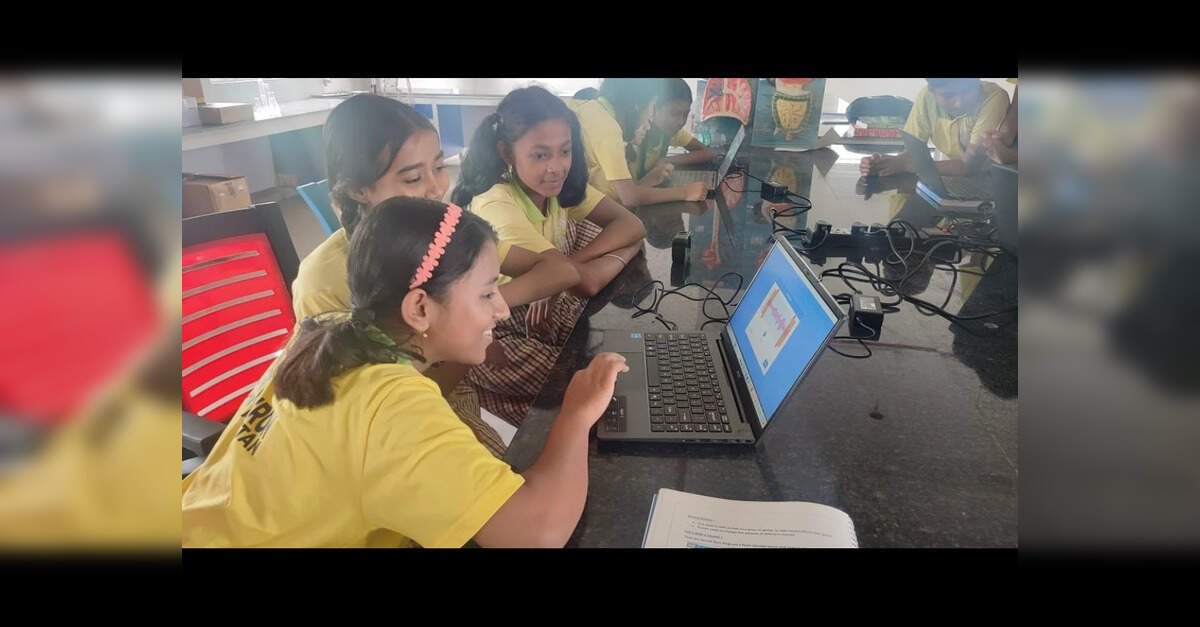
Two Indian-American sisters are helping transform learning at Swapnopuron Shiksha Niketan in the Sundarbans through a long-term partnership with the Katakhali Swapnopuron Welfare Society. The initiative is bringing improved infrastructure, digital access and hands-on learning opportunities to students in one of India’s most underserved regions, where educational resources have long been limited.
At Swapnopuron Shiksha Niketan in Hingalganj, a quiet but meaningful transformation is underway. Students are being introduced to a new way of learning that encourages curiosity, experimentation and ambition through technology-enabled and experiential education. The initiative is being driven through the long-term partnership between the Katakhali Swapnopuron Welfare Society and US-based youth-led nonprofit With Our Hearts (WOH), founded by sisters Nisha Tara Saraiya and Nimisha Saraiya.
Since 2023, With Our Hearts has been working closely with the school through regular on-ground visits and sustained remote engagement. The organisation has helped the Society raise funds from India-based companies, enabling the school to build permanent classrooms, set up a computer lab with internet access, provide laptops to teachers, introduce school uniforms, and arrange safe transport through a school bus.
In the remote Sundarbans, where classrooms once stood on bamboo stilts and educational resources were scarce, the initiative is helping redefine what rural schooling can look like. From creating permanent infrastructure and digital facilities to introducing experiential and STEAM-based learning, the effort is opening opportunities that were once beyond the reach of many students in the region.
“What we saw when we first visited the school in 2023 was a place trying to function with very limited resources,” said Nisha Tara Saraiya, co-founder of With Our Hearts. “But we also saw immense potential in the students. That is what stayed with us.”
Her sister and co-founder, Nimisha Saraiya, said the organisation has focused on building a sustainable ecosystem rather than offering one-time support. “We spent time understanding what the school actually needed, speaking to teachers, parents, and students. The goal has always been to create an environment where children don’t just attend school, but truly learn and grow.”
“What is encouraging now is that we are moving beyond basic access,” Nisha added. “It’s about depth — how students engage with learning, how they ask questions, and how they apply what they learn.”
That approach is now reflected in the school’s latest initiative: the transition to STEAM-based education. The school is working to establish dedicated STEAM and composite science laboratories designed to make learning more practical and experiential.
“At Swapnopuron Shiksha Niketan, our mission is to provide education that ignites curiosity and empowers students to become problem-solvers,” said Secretary Satarupa Majumdar. “We believe learning must go beyond textbooks, which is why we are building spaces where children can experiment and explore.”
The planned composite science lab will align with CBSE standards and provide facilities for physics, chemistry and biology experiments. Students will be able to use scientific instruments, conduct chemical experiments safely and study biological models in detail—opportunities that were once unimaginable in this region.
Alongside this, the STEAM lab is being developed as a multidisciplinary space where science meets creativity. Students will work with electronics kits, learn coding and explore design thinking. Tools such as 3D printers will allow them to turn ideas into tangible models, helping make abstract concepts easier to understand.
The initiative also includes early exposure to robotics, where students will learn to build and programme simple machines. Educators say this hands-on approach helps develop problem-solving skills and teamwork while making learning more engaging.
“This kind of exposure builds confidence,” Majumdar said. “It prepares students not just for exams, but for the future.”
With Our Hearts has also supported academic initiatives. During a visit in January, the team worked with teachers across subjects to develop a technology-integrated curriculum. Students are now being introduced to digital tools, while teachers are being trained to integrate technology into everyday lessons.
Challenges remain, however. Like many rural schools, student numbers decline significantly in higher grades. Efforts are now focused on improving retention through community outreach and more engaging teaching methods.
“We are not just building classrooms; we are building a future,” Majumdar said. “With the right support, these children can dream bigger.”
In a region where access often shapes aspiration, the initiative represents more than infrastructure development. It reflects an effort to make education more connected, creative and meaningful for the next generation.


