



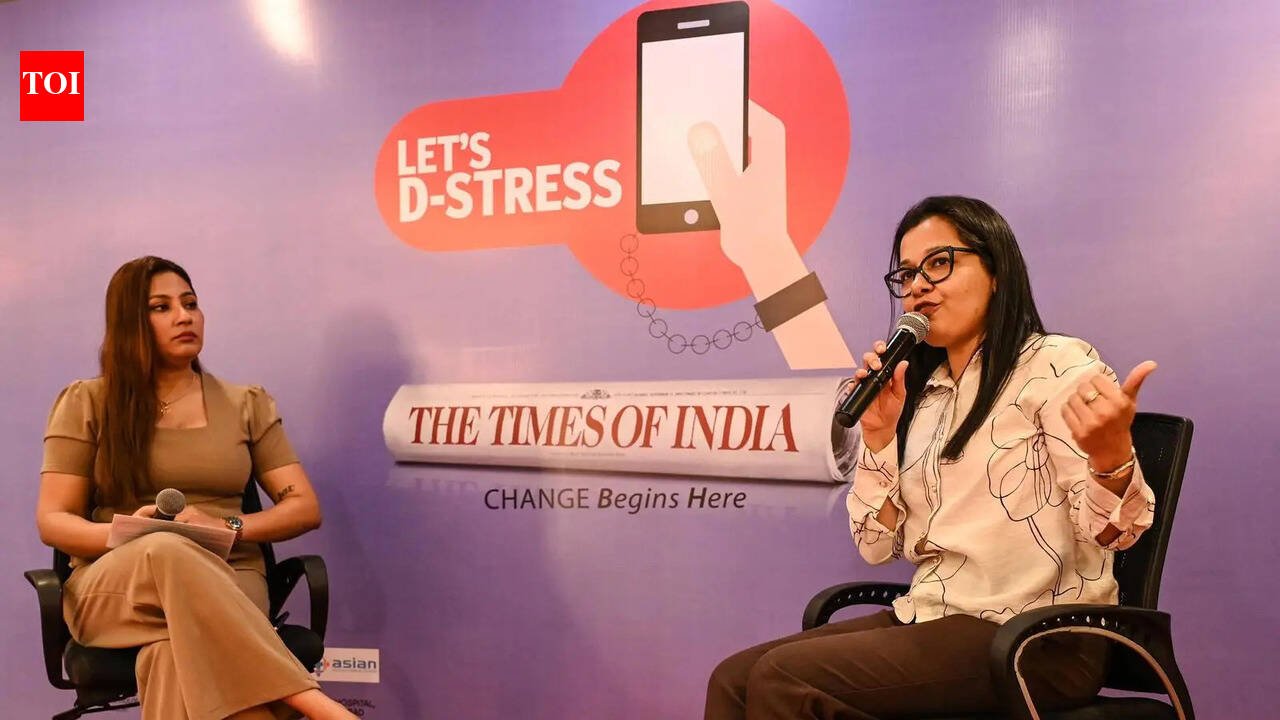
Noida: It began with games. No phones, no notifications, just residents of Prateek Wisteria in Sector 77 pulled briefly out of their digital routines and asked to pay attention to something else. By the end of the evening, the simple community engagement exercise became, in the words of those present, an uncomfortable mirror.At the centre of TOI’s Let’s D-Stress event on mental health was a question most people recognise, but rarely pause to examine: how much of our time on screens is chosen, and how much of it just happens?Clinical psychologist Dr Deepika Sharma of Asian Hospital, Faridabad, led the session, speaking at length about the quiet ways digital habits are reshaping behaviour — not just in teenagers, but across generations.“In today’s world, a lot of our work happens on the phone,” she said. “But what is more important is to notice how much time we spend on it without any need.” The distinction, she suggested, is one most people blur without realising it.Addiction, she explained, begins with curiosity, settles into comfort, and is reinforced by dopamine — the brain’s reward signal, reliably triggered by a new message, a liked post, a fresh scroll. “The dopamine rush pushes a person to use the device again and again,” she said, “and gradually it can turn into addiction.”She offered a simple diagnosis. “Put the phone down for a few minutes, turn it face down, and notice what happens. If you are reaching for it every few minutes, that shows dependency,” she said.Dr Sharma also pointed to a habit she called pervasive in Indian households — the phone offered as a distraction to get a child to eat. “Parents need to address that habit from the beginning,” she said. “From day one, phones should not become the alternative solution for everything.” The device, she noted, belongs to the parent. So does the decision about when and how it is used.Underlying much of the evening’s discussion was the concept of instant gratification, the phone as a first resort in any moment of boredom, restlessness or emotional discomfort. “People often turn to their phones when they feel restless and want immediate relief,” Dr Sharma said. “That is where addiction can begin.” The issue, she argued, is not screen time alone but what screens are replacing: stillness, patience, face-to-face connection, the ability to simply sit with an uncomfortable feeling.The physical costs, she added, are just as real. Prolonged screen exposure affects skin, muscles and posture. For those spending five to six hours or more on devices daily, deliberate movement becomes essential, not optional.Cutting back, she said, was not straightforward. “When people suddenly cut down phone usage, they may feel vacant or bored,” she said. The empty space left by reduced screen time needs to be filled with physical activity, hobbies, or the kind of conversation that does not fit into a notification. “Small interactions matter,” she said. “Sit and eat with your children. Ask them what they are eating, what colour the food is.”For those whose work demands long hours on screens, she recommended breaks every 30 to 40 minutes and attention to early warning signs — burning eyes, headaches, fatigue — before they become chronic.The session also drew personal accounts from residents about screen dependency, work-life imbalance and the particular difficulty of limiting children’s device use when adults in the same household are no less attached.


