



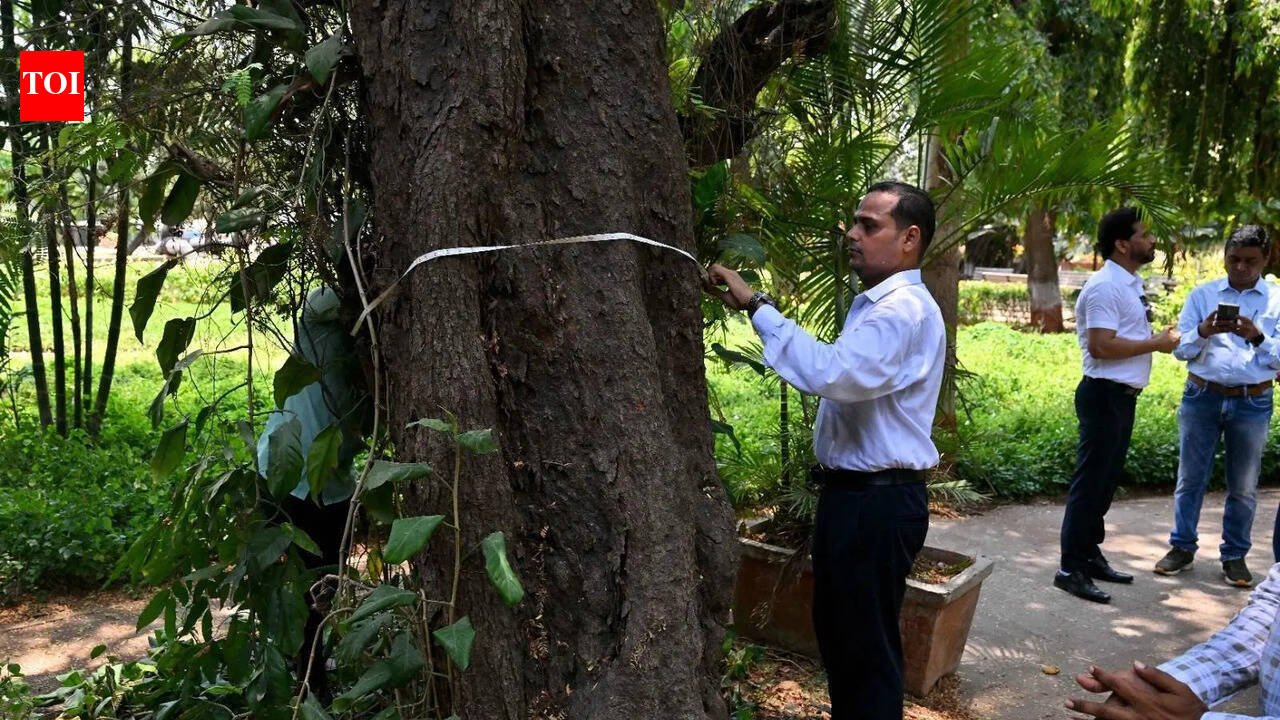
Mumbai: The focus of a team of surveyors is fastened on a mango tree’s height, girth and canopy at the civic-run Pramod Mahajan Garden in Dadar. A measuring tape is wrapped carefully around the trunk, but only after the tree meets one of BMC’s qualifying conditions: a minimum girth of 3am at chest height or a height of at least 2.5m. Once the tree’s readings are entered into an app—Treecotech—the team moves on to a tamarind tree standing a few feet away, and then to a fishtail palm, a striking tropical species known for its jagged fronds resembling a fish’s tail.The meticulous exercise is part of Mumbai’s first tree census in nearly eight years. The last enumeration, conducted in 2018, recorded about 29.8 lakh trees within city limits and rose to nearly 33.7 lakh after Aarey Colony’s inclusion. This time, civic officials expect the numbers to increase, pointing to the rise in urban plantations and Miyawaki forests developed across the city in recent years.Across Mumbai, 64 botanist teams have been deployed for the exercise, each tasked with documenting around 120 trees a day. “The census, which began in Feb, is expected to go on for two years. The process covers not just public spaces but private properties too—from housing societies and institutional campuses to restricted defence and airport zones,” says Sunil Rathod, deputy superintendent of gardens. For every tree documented along with its latitude and longitude, surveyors physically record the girth, canopy spread and height, while also noting species name, health condition, ownership, balance, mechanical damage and geographic coordinates through a GIS-enabled internal app. The process takes 2-3 minutes per tree. This time, there are also plans to assign QR codes using synthetic paper to large trees as well as unique identification numbers.“People often think we count only large trees, but there is a scientific criterion,” explains Sarfaraaz Khan, a horticulturist at the garden from SAAR IT Resources Pvt Ltd, the agency appointed for conducting the census. He says if a tree meets the girth or height condition, then it is included in the census. He says the app used by the teams standardises data collection across the city. Once a local or common name is selected from a dropdown menu, the botanical name is automatically generated. Surveyors then feed in measurements, canopy diameter, distance between adjoining trees and the tree’s physical condition.Rathod points out that dense urban neighbourhoods often present unexpected challenges. “In gardens and open patches, the work moves fast. But in private societies and restricted establishments, permissions take time. Hence, our surveyors have been provided with a letter from the BMC garden department asking the establishments to cooperate with them,” he says. Defence land, airport premises and gated residential compounds are among the locations where access is a hurdle.Despite the logistical difficulties, the census is already throwing up striking ecological patterns across neighbourhoods. In Parsi colonies, for instance, a concentration of uncommon species such as baobab trees and branching palms has been found—a reflection, surveyors believe, of the community’s long association with trade and its culture of preserving green spaces. “Parsis who travelled overseas for trade would often carry saplings from here on their boats and return with tree species from the countries they visited. That is probably why many Parsi colonies today have such unique varieties of trees,” says a surveyor, while also referring to strong local resistance often witnessed against tree cutting or concretisation around roots. Even today, tree cutting in these neighbourhoods is comparatively rare, officials say, owing to residents’ vigilance.Jitendra Pardeshi, BMC’s superintendent of gardens, says the census is crucial not just for counting trees but also for understanding Mumbai’s changing urban ecology. “The data collected will eventually help BMC map tree diversity.”Ecologist Anand Pendharkar, chief executive officer of Sprouts Environment Trust, says physical verification by experts remains crucial, particularly for accurate species classification. “The tree census should become a continuously monitored public exercise rather than a one-time counting activity. Species identification is extremely important because the climate benefits of indigenous and exotic trees are very different.”He suggests that institutions and private establishments be encouraged to upload their tree data onto a central platform, which can then be independently verified. He also calls for greater scrutiny of exotic species in Mumbai’s landscape. “Certain species such as eucalyptus adversely affect the soil and surrounding flora. Even ornamental trees like gulmohar, although aesthetically attractive because they add colour during the dry season, should gradually be discouraged in the city in favour of native species.”Pendharkar says the exercise could become more participatory by involving botany colleges, citizen groups and local communities. “The moment people begin observing trees closely—when they flower, how they grow, why they fall—society becomes more engaged with urban ecology. Mapping trees architecturally and scientifically is essential for long-term planning and safety.”Back in the Dadar garden, the team finishes documenting another tree before moving ahead with tapes, smartphones and clipboards in hand. Outside, commuters rush towards the station, a short walk away, largely unaware of the mammoth exercise underway.


