


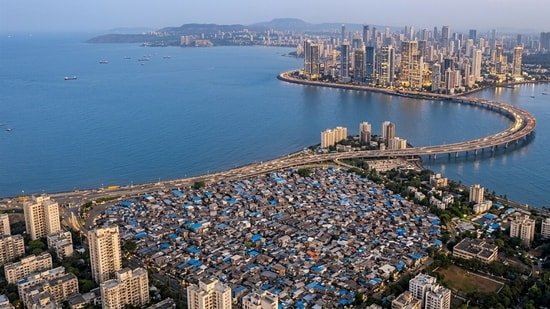
Dharavi Redevelopment Project’s first phase, comprising around 10,000 rehabilitation homes, is expected to be completed within the next 18 months, marking a key milestone in one of India’s largest urban renewal initiatives, Maharashtra Chief Minister Devendra Fadnavis informed the state assembly on July 7.

Addressing the state assembly on July 7, Fadnavis said around 10,000 rehabilitation homes will be ready in the first phase, marking a significant milestone in the transformation of Mumbai’s most densely populated informal settlement.
The chief minister also said the state has identified 19 cluster redevelopment projects across Mumbai, with the Dharavi project serving as the flagship model for large-scale urban regeneration.
The announcement comes at a time when the Maharashtra Housing and Area Development Authority (MHADA) and the Slum Rehabilitation Authority (SRA) are undertaking cluster development projects in large clusters of old buildings and slums.
Fadnavis said the government adopted a cluster redevelopment model to facilitate planned urban growth while preserving open spaces and improving civic infrastructure. The state also set an ambitious target to construct more than 7 lakh houses across the Mumbai Metropolitan Region by 2030 to address the region’s growing housing demand.
The Dharavi redevelopment project has long been regarded as one of the most complex real estate and rehabilitation exercises in the country because of its dense population, mixed land ownership, thriving informal economy and intricate social fabric. With the first phase now targeted for completion within 18 months, the project is moving from the planning stage to execution, making it one of the most closely watched urban redevelopment initiatives in India, experts said.
All about the Dharavi Redevelopment project
Spread across nearly 600 acres in the heart of Mumbai, the Dharavi Redevelopment Project seeks to transform the sprawling settlement into a modern, integrated and transit-oriented urban neighbourhood. Beyond replacing dilapidated housing with formal residences, the project aims to provide residents with improved civic infrastructure, wider roads, open spaces, healthcare and educational facilities, while retaining Dharavi’s unique social fabric and thriving informal economy.
Home to thousands of small-scale manufacturing units, leather workshops, pottery clusters, recycling businesses and home-based enterprises, Dharavi is an economic powerhouse that contributes significantly to Mumbai’s local economy. The redevelopment plan seeks to preserve and formalise these livelihoods by creating dedicated commercial and industrial spaces alongside residential development.
The project officially commenced in January 2025 and is being implemented in phases. Once completed, it is expected to reshape not only Dharavi’s skyline but also redefine the future of inclusive urban redevelopment in India, balancing large-scale infrastructure upgrades with the challenge of rehabilitating one of the country’s most vibrant informal communities.
The Adani Group emerged as the winning bidder for the project in November 2022, pledging an initial investment of ₹5,069 crore to kickstart the long-awaited transformation of one of Asia’s largest slum clusters.
Also Read: Dharavi Redevelopment: 5 highlights of the master plan and the ongoing survey
The Adani Group’s SPV Navbharat Mega Developers Private Limited (NMDPL) is a joint venture between the Government of Maharashtra and the Adani Group, which is executing the project. It is also known as ‘the largest urban rejuvenation project in the world’ and ‘the first step towards making Mumbai slum-free.’
NMDPL has a 7-year deadline to construct the homes required for rehabilitation, while the government has set an overall 17-year timeline to complete the full redevelopment of Dharavi.
Eligibility criteria
According to officials, about 1.25-1.5 lakh new homes will be constructed to rehabilitate about 10 lakh residents of Dharavi.
As per Maharashtra’s Slum Rehabilitation Act, each eligible resident of Dharavi will receive one rehabilitation unit, regardless of the number of tenements they own. These units will be 350 sq. ft., an upgrade from the 300 sq. ft. units provided in other slum redevelopment projects.
Also Read: Dharavi project to follow Singapore and Hong Kong housing development model: Fadnavis
Residents deemed ineligible for rehabilitation within Dharavi will be relocated to rental housing complexes outside the area under a hire-purchase arrangement.
To rehabilitate ineligible residents of Dharavi, the state has identified and allocated about 540 acres of land parcels within the Mumbai Metropolitan Region (MMR). These include land at Kurla, salt-pan lands at Kanjur, Bhandup, and Mulund, and portions at the Deonar dumping ground, to facilitate large-scale rehabilitation.
