



New Delhi


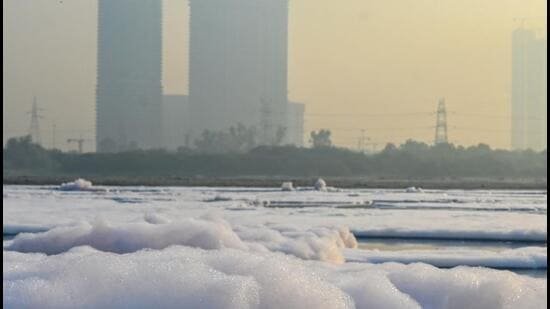
A year on since the Delhi government made the Yamuna clean-up a key agenda of the government’s environmental focus and budget allocation in 2025-26, the issue failed to find a significant mention in this year’s budget on Tuesday.
Barring fleeting observations, the focus in the chief minister’s budget speech and allocations was mostly confined to the river’s periphery, cycle tracks along it, development across the trans-Yamuna region and developing a flood protection “wall” as an embankment along the river.
CM Gupta said ₹300 crore has been allocated to the Trans-Yamuna Development Board. The government will develop cycle tracks along the Yamuna’s periphery to promote green mobility. Gupta said that in addition to carrying out desilting, a flood protection wall has been proposed in this year’s budget. “It will be from Old Railway Bridge to Majnu Ka Tilla, which will prove to be an impenetrable shield for Delhi,” she said.
Key focus, Gupta said, remains on increasing the capacity of sewage treatment plants (STPs).
In her speech, she said that while 180 kilometres of new sewer lines were laid last year, 110km of sewer lines were also replaced in the past year. “This is proof of the rapid pace of transformation in one year. This will also pave the way for a clean and pristine Yamuna, as all sewer lines and drains will be cleaned through STPs before reaching the Yamuna,” she said, stating the government seeks to double the current treatment capacity.
“The approval of 35 decentralised STPs and the proposal for 10 new STPs demonstrate our commitment to eradicating the problem at its root,” she said.
In the 2025-26 budget, the government had unveiled an ambitious road map to clean up the Yamuna in its maiden budget. This included the establishment of 40 decentralised sewage treatment plants along the river’s course, with an allocation of ₹500 crore for new DSTPs and another ₹500 crore to upgrade existing ones. The government had also announced the procurement of modern machinery, such as trash skimmers, weed harvesters, and dredge utilities for ₹40 crore, with ₹200 crore allotted to convert and intercept the Najafgarh drain, a major conduit of sewage and effluents into the Yamuna.


