


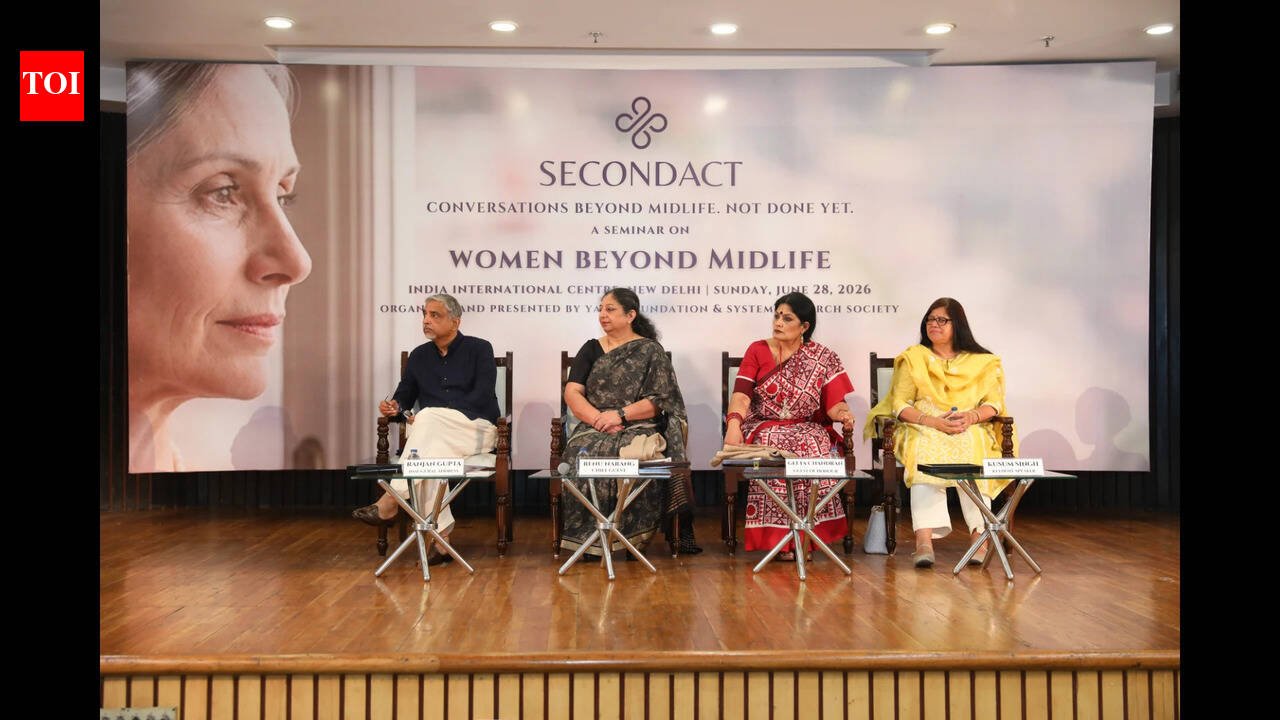
At a time when India’s urban demographic is quietly ageing, a day-long seminar at the India International Centre on June 28 shifted the lens to a cohort that rarely makes it to mainstream conversations. Titled Women Beyond Midlife: Informed, Empowered and Thriving, the inaugural edition of the “Second Act”, a platform by Yagn Foundation and System Research Society, brought together doctors, financial experts, entrepreneurs and practitioners to examine what life after 50 looks like for women today, and how it is changing.Curated as a series of conversations, the seminar focused on health, financial independence, technology and identity. The underlying idea was to move the narrative around ageing away from decline and towards possibility, reflecting a broader shift in how many women are reimagining later life.The programme opened with the release of The Night That Divided My Life, a book by spiritual mentor Shree Shree Babaji, whose guidance underpins the initiative. Organisers described the platform as an attempt to build a sustained, credible forum where women can access practical insights and exchange lived experiences relevant to this life stage.
Sh Sh Babaji’s book The Night That Divided My Life was released at the seminar.
There is a larger context to this push. Women today are living longer, remaining professionally and socially engaged for longer, and often navigating multiple roles simultaneously. Yet, as the seminar repeatedly underlined, conversations around menopause, financial planning, digital literacy or reinvention remain fragmented or delayed.“The platform seeks to shift the conversation on ageing away from limitation and toward possibility, recognising the experience, wisdom and potential that women bring to the later decades of life,” said Renu Narang, CEO of NTPC Vidyut Vyapar Nigam Ltd, who attended as chief guest. “It is extremely relevant to women today who find themselves navigating the demands of the demanding world.”
NVVN CEO Renu Narang was the Chief Guest at the seminar.
Across four panels, the discussions attempted to map the contours of this “second act.”A opening session turned to financial preparedness, framing independence not just as a matter of income, but of agency and decision-making. With rising life expectancy and shifting family structures, participants discussed retirement planning, will-making, and the importance of navigating finances independently in later life.
The second panel on health zoomed in on menopause, cardiovascular risks, bone health and cognitive wellbeing, areas that often go underreported despite their impact on quality of life. Experts pointed to gaps in awareness and preventive care, even as they emphasised the need for a more proactive, evidence-based approach to ageing.
If health and money formed the foundation, the third discussion on technology tackled a rapidly evolving terrain. Artificial intelligence, deepfakes and online scams are reshaping everyday life, often disproportionately affecting those who entered the digital world later. At the same time, the panel noted, technology is also enabling new pathways, from entrepreneurship to learning and community-building, making digital literacy less optional and more essential.
The final session focused on reinvention, arguably the most personal theme of the day. Speakers reflected on transitions such as retirement, empty nests or shifting identities, positioning them not as endpoints but as openings for new pursuits. The emphasis was on reframing midlife as a period of creative possibility rather than withdrawal.
The conversations echoed a recurring insight from the seminar’s background material. The years between 50 and 70 are emerging as a distinct life stage, one that does not fit neatly into traditional binaries of work and retirement or relevance and decline.Organisers said the initiative will now expand into a series of conversations across cities, with the aim of building a community-led ecosystem around ageing, longevity and reinvention. The intent, they added, is not just to host discussions but to normalise them.“Second Act is envisioned as a national platform dedicated to fostering informed conversations around midlife, longevity and purposeful ageing. Beginning with its inaugural seminar, the initiative will evolve into a series of curated events across India, spanning Tier 1 cities such as Hyderabad and Bengaluru, as well as Tier 2 cities including Nagpur, Guwahati and Patna. By bringing together experts, practitioners, organisations, researchers, policymakers and changemakers working across the midlife and longevity ecosystem, Second Act seeks to create a collaborative forum for knowledge-sharing, dialogue and innovation,” said a member of the involved organisations.For a generation of women that has already negotiated rapid social and economic change, the question is no longer whether life slows down after midlife. It is how it can be reimagined.
