



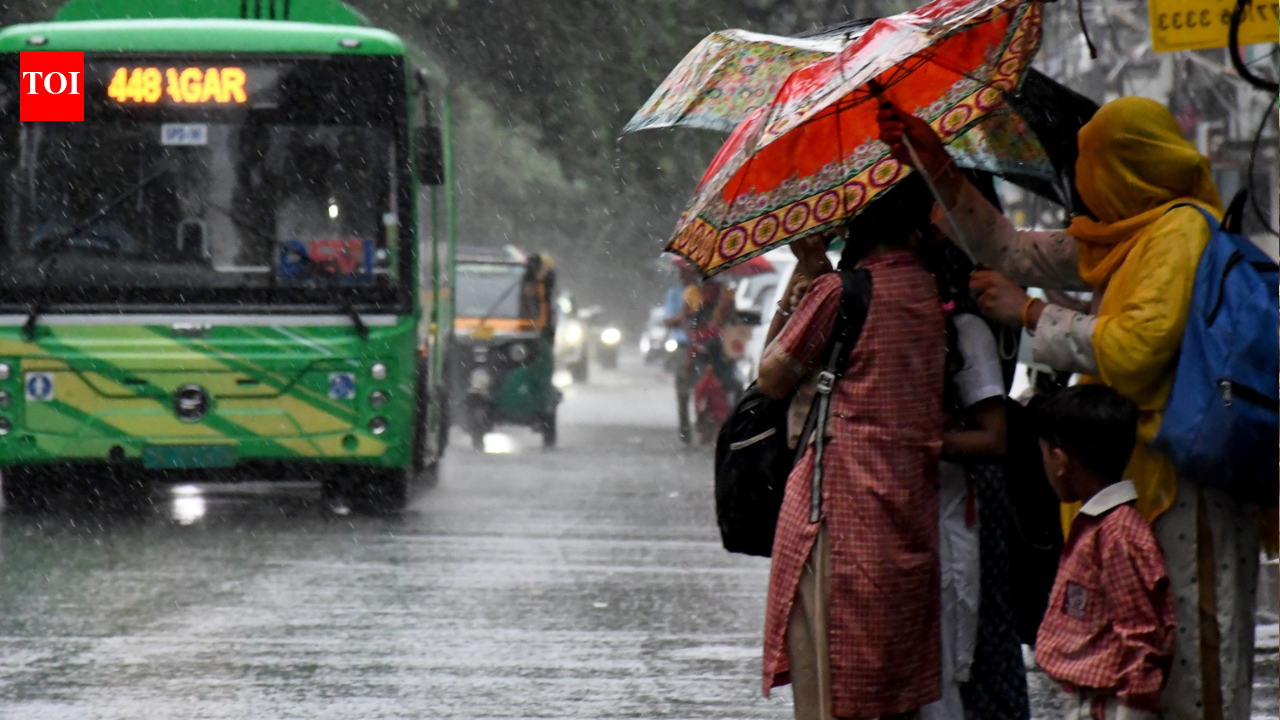
NEW DELHI: After days of oppressive heat and humidity, the southwest monsoon finally reached the national capital on Thursday, arriving five days later than its normal onset date and marking Delhi’s first July monsoon onset since 2021.Parts of the city witnessed light rainfall and overcast skies during the morning, bringing a sharp drop in temperatures.The India Meteorological Department (IMD) officially declared the onset of the monsoon over Delhi after atmospheric conditions turned favourable.Weather experts said more widespread monsoon-like rainfall is likely from July 5 as the seasonal trough shifts northwards again, triggering another spell of showers over Delhi and other parts of northwest India.The IMD has issued a yellow alert for Friday, forecasting a generally cloudy sky with moderate rainfall. The minimum and maximum temperatures are expected to settle around 22 degrees Celsius and 32 degrees Celsius, respectively.According to IMD data, this is the first time since 2021 that Delhi has witnessed the onset of the monsoon in July. In 2021, the seasonal rains arrived on July 13.Last year, the monsoon reached Delhi on June 29. The earliest monsoon onset recorded in the capital over the last 125 years was on June 15, 2008, while the most delayed arrival was on July 26, 1987.The IMD data shows that the monsoon reached Delhi on June 25 in 2020, July 13 in 2021, June 30 in 2022, June 25 in 2023, June 28 in 2024 and July 3 this year. It covered the entire country on July 13 in 2021, July 2 in 2022, 2023 and 2024, and on June 29 last year.Explaining the delayed onset this year, Mahesh Palawat of Skymet Weather said the humid easterly winds from the Bay of Bengal, which are crucial for sustained monsoon rainfall over Delhi, had not reached the region earlier.“The monsoon generally advances along the seasonal trough, which currently stretches from Punjab to the Bay of Bengal,” Palawat said.He said the seasonal trough is expected to shift southwards towards central India from Friday, resulting in enhanced rainfall over central India. However, rainfall activity over the Indo-Gangetic plains, including Delhi, Punjab and Haryana, may temporarily weaken.According to the IMD, Delhi’s base weather station at Safdarjung recorded a maximum temperature of 33 degrees Celsius on Thursday, 4.4 degrees below normal, while the minimum settled at 22.8 degrees Celsius, 5.1 degrees below normal.The city also recorded its lowest minimum temperature since July 21, 2021, when the mercury had dipped to 22.4 degrees Celsius at the Safdarjung observatory.Palam recorded a maximum temperature of 33 degrees Celsius, 4.8 degrees below normal, and a minimum of 21.2 degrees Celsius, 6.6 degrees below normal.Lodhi Road recorded a maximum temperature of 33 degrees Celsius, 3 degrees below normal, while the minimum stood at 23.6 degrees Celsius, 3.4 degrees below normal.The Ridge station recorded a maximum temperature of 33.8 degrees Celsius, 2.9 degrees below normal, and a minimum of 21 degrees Celsius, 4.5 degrees below normal.Ayanagar registered a maximum temperature of 32.4 degrees Celsius, 5.7 degrees below normal, while the minimum settled at 22.6 degrees Celsius, 4.2 degrees below normal.Safdarjung recorded 4.6 mm of rainfall till 8.30 am on Thursday, with no rain recorded between 8.30 am and 5.30 pm.Palam received 1.9 mm of rainfall and Ayanagar 5 mm till 8.30 am, with only trace rainfall later in the day. Lodhi Road received 4.1 mm, while the Ridge station recorded 3 mm during the same period.The arrival of the monsoon follows a warmer-than-usual pre-monsoon season in the capital. IMD data shows Delhi recorded its warmest summer nights in four years, with the average minimum temperature during the March-June pre-monsoon period rising to 22.9 degrees Celsius, the highest since 2022.The season was marked by early pre-monsoon showers, persistently hot days, short but intense heatwave spells and a delayed monsoon onset.The average minimum temperature during the March-June period stood at 22.9 degrees Celsius this year, compared with 21.2 degrees Celsius in 2021, 23.3 degrees Celsius in 2022, 20.9 degrees Celsius in 2023, 22.8 degrees Celsius in 2024 and 22.5 degrees Celsius in 2025, making it the highest seasonal average since 2022.The average maximum temperature during the same period was 37 degrees Celsius, compared with 36.5 degrees Celsius in 2021, 38.4 degrees Celsius in 2022, 35 degrees Celsius in 2023, 37.6 degrees Celsius in 2024 and 36.6 degrees Celsius in 2025, making it the second-highest seasonal average in the last six years after 2024.(With inputs from PTI)


