


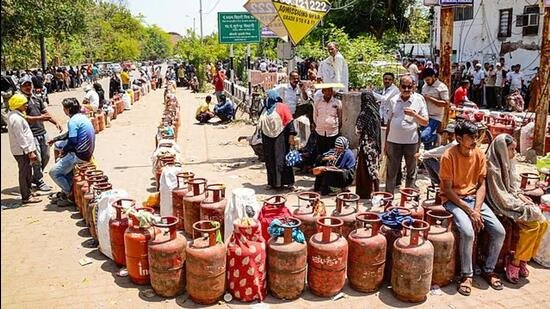
The Delhi high court on Wednesday declined to entertain a plea seeking to restrain liquefied petroleum gas (LPG) exports amid an alleged domestic shortage, observing that such matters fall within the domain of economic policy and must be handled by the executive, not the judiciary.

A bench of chief justice DK Upadhyaya and justice Tejas Karia, while hearing petitioner Rajender Kumar Mittal’s PIL raising concerns over an alleged acute shortage of LPG, an essential household cooking fuel, said, “These are the functions of the executive we can’t take upon them and cannot take over their duties. Please. These are the situations which must be left to be handled, tackled by the executive. We cannot pass any such order. These are economic policies and we cannot reflect upon all this. These are not that easy, and these are all economic policies. All this (shortage) is a fallout of the war, can you stop that?”
“Are we running the government? All these are areas which are the reserve of the executive. We do not enter into such matters. We cannot assume the charge of the executive, and if we start entertaining these petitions, we will be issuing a futile mandamus. You’re asking us to pass a decree which is non-executable,” it added.
Mittal urged the court to restrain exports, contending that LPG was being exported even as residents of Delhi faced shortages, with supply falling short of demand and cylinders allegedly being sold on the black market for over ₹5,000 despite an official price of around ₹1,000.
During Wednesday’s hearing, the court said that the government had already taken steps to address the shortage, including issuing an order on March 9, reinforcing the 1999 framework to regulate shortages in the interest of sustaining public life, as well as a Gazette notification dated March 14, aimed at ensuring an adequate supply of petroleum products, including LPG.
The court observed that no further directions could be issued after action had already been taken. “The government is taking all actions to address the situation. We cannot issue mandamus when there is already an action taken by the government. We can issue directions if the government is not taking action,” the court remarked.
The court, however, granted Mittal liberty to approach the concerned authorities to espouse his cause. “As already observed above, meeting such exigencies lies in the realm of the executive, and we thus give liberty to the petitioner to highlight the issues before the authorities. If the issues are highlighted, the same must be attended to and adequate measures must be taken. The petition is disposed of,” the court said in the order.
The supply crunch has largely been attributed to geopolitical tensions in West Asia, particularly the ongoing conflict involving the United States, Israel, and Iran. The tensions have disrupted key shipping routes and energy imports, including LPG shipments that pass through strategic chokepoints such as the Strait of Hormuz, contributing to supply constraints in several markets.
The Centre, in a petition before the Bombay high court, alleged that Confidence Petroleum India Ltd, a Nagpur-based LPG bottling firm, was prioritising exports to capitalise on higher international prices despite an acute domestic shortage, and informed the court in March that it was making all possible efforts, both domestically and internationally, to ensure that citizens do not face hardship due to disruptions in LPG supplies caused by the conflict in West Asia.
