


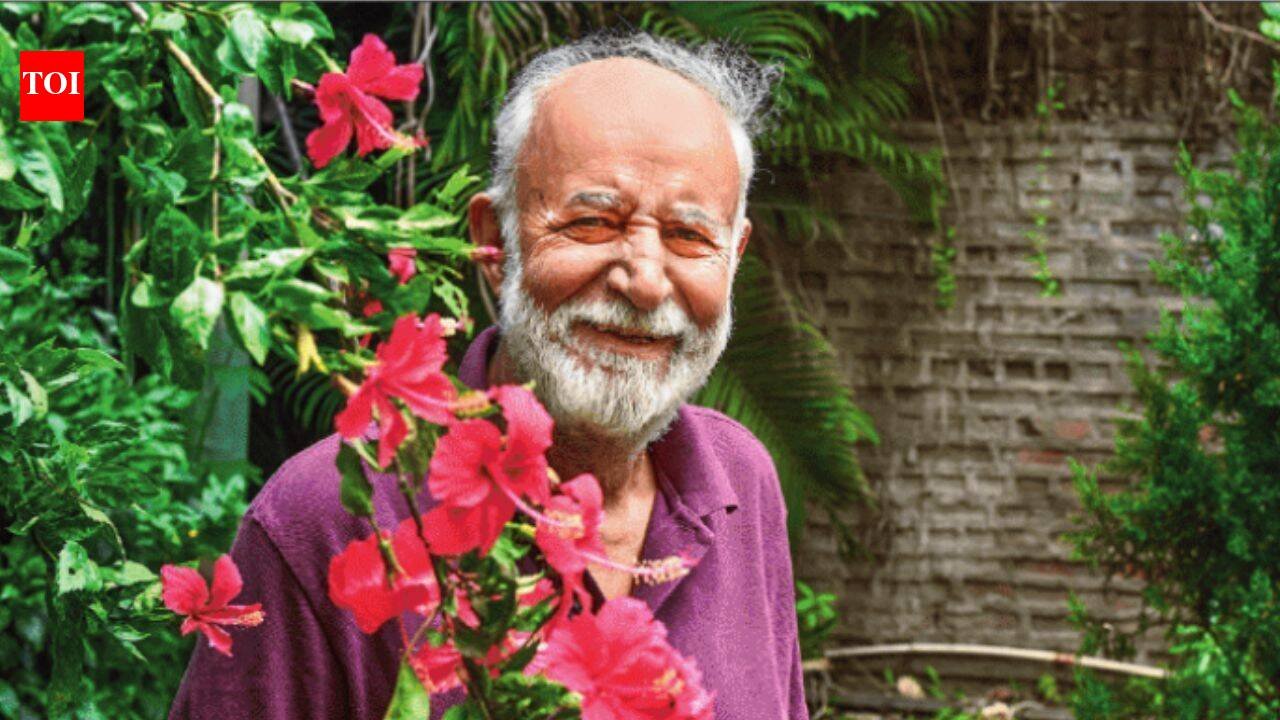
Perched in a corner near a busy traffic light but veiled by a prosperous tree, ‘Rainawari’ can be defined by the phrase, hiding in plain sight. Fierce red hibiscus flowers command centre stage in the front garden, while a fecund orange tree laden with sour fruits, adds a dash of the avant-garde. It’s a snug double-storey residence that theatre personality MK Raina and his pediatrician wife Anjali have built in Sector-26, Noida. But the actor-director still carries the lingering ache of his lost Srinagar home as many other Kashmiri Pandits. “I can never say, I am going back to my ancestral home,” says Raina, now 77.Yet memories of his childhood and teenage years breathe in him like a living organism. Raina’s earliest experience with theatre was as a Class IV student in an opera, “Neki Badi” written by Kashmiri poet Dinanath Nadim. “I played the part of a kid who gets lost in the forest,” he says. He remembers listening to Mohd Rafi sing ‘Chahe koi mujhe junglee kahey’ in Srinagar’s Bakshi stadium, watching Dilip Kumar’s ‘Insaniyat’ through a keyhole at Amrish cinema and acting in plays at Kala Kendra, an influential theatre group then.Early 1960s were vibrant for progressive art in Kashmir. Writer Sajjad Zaheer, theatre personality Habeeb Tanvir, painter SH Raza and others would visit Srinagar, interact with local artists. Raina recalls performing in a John Galsworthy’s play, translated as “Jannat Ke Darwaze Tak”. Theatre elders collectively decided to send the dentist’s son to Delhi’s National School of Drama on a J&K state scholarship to study dramatics in 1967.NSD trained him in theatre, groomed him for life. The open-air theatre Meghdoot was built by students, the devoted NSD director Faisal Alkazi joining them to carry bricks. Among other things, the theatre titan would urge students to read, visit the Sunday book market. Copies of ‘Life’ magazine on Egyptian art bought there are part of his personal collection. “Alkazi not only taught us theatre, but also how to live,” he says.Raina had just finished his NSD course and was sitting in his hostel room, when one of his juniors, Naseeruddin Shah, told him that a film director had come to meet him. “I initially thought it was a joke,” he says. It wasn’t. The director was Awtar Krishna Kaul. The gentleman accompanying him was Hindi writer Ramesh Bakshi. After a brief chat, the trio went to Bengali Market, ate golgappas and carried on the conversation at Bakshi’s South Delhi residence where more food and alcohol followed. In time, Raina learnt that Kaul, who had driven taxis and studied films in New York, wanted to make a film on Bakshi’s novel, ‘Attarah Suraj Ke Paudhe.(Saplings of 18 Suns)’. ‘27 Down’, the award-winning film of 1974, rewarded Raina with recognition. But Bombay wasn’t what he wanted. “I had no intention to stay in a film industry where you had to network for work. It is not me. I couldn’t stay in a city without trees,” he says.Theatre, his true love, beckoned. In Delhi, serious theatre groups such as Abhiyan, Dishantar and Yatrik, were active. So was NSD’s repertory. Om Shivpuri, Sudha Shivpuri, Surekha Sikri, Uttara Baokar and Manohar Singh were stars in their own right. Raina plunged headlong into theatre activism. He would travel to Punjab, Manipur, Ladakh and other areas trying to create a theatre movement. During the Emergency, his play, Bertolt Brecht’s ‘Chalk Circle’, was banned.In 1977, he founded Prayog with friends, their own experimental theatre group, starting with Badal Sircar’s ‘Julus’. Bhisham Sahni’s ‘Kabira Khada Bazaar Mein’ followed. “We thought of the group as a lab where new forms could be experimented with,” he says. In their play, ‘Tum Saadat Hasan Manto Ho’, the lunatics/characters of the gut-wrenching Partition short story, ‘Toba Tek Singh, put Manto on trial.Through the 1980s, the actor mostly worked in parallel cinema: Mani Kaul’s ‘Satah Se Uthta Aadmi’, Kumar Shahani’s ‘Tarang’, to name a couple. But his film career found a second wind with Taare Zameen Par (2007). “With Taare… Many children became my fans,” he smiles. He is also fond of the more-recent Kabir Khan’s INA-inspired, ‘The Forgotten Army.’ “I do films because I am a trained actor, a professional. But for me, it is a deviation, a picnic,” he laughs. His dictum: ‘Earn and Burn’ — earn money from films, invest it in theatre.Even today, Delhi is a theatre hotspot. “Lots of young people buy tickets and watch plays. That’s encouraging,” he says. There are downsides too. Raina details how production costs, especially auditorium rentals, have soared. “Hiring an auditorium cost Rs 3,000-5,000 in the 1970s. Now you pay Rs 1 lakh or more for eight hours. Even if you factor in inflation, that’s too steep,” he says. He also observes that many young actors are in a hurry to join Bollywood and don’t spend enough time learning,” he says. And it worries him that NSD’s permanent faculty has dwindled and short-term courses have proliferated and there’s a shift from quality to quantity. “NSD has deviated from its mission of being an apex national institute of theatre excellence,” he says.What endures is Raina’s love for Delhi. “The city sheltered me, gave me the space and courage to carry on. I sleep in Noida but I work in Delhi,” he says. Advancing age hasn’t fleeced him of enthusiasm. The actor’s eyes light up like a child’s discussing his forthcoming play, ‘Conference of Birds’, interpreted from a 12th century Persian poem. Or, when talking about “To do or not to do theatre,” a book on Prayog to be released when the group turns 50 next year.But his voice trails into sadness when the conversation turns to Woofi wandering in the drawing room. The elderly Indie has lost his eyesight and has to be fed by hand. Even its bark has lost its bite. “We never chain our dogs,” he says.
