



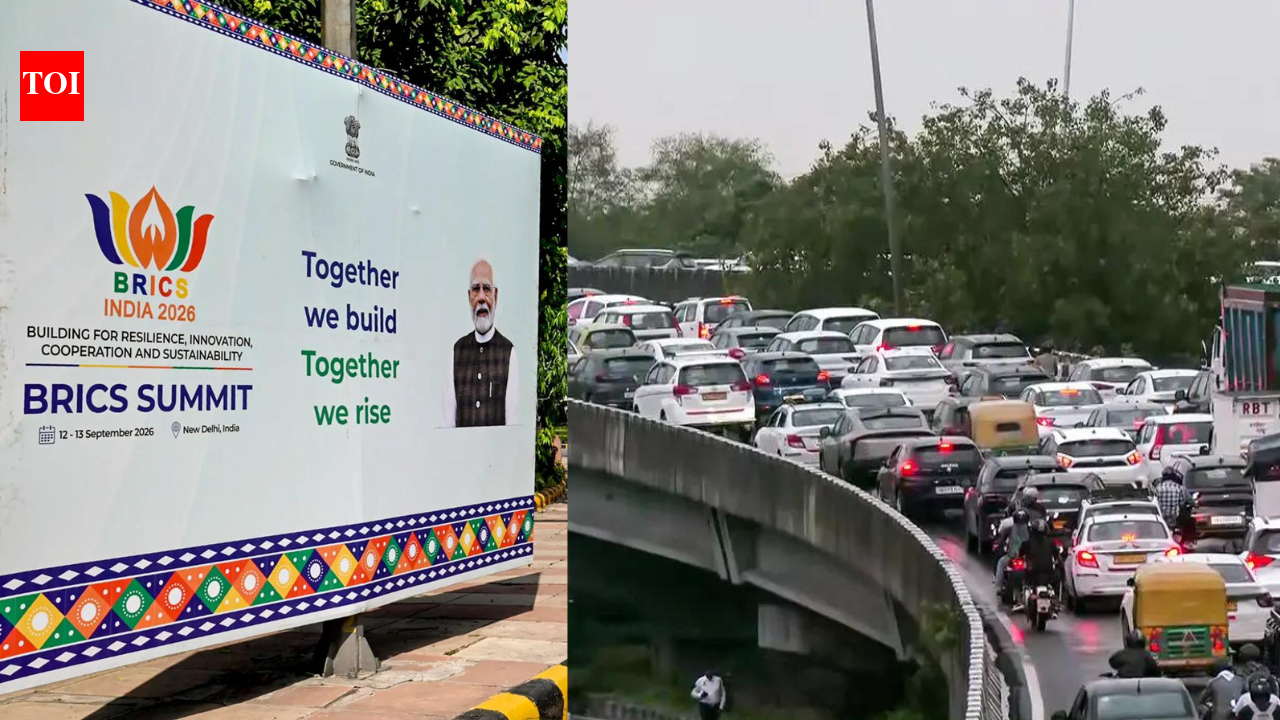
NEW DELHI: For Delhi’s daily commuters, the BRICS Summit is not just about world leaders, diplomacy and Bharat Mandapam. It could also mean longer journeys, sudden diversions and having to rethink routes that are part of their everyday routine.With the summit scheduled from September 11 to 13, traffic restrictions linked to the movement of foreign delegations and VVIP convoys are set to affect more than 35 roads across the capital, news agency PTI reported.A motorcade rehearsal is scheduled for Wednesday from 7pm to 10pm, with traffic to be regulated at 22 diversion points.The exercise is expected to give traffic authorities a final run-through of the arrangements, and commuters a sense of what travelling through the affected corridors could be like during the summit.For people travelling between Noida and central Delhi, east Delhi and central areas, and from Dwarka towards Dhaula Kuan, the airport and south Delhi, the restrictions could add considerable time to regular journeys.The problem is not limited to roads directly around Bharat Mandapam.VVIP movement can trigger temporary stoppages on one stretch and push traffic on to already busy connecting roads, creating a ripple effect far beyond the controlled corridor, PTI reported.
When a VIP movement changes an ordinary commute
The experience of cities hosting high-profile visits shows how quickly everyday movement can be affected when security arrangements take precedence.The Eiffel Tower in Paris, for instance, was closed to visitors on Monday for what was described as “operational reasons” during the visit of a prominent Hindu religious leader.The episode highlighted how the movement and security requirements of high-profile visitors can temporarily alter access to public spaces.In Delhi, the scale is different, but the challenge for ordinary commuters is similar: roads normally used for work, school, airport and railway journeys will have to accommodate secure movement of international delegations.
For Delhi-NCR commuters , the impact could stretch well beyond central Delhi
Those coming from Noida and east Delhi towards Pragati Maidan and central Delhi could face diversions around key connecting roads.Similarly, commuters from Dwarka and west Delhi towards Dhaula Kuan, IGI Airport and central Delhi may have to take longer alternative routes during VVIP movements, PTI reported.The movement of the Egyptian delegation between its hotel in Saket and central Delhi could put additional pressure on south Delhi roads, particularly during peak hours.Traffic police had earlier flagged concerns over the delegation’s accommodation in Saket and suggested shifting it closer to central Delhi to reduce the impact on traffic.For people whose daily commute already involves long distances, even a temporary diversion could mean a significant increase in travel time.
The roads commuters need to watch
The latest Delhi Traffic Police advisory lists more than 35 roads where movement will be regulated or diverted.These include Sardar Patel Marg, Mother Teresa Crescent, Teen Murti Marg, Akbar Road, Tees January Marg, Rajesh Pilot Marg, Subramaniam Bharti Marg, Mathura Road, Moti Lal Nehru Marg, Dr Zakir Hussain Marg, Brig Hoshiyar Singh Marg, Africa Avenue Road, Satya Marg, Shanti Path, Janpath, Ashoka Road, Barakhamba Road, Tolstoy Marg, Ranjeet Singh Flyover, Niti Marg, Panchsheel Marg, Kemal Ataturk Marg, APJ Abdul Kalam Road, Press Enclave Road, Lal Bahadur Shastri Marg, Josef Broz Tito Marg and Lala Lajpat Rai Marg, among others.Major diversion points include Janpath, Patel Chowk, Dhaula Kuan, Moti Bagh, Lodhi Road, Neela Gumbad, Under Oberoi Flyover, Bhairon Road and Mandi House.
What happens at the major diversion points?
At Dhaula Kuan flyover, traffic on Sardar Patel Marg will not be allowed during regulation. Vehicles heading towards the airport and Gurgaon will be diverted towards NH-48/Gurgaon Road, while other traffic will be moved towards Ring Road or Vande Mataram Marg, depending on the direction.At Moti Bagh flyover, Shanti Path will be restricted, with traffic diverted towards Ring Road and Rao Tula Ram Marg.Several points around Lodhi Road will also see restrictions, including Amrita Shergil Marg, Max Mueller Marg, Maharishi Raman Marg and Arch Bishop Macarius Marg.At Under Lodhi flyover, traffic towards Bharat Mandapam on Mathura Road will not be allowed.At Mandi House, movement on Feroz Shah Road, Bhagwan Das Road and Copernicus Marg will be restricted, with vehicles diverted towards Barakhamba Road or Sikandra Road, depending on their direction.
Airport travellers: Leave early, use Metro
For commuters heading to IGI Airport, the traffic advisory recommends using the Metro wherever possible.Those who have to travel by road have been advised to leave early and check their routes before starting their journey.The advisory has also laid out alternate corridors for airport-bound traffic from Gurgaon, Dwarka, south Delhi, west Delhi, north Delhi and east Delhi.People travelling to railway stations and inter-state bus terminals have similarly been asked to factor in additional travel time.
Metro, buses, cabs: What commuters can expect
Metro services will continue to operate, while some bus routes may be diverted during VVIP movements.Autos and taxis will remain available, but pick-up and drop-off points will not be permitted in restricted or controlled areas during convoy movement, PTI reported.Traffic police have also coordinated with online map service providers so that restrictions, diversions and alternate routes can be reflected on navigation platforms.Cab aggregators have been advised to avoid keeping pick-up and drop-off points inside restricted areas.
One parking rule commuters cannot ignore
Roadside parking will not be permitted within 200 metres of roads under traffic restrictions.Motorists have been advised to use designated parking facilities and follow instructions from traffic personnel.
Why the next few days could be difficult
The traffic restrictions are not expected to operate like a fixed road closure throughout the day.Instead, officials have said movement will be regulated depending on the arrival and movement of VVIP convoys.A road could therefore remain open and then be temporarily stopped or diverted when a motorcade approaches.That uncertainty could make route planning particularly difficult for daily commuters.For someone travelling across Delhi-NCR for work, the challenge may therefore not be just which road is closed, but how much longer the alternative route takes once thousands of other vehicles are pushed onto it.With 4,800 traffic personnel being deployed for summit arrangements and more than 35 roads coming under the traffic plan, Delhi is preparing for one of the biggest VVIP traffic operations of the year.For commuters, the safest strategy over the next few days may be simple: check the route before stepping out, keep extra time and do not assume the usual route will remain open.Because, BRICS has not started yet, but the traffic impact has.(With agency inputs)
