



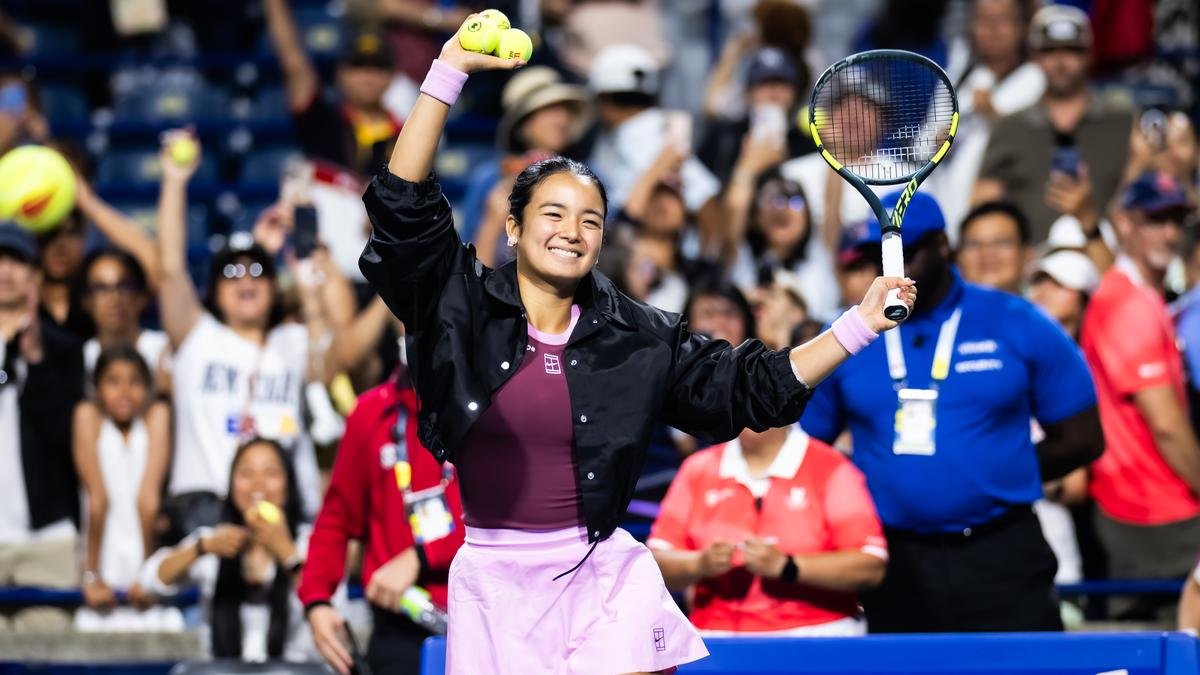
There are two places in the world where you would want to do well as a tennis player. The first is Wimbledon, because of its history, prestige and the sheer romance of playing in pristine white on lush green grass, the sport’s original combination.
Then comes the United States of America, with all its glitz, glamour and the seemingly unlimited marketing potential that can turn sportspersons into walking billboards and brands unto themselves. Being a nation of immigrants, it is a melting pot of multiple ethnicities and home to many diasporas, which means every achievement has a de facto worldwide audience.
Capturing the imagination
Over the last two months, Alexandra Eala has aced this twin-test and captured the transatlantic imagination, and of the world at large. At Wimbledon, she put together her best Grand Slam streak by reaching the fourth round, the first from the Philippines to do so. En route, she dethroned six-time Major winner Iga Swiatek in straight sets.
Weeks later in Washington, she came up with another stirring run to clinch the Mubadala DC Open WTA 500, her first-ever Tour title. Eala beat Slam finalists Qinwen Zheng and Leylah Fernandez, No. 10 Elina Svitolina, four-time Major champion Naomi Osaka and No. 3 Jessica Pegula.
The come-from-behind victory over Pegula — the 2024 US Open runner-up — came in a rain-affected final played across two days, and saw an astonishing 6-0 scoreline in the decider.
The performance helped the 21-year-old break into the world’s top-20 — she is No. 18 now — and sent her fame skyrocketing. So much so that sportswear behemoth Nike designed a signature black t-shirt, replete with Sampaguita flower motifs and Tagalog phrases — the Philippines’ national flower and native tongue — and it sold out instantly!
Ahead of the season’s fourth and final Slam starting this Sunday (August 30) in the United States, ‘Eala Mania’ is tennis’ foremost buzz phrase.
“It’s so refreshing and nice to see how they’ve embraced her, and how well she has handled the stardom that has come with her being from the Philippines,” Pegula said after the Washington final. “It’s crazy how she deals with it every single week, which just shows her maturity as a player and a person. It’s cool to see what she’s brought to the women’s game.”
Sports fandom, at times, can seem irrational, emotionally charged and borderline delusional, but the investment in Eala appears to follow a certain logic.
For one, she is a top-notch tennis player, seen not just in her recent form but also from last year when she made the semifinal in Miami while ranked 140. She beat 2017 French Open champion Jelena Ostapenko, 2025 Australian Open winner Madison Keys, and Swiatek consecutively. In fact, the contests versus Keys and Swiatek were her first against top-10 players.
Since then, she has accumulated seven more top-10 wins, including five in her last six outings. According to the Australian Open website, since 1990, only three other players have had more wins in their first 13 matches against top-10 opposition — Martina Navratilova, Monica Seles and Steffi Graf.
The lefty angle
Secondly, Eala is a lefty, a species instantly placed in a different aesthetic category. And the tennis universe appears desperate for the next left-handed Major champion, for there is none active now among men or women, with the last being Marketa Vondrousova at Wimbledon in 2023.
There is her connection with 22-time Slam titlist Rafael Nadal, whose academy she trained at starting 2018 before graduating in 2023.
Giant-slayer: Eala has an excellent record against top-10 players. She has beaten six-time Major champion Iga Swiatek twice.
| Photo Credit:
Getty Images
“She is fearless and takes the ball early,” former World No. 4 Greg Rusedski — a fellow southpaw — said on his podcast. “Her mentality is so good and strong. The one area she needs to win a Major is to get that serve a bit better and more powerful. If she can get that, she’s definitely in the mix because the rest of her game is there.”
Thirdly, she is from Asia, an outlier in tennis success stories when compared to Europe and America. From Li Na to Kei Nishikori to Naomi Osaka, all have had fervent fan followings because Asia has been thirsty for torchbearers. It helps that the continent is expected to be the next driver of the world economy and among the biggest markets, thereby increasing a sportsperson’s commercial value in the region.
Also, in a developing nation like the Philippines, which isn’t historically known for wide-ranging sporting excellence, an athlete’s journey often intertwines with that of the nation and their goals become synonymous. It is clear in the case of Eala and tennis, for the Southeast Asian archipelago is more famous for boxing and basketball.
Manny Pacquiao, one of the greatest professional boxers of all-time, is Eala’s compatriot, and after the latter’s triumph in Washington, he wrote on social media: “Down in the first round [set] but got back up. That is the heart of the Filipino! Congrats Alex Eala, our new champion!” Recently, in Taguig City back home, Eala was honoured with a giant mural on a basketball court that once celebrated icons such as LeBron James and Kobe Bryant.
“I think we’re just very proud of where we come from,” Eala said at Wimbledon. “We have a really strong sense of community, and we uplift each other. When positive things happen to other Filipinos around the world, we share the enjoyment and the happiness.”
This group identity and cohesion was well reflected in Toronto where Eala played her first match after the title at Washington. The Athletic reported that Tennis Canada’s head of ticketing Jason Maglantay, himself a Filipino, was inundated with queries from the diaspora about where Eala would play her opening tie.
She was eventually put on centre court on a Wednesday night, and tickets sold out in 30 minutes, according to Maglantay. “A sold-out Wednesday night this early in the tournament is really unheard of,” said Karl Hale, the Canadian Open tournament director.
Sporting communion: In developing nations, an athlete’s journey often intertwines with that of the country. Filipinos around the world are living Eala’s dream with her.
| Photo Credit:
Getty Images
There is every chance that this pattern will repeat at the US Open. Grand Slams neither require publicity nor need to go the extra mile to sell tickets, but Alexandra Eala in a night session at the Arthur Ashe Stadium is a match made in heaven. The United States Tennis Association lives for such moments, and has a history of awarding the world’s most marketable athletes with show-court appearances.
The appeal of star power
The high-profile example one can think of is the return of Maria Sharapova from her doping ban in 2017 as a wild card, on Arthur Ashe under the exotic New York night sky, sporting a sparkling black dress and a glittering jacket.
Eala’s career graph is nowhere close to the Russian’s, for Sharapova was a five-time Major winner. But fans and businesses connect with both performance and potential. Nike, it is reported, has already designed a basketball-themed bespoke outfit for Eala.
A deep run in the United States may or may not materialise, but ‘Eala Mania’ is here to stay!


