


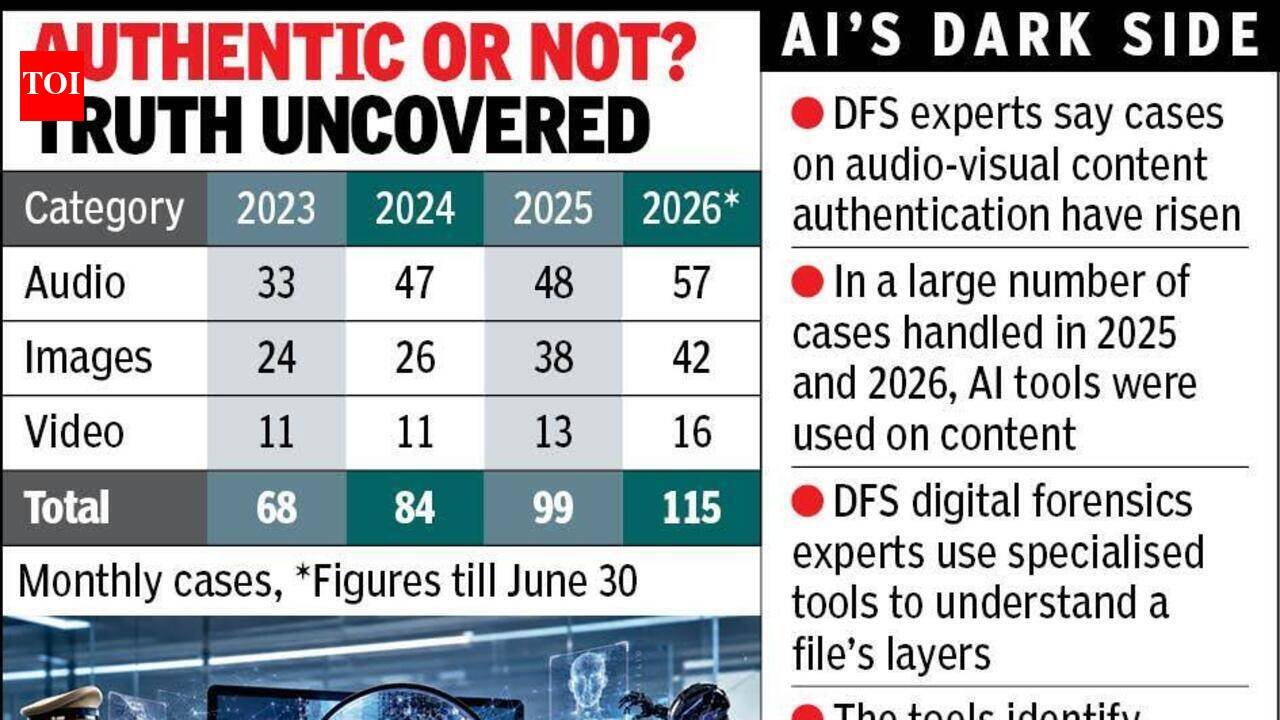
Ahmedabad: Earlier this year, a school in Saurashtra documented a prize distribution ceremony and shared the pictures purely for record and communication. Something traumatising emerged from this innocuous act. Using AI tools, an unidentified person created a video by morphing the picture of a 15-year-old girl student and circulated it in messaging groups. Her parents then filed a complaint under the Protection of Children from Sexual Offences (Pocso) Act, 2012.At the Directorate of Forensic Sciences (DFS) in Gandhinagar, a team of digital forensic experts analysed the video. Based on the past activities recorded in a mobile phone which investigators had seized earlier, the team linked the video to a specific account. The sleuths even zeroed in on the application used to create the video.AI may have made generating audio, video and images easy, but the flip side is its misuse to malign, cause disrepute or use someone’s image for satire, say experts. And DFS has its hands full with such cases. Compared to 815 such cases handled during all of 2023, DFS has recorded 687 cases in the first six months of 2026 alone.Month-wise, 2023 recorded 68, which has increased to 115 in 2026, according to DFS data. Fifty per cent of the 687 cases from Jan to June 2026 are audio files sent by police investigators to check authenticity, followed by images (36%) and videos (14%).DFS director H P Sanghavi says that there has been a steady increase in the use of AI for manipulating original content or generating content used for crimes. “We have procured tools to investigate such cases and have also trained human resources for the same,” he said. He added that the theme of this year’s DFS Day – celebrated annually on July 3 – was integrating AI in workflow and developing capabilities to handle AI-related cases.Experts pointed to another case where a woman’s jilted lover circulated her pictures online. A person known to him had used AI tools to create an obscene video of the woman.“The digital evidence was subjected to detailed forensic examination by experts of the Computer Forensic Division. The video was analysed for its metadata, technical characteristics and content integrity,” said a senior official at the digital forensics department.“Scientific analysis revealed the presence of multiple AI-generated artefacts and indicators within the video. The forensic findings, presented to the investigating agency, established the software/application used and supplied crucial evidence against the accused,” added the official.Experts said that AI does not provide immunity to the accused, and modern tools are capable of linking evidence with the accused in the majority of cases.BOX1Authentic or not? DFS checksCategory – 2023 – 2024 – 2025 – 2026Audio clips 33 – 47 – 48 – 57Images 24 – 26 – 38 – 42Videos 11 – 11 – 13 – 16Total 68 – 84 – 99 – 115Figures till June 30; Source: DFSBOX2Audio clips top categoryCategory – ShareAudio clips: 50%Images: 36%Videos: 14%Total 100%PointersAI’s dark sideDFS experts say cases on audio-visual content authentication have risenIn a large number of cases handled in 2025 and 2026, AI tools were used for contentDFS digital forensics experts use specialised tools to understand a file’s layersThe tools identify organic and artificial content and also indicate if AI has been usedExperts search for finished files when the digital device of the accused is availableAnalysis of the device also uncovers which software was used for generating objectionable content
