



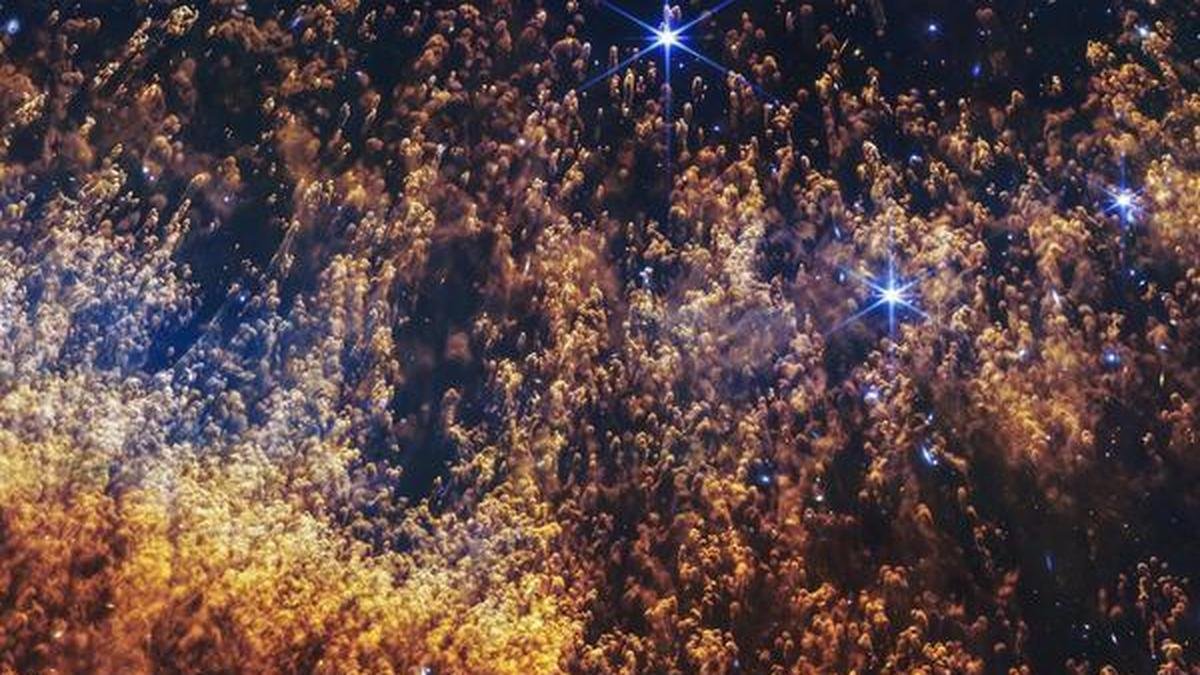
A view of a planetary nebula. Image used for representation only. Credit: NASA
Dark matter, the unseen substance that makes up most of the universe’s matter, could play a more dramatic role than previously thought.
A new study suggests that heavy dark matter particles trapped inside a dense star could accumulate at its core, collapse into a tiny black hole roughly the mass of a loaded semi-truck and gradually transform the entire star into a black hole.
The authors of the study, published in the latest issue of the Physical Review D, are H.A. Adarsha and Chandrachur Chakraborty of the Manipal Centre for Natural Sciences at Manipal Academy of Higher Education, and Sudip Bhattacharyya of Mumbai’s Tata Institute of Fundamental Research (TIFR).
Two stellar objects
Their study focuses on two extremely dense types of stellar objects — millisecond pulsars and white dwarfs.
An extremely dense star is essentially a dead star that has run out of nuclear fuel. A millisecond pulsar is a rapidly rotating neutron star that emits regular beams of electromagnetic radiation at intervals of less than 10 milliseconds, while a white dwarf is a hot, dense stellar remnant.
A black hole would evaporate rapidly if left on its own, but the researchers’ calculations through a new mathematical framework showed that a continuous supply of dark matter could keep such tiny black holes growing inside dense stars.
The researchers used a conservative age of about 1 billion years for millisecond pulsars and about 10 billion years for white dwarfs to place limits on the possible properties of ultra-heavy dark matter.
“Hawking radiation causes black holes to lose mass, with smaller black holes evaporating faster. However, some hypothetical ultra-heavy dark matter particles could be captured by dense stellar remnants such as millisecond pulsars and white dwarfs, collect at their centres, and eventually collapse into a tiny black hole,” the researchers said.
They calculated what would happen next by considering a black hole’s consumption of stellar material, continued feeding by dark matter, Hawking evaporation, and quantum effects important at extremely small scales.
“We find that continued dark matter feeding can allow black holes born with masses as low as about 40 tonnes to overcome evaporation and eventually consume their host stars. Because many millisecond pulsars and white dwarfs have survived for billions of years, dark matter capable of destroying them sooner can be ruled out,” the study said.
“These ancient stars, therefore, provide natural laboratories for probing forms of ultra-heavy dark matter that are difficult to test on Earth,” they found.
Published – September 04, 2026 06:07 pm IST


