



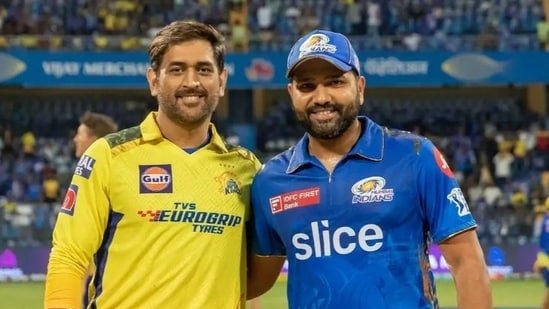
When Chennai Super Kings and Mumbai Indians are reduced to their best all-time XIs, the debate usually gets trapped between sentiment and star power. A better way to test it is to build proper, role-correct teams, place them in a modern 2026 scoring environment, and then ask a harder question: which side actually wins more often once venue conditions are factored in.
That is where the rivalry sharpens. Both franchises have built dynasties around distinct identities. Mumbai’s great teams have tended to win through high-end pace, explosive middle-order finishing and big-match power. Chennai’s best sides have been defined more by batting continuity, spin control, tactical flexibility and the ability to drag opponents into their pace of game. Put those strengths into the same frame, and the answer changes depending on where the match is played.
The all-time XIs of Chennai Super Kings and Mumbai Indians
Chennai Super Kings XI
1. Shane Watson ✈️
3. Suresh Raina
4. Faf du Plessis ✈️
5. Ambati Rayudu
6. MS Dhoni (captain, wicketkeeper)
7. Ravindra Jadeja
8. Dwayne Bravo ✈️
9. Ravichandran Ashwin
10. Deepak Chahar ✈️
11. Muttiah Muralitharan
Impact Substitute: Mohit Sharma
Mumbai Indians XI
1. Rohit Sharma (captain)
2. Lendl Simmons✈️
3. Suryakumar Yadav
4. Ishan Kishan (wicketkeeper)
5. Kieron Pollard ✈️
6. Hardik Pandya
7. Krunal Pandya
8. Harbhajan Singh
9. Lasith Malinga ✈️
10. Jasprit Bumrah
11. Trent Boult ✈️
Impact Substitute: Sachin Tendulkar
These XIs were built under standard IPL restrictions, with only 4 overseas players per side.
Why the model had to be modernised
Any serious comparison between these teams has to be run in today’s scoring climate, not in an older IPL run environment. Recent IPL seasons have pushed batting conditions into a different bracket, with Wankhede regularly sitting in a high-scoring band and Chepauk remaining comparatively lower-scoring and more rewarding for spin and control. That changes the value of certain players. A side built around Bumrah, Malinga and Boult becomes even more dangerous when the game is moving fast, while a side with Jadeja, Ashwin, Murali and MS Dhoni’s tactical grip becomes more valuable when the surface starts asking more technical questions.
What happens at Wankhede
At Wankhede, the Mumbai Indians came out as slight favourites. In the venue-adjusted simulation, MI won 51% of the matches, CSK won 46%, and 3% ended tied.
Mumbai’s great all-time strength is not just star quality but phase dominance. Boult can strike immediately, Bumrah can choke both the middle and the death overs, and Malinga remains one of the defining late-innings bowlers in IPL history. Add Rohit, Suryakumar, Pollard and Hardik to that structure, and MI become better equipped to win games that stay fast and force both teams into boundary-hitting patterns.
Why Chepauk tilts heavily toward CSK
At Chepauk, the simulation swung sharply toward Chennai. CSK won 55% of the matches, MI won 43%, and 2% were tied. Scores fell, tempo became more important, and Chennai’s side started looking structurally superior.
This is where Chennai’s all-time identity bites hardest. Jadeja, Ashwin and Muralitharan give them sustained control through the middle overs, while Dhoni’s game-reading adds another layer to how those bowlers are deployed. On slower surfaces, CSK do not need to overpower opponents. They need to keep shifting the game into less comfortable areas, and this XI is built exactly for that.
Neutral venues and the final verdict
On a neutral high-scoring surface, the simulation still gave Chennai a narrow edge. CSK won 51% of the matches, MI won 48%, and 1% were tied. That suggests Chennai’s batting order holds together slightly better across conditions, while Mumbai remain the side with the higher pace-driven ceiling.
The clean verdict is this: Mumbai Indians are marginal favourites at Wankhede, Chennai Super Kings are clear favourites at Chepauk, and CSK hold a slight overall edge on neutral surfaces because their all-time XI is more flexible ball-to-ball.
That is what makes this rivalry so durable. Mumbai’s best side looks more brutal. Chennai’s best side looks more complete. And when two teams that strong are separated mainly by venue rather than by quality, the argument stays alive for a reason.


