


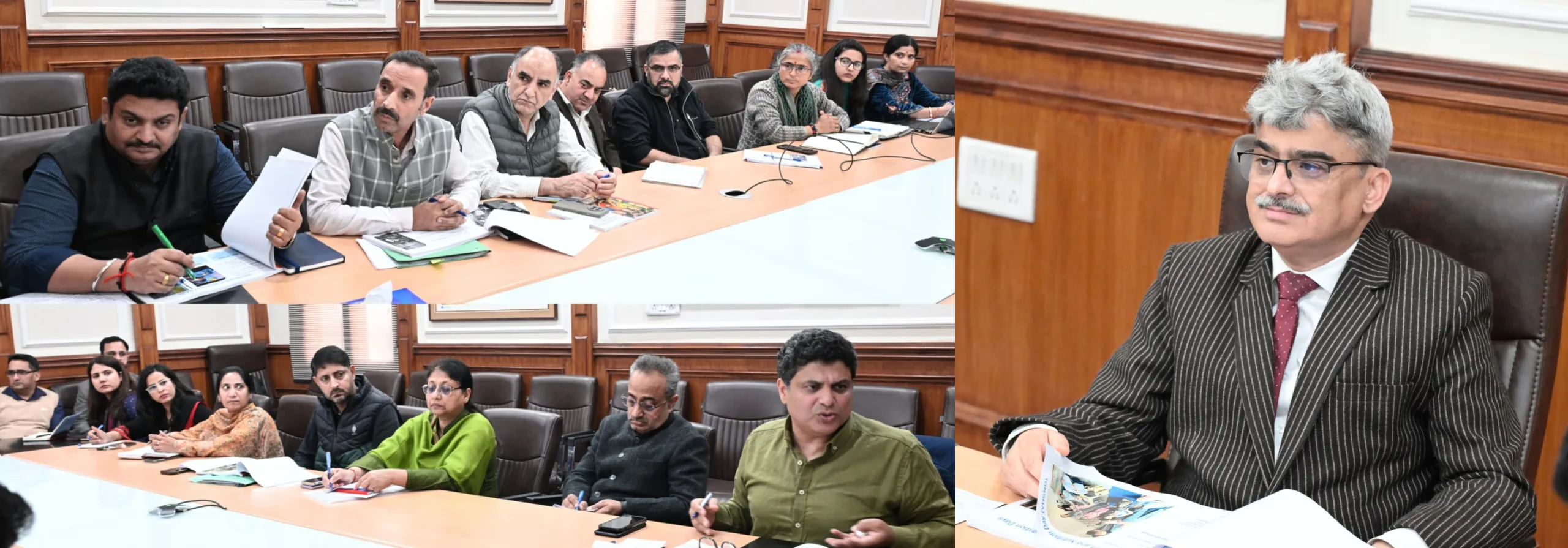
Chief Secretary, Atal Dulloo, held a meeting of all the stakeholders to take assessment of the interventions proposed for the Early Childhood Care and Education (ECCE) by the Social Welfare Department.
Speaking in this meeting he called for a time-bound, outcome-driven “Whole-of-Government” approach to transform Anganwadi Centres into vibrant hubs of holistic child development across Jammu & Kashmir.
The meeting was attended by Commissioner Secretary, GAD; Commissioner Secretary, Social Welfare; Project Director, Samagra Shiksha; MD, Mission Poshan; MD, JKRLM; Director, School Education, Jammu/Kashmir; and other senior officers of the concerned departments.
Highlighting the transformative role of early childhood development in light of the National Education Policy and the vision of ‘Viksit Bharat’, the Chief Secretary observed that no nation can dream of sustainable development without productively investing in its children.
He described children as the guarantee of a prosperous tomorrow and the real wealth of any nation. He emphasized that even nations endowed with abundant natural resources ultimately depend on the quality of their human resources for productivity and growth, and asserted that there is no better way to create quality human capital than through timely and strategic early childhood interventions.
Stressing clarity of goals and adherence to timelines, he directed all departments to work in close coordination to achieve measurable improvements in nutrition, school readiness and foundational learning outcomes.
The Commissioner, Social Welfare Department, Sarmad Hafeez took this occasion to reveal that ECCE services are being delivered through 28,190 Anganwadi Centres (AWCs) across the Union Territory, integrating preschool education (3–6 years), supplementary nutrition, immunization, growth monitoring, early identification of developmental delays and inclusive services for Divyang children.
He added that the pedagogical framework is anchored in Navchetna (0–3 years) and Aadharshila (3–6 years), promoting play-based and activity-oriented learning across five developmental domains as that of cognitive learning, language, socio-emotional, physical and cultural development.
While throwing light on the proposed interventions under the roadmap of ECCE, the MD, Poshan, Sajad Hussain Ganai informed the meeting that a key pillar of the roadmap is structured as inter-departmental convergence. He elaborated that with the Health Department, integrated home visit protocols for AWWs and ASHAs, ECD-focused Village Health, Sanitation and Nutrition Days (VHSNDs), co-counselling sessions and developmental delay screening mechanisms have been institutionalized.
Additionally under this new strategy the School Education Department had ensured 100 percent mapping of AWCs with nearby primary schools has been completed, and 657 AWCs have been identified for co-location to ensure seamless transition from preschool to Grade 1 and alignment with Foundational Literacy and Numeracy goals under the NIPUN Bharat Mission.
Innovative mentorship models are being implemented to bridge Anganwadis and primary schools, with mentor teachers providing pedagogical support and on-site guidance. In addition to that internship collaborations are being rolled out with the engaging students from local Universities as Poshan Mitras and ECCE interns to strengthen service delivery at the grassroots.
The roadmap also envisages digital transformation forming it another major component of the strategy. QR-enabled Anganwadi profiling, the “One Child, One Card” initiative and integration with Poshan Tracker, RCH and UDISE platforms are going to streamline the monitoring and service delivery.
Under Saksham Anganwadi and Poshan 2.0, APAAR IDs are being generated for preschool children to enable seamless academic tracking, with 94 percent of Aadhaar-seeded children already covered and full saturation targeted by March 2026.
To strengthen transparency and community ownership, District-Level Monitoring Committees and a biannual Social Audit framework involving PRIs, SHGs, Mahila Mandals and parents is going to be instituted. Community-Based Events under POSHAN Abhiyaan including Godhbharai, Annaprashan, Pratham Diwas and Vidyarambh ceremonies are slated for regular conduction to promote behavioural change, enrolment and parental engagement.
The meeting also reviewed the impact of some best practices in vogue here such as “Poshan on Wheels” facilitating doorstep delivery of services, on-the-spot registration under the Pradhan Mantri Matru Vandana Yojana, Aadhaar generation and screening of malnutrition and developmental delays.
It was further detailed out that the capacity building under the “Poshan Bhi Padhai Bhi” initiative has equipped supervisors and Anganwadi Workers with play-way pedagogy skills and digital literacy, with Round-II training scheduled for completion in a phased manner by FY 2026–27.
Reiterating that early childhood investment is foundational to building a developed and inclusive Jammu & Kashmir, the Chief Secretary directed all stakeholders to work in mission mode, ensure convergence and deliver tangible outcomes within defined timelines.


