


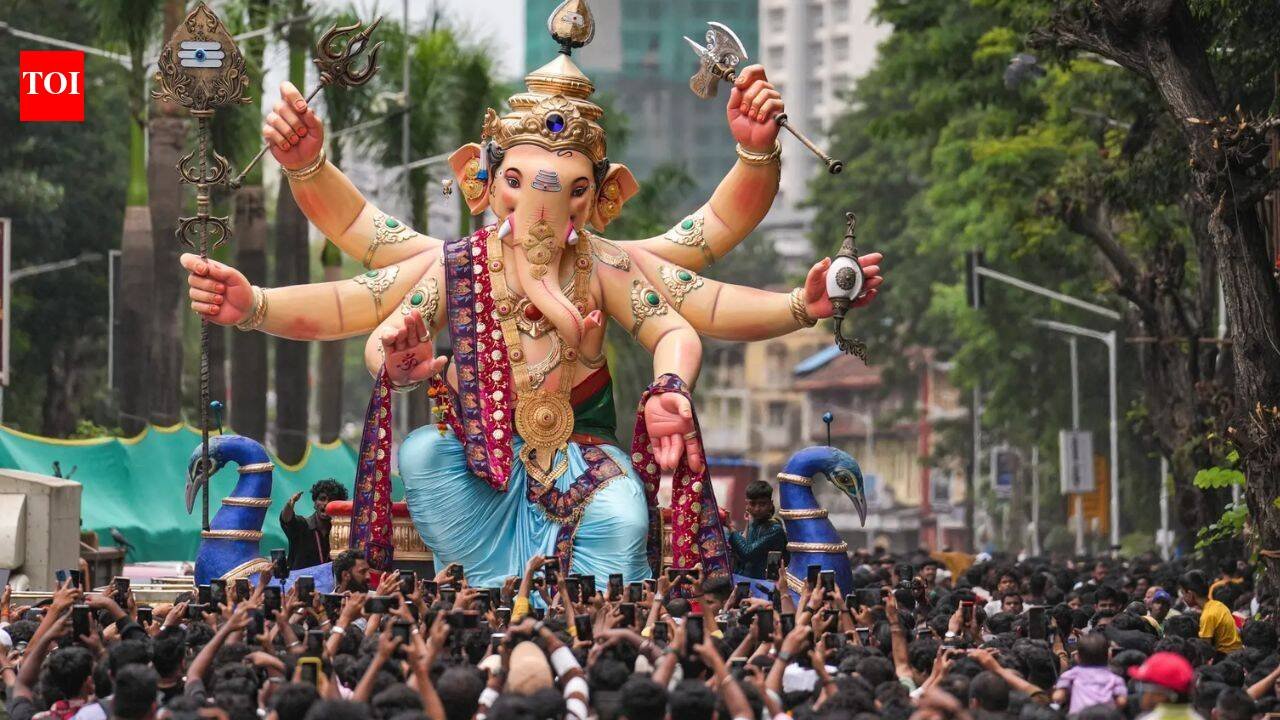
MUMBAI: In 2022, Malvani Mhada Cha Raja stood around 22-ft tall. The next year, it grew to 28 ft. Then came 32-33 ft. Last year, the idol towered 36 ft above visitors. The steady climb has not been by accident.“This is nothing but a competition. If one mandal brings an idol, another wants to bring the same or something bigger,” said Mustakim Sayyed, a founding member of the mandal, adding internal politics within mandals also drives the trend.Two people were killed and five injured when a 22-ft-tall idol collapsed during an arrival procession in Bhuleshwar on Aug 22. The accident has cast a spotlight on a competition of heights that has transformed Ganeshotsav, reports Abhishek Singh.Mumbai’s giant-idol culture is often traced to Ganesh Galli in Lalbaug, where the Lalbaug Sarvajanik Utsav Mandal introduced a 22-ft Ganpati in 1977 during its golden jubilee. The bar kept rising: Khetwadi’s 12th Lane installed a 40-ft idol in 2000, while Khetwadi’s 11th Lane produced a 45-ft idol in 2023 and is set to take it to 47 ft this year.While the competition can become a show of strength, it’s also driven by a desire to lure crowds. Bigger idols also mean bigger investments. A 10-15-ft idol can start at around Rs 3.5 lakh, while a 40-45-ft idol can cost Rs 12-13 lakh, according to sculptor Siddhesh Dighole.‘Race of taller idols driven by competition to lure crowds’Nikhil Morye of Brihanmumbai Sarvajanik Ganeshotsav Samanvay Samiti attributes the competition to the human instinct to outdo one another. Murtikar Rajan Zard said the pressure from mandals is unmistakable.“There is always a competition between mandals; they want their Ganpati to be bigger than the one in the neighbouring mandal. They may not say it directly, but we understand what they want.”Zard believes idols up to 15 ft are safest and those up to 20 ft can be managed with adequate support. But commercial pressure remains. “If we don’t do something new, the advertising money won’t come. And if the advertisements don’t come, mandals cannot afford to conduct the festival.”For Umesh Sitaram Naik, former chairman and current Karyakarini Sadasya of 107-year-old Chinchpokli Sarvajanik Utsav Mandal, problem lies in what happens when increasingly large idols have to be moved. “A 40-foot idol may not be a problem if it remains in one place, but when you have to move it, transport it and finally immerse it, the risks are very different. The sculptor also needs the experience and expertise to build an idol of that height safely,” he said.Despite the growing scale of idols, there is no government-prescribed cap on their height. Prashant Sapkale, BMC deputy municipal commissioner for zone II, said the issue had not been discussed in recent years. Nor is there a BMC team that certifies the structural stability or safety of idols.“There is no such team from BMC that works on the structural stability or safety of the idols…There is no standard engineering method or formula being used to guarantee stability. Generally, the sculptors themselves ensure it,” Sapkale said, adding that the Bhuleshwar incident had led to greater caution during transportation.This is not the first time giant idols have come under the glare. After the collapse of a 22-ft idol before immersion in 2011, the Salgaonkar committee proposed an 18-foot limit in 2012, but it did not endure.During Covid, public mandal idols were capped at four feet in 2020 and 2021; the restrictions were later lifted.Sociologist Dipti Shahu said the competition can become a show of strength. “An idol attracting lakhs of people becomes a matter of pride for the mandal, creating a hype that can turn into a show of strength: ‘I can do better than you.’” But the competition is also driven by crowds.In the suburbs, mandals increasingly want to offer devotees an experience comparable to visiting popular idols in South Mumbai, said Sameer Bambardekar, 50, a member of Upnagar Cha Raja Sarvajanik Ganeshotsav Mandal in Borivli.His mandal increased its idol from eight feet to 25 ft in 2006 to mark its 25th anniversary. Soon, several mandals in Kandivali, Borivali, Dahisar and Bhayander also began installing larger idols. “Why would someone go to South Mumbai and queue up for six to eight hours if they could see idols of the same height on this side in just one hour?” he said.And where crowds go, advertising follows. With around 2,500-3,000 pandals registered in the city every year, they are competing for a limited pool of sponsors. “An advertiser will ask, ‘If I invest Rs 50,000 with your mandal, what benefit will I get? If I put up a stall here, how many people are going to visit it?’ So, footfall has become an important factor in the competition,” Morye said.“The bigger the idol, the more material and work it requires. But mandals cannot assume that sponsorship will rise in proportion to the idol’s height. Sponsors look at the mandal’s reach, location and footfall. For a sculptor, making a very large idol also means investing heavily in new moulds. That is why I make idols only up to 24-25 ft; there are very few mandals willing to pay Rs 7-8 lakh or more,” he added.For engineer-turned-farmer Rajesh Gadepatil, 56, the race has become a display of power and prestige. “A mentality of ‘the taller it is, the greater it is; the grander it is, the superior it is’ has taken root. As the crowds increase, power, publicity, politics and money also find their way into the festival. We need to ask ourselves whether, in the name of Ganeshotsav, we are trying to make Ganesha greater, society greater, or simply our own mandal greater?”
