


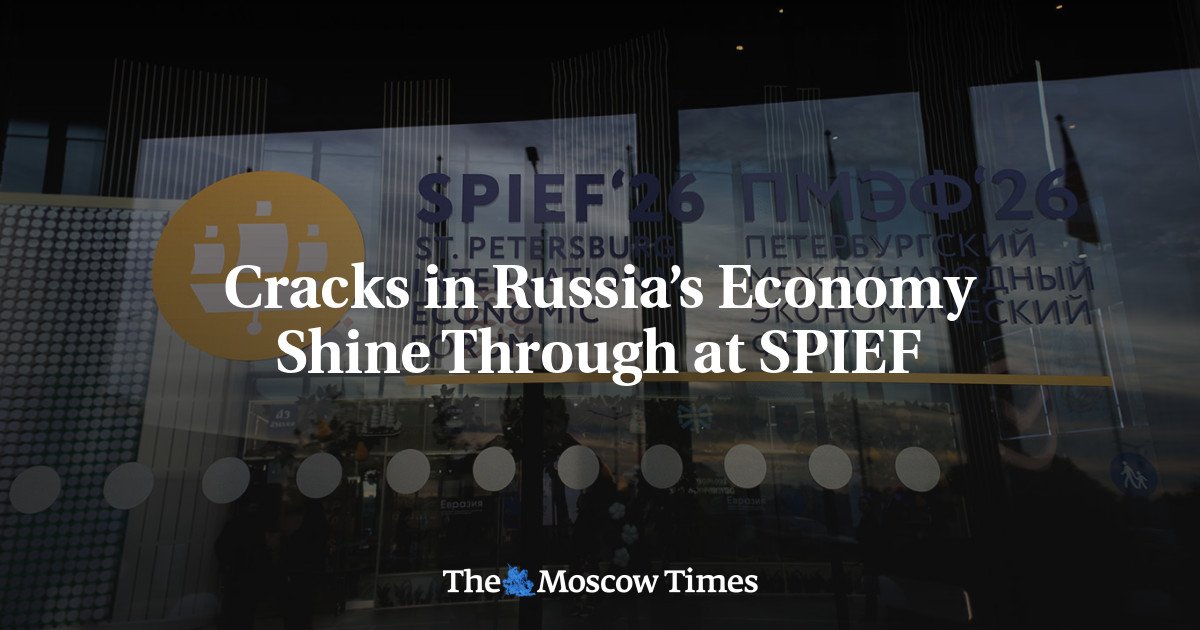
When black smoke hung in the sky above St. Petersburg as Russia’s flagship annual investment event opened this week, the result of a Ukrainian drone attack, the metaphor for Russia’s economy was almost too obvious to ignore.
The St. Petersburg International Economic Forum (SPIEF) is a glitzy multi-day meeting between officials, business executives, media personalities and other high-powered individuals from Russia and abroad.
Since the invasion of Ukraine, Russia has used the high-profile forum to shore up ties with non-Western allies and project economic stability. But this year’s event came as financial worries are mounting for the regime.
The main question on the table: can Moscow’s economy keep sustaining its war effort?
For those seeking an answer, SPIEF was underwhelming. The war in Ukraine was notably absent from the spotlight in panel discussions that addressed more prosaic challenges, like improving the investment climate and contending with AI.
Yet between the drone attack, the spectacle of the exposition center’s displays and attention-grabbing visits by American figures, comments from Russia’s top business leaders and officials suggested increasing unease about the state of the economy.
The wartime economy is here to stay
“We shouldn’t expect things to return to the way they were, or for Western sanctions to be lifted.”
That was how Maxim Oreshkin, a Kremlin official, answered a question about whether Russia should embrace the idea that its economy will more or less be isolated from the West in perpetuity. He was speaking on a Thursday panel addressing Russia’s flagging economic growth.
Valentina Pevtsova / Roscongress
The story of Russia’s economy in 2026 is one of a slowdown approaching stagnation. Key financial indicators began to spell trouble on the horizon last year, and some analysts and Russian officials have even predicted a slip into recession amid mounting wartime strains.
The issue was brought into full relief last month when Deputy Prime Minister Alexander Novak announced that the government had downgraded expected GDP growth nearly an entire percentage point, from 1.3% to 0.4%.
It’s a stark reversal from the early years of the Ukraine war, when massive defense spending fueled a booming economy even as sanctions put stress on civilian industries. Russia’s economy grew by 4.1% and 4.9% in 2023 and 2024, respectively. Officials refer to that time as a period of “overheating” and the past year as “managed cooling.”
Oreshkin said Russia needs to meet the moment with more aggressive economic policies aimed at stimulating mutual investment and trade with non-Western countries.
But there is growing skepticism about such proposals. Just days before SPIEF began, in rare public criticism from a sitting official, one Communist Party lawmaker essentially said the best way to correct the economy’s course would be to end the war.
“What development, investments, and capital expenditures can we talk about?” Renat Suleimenov, a State Duma representative from Siberia, said in an interview. “Neither tanks nor shells have consumer value: the economy produces them, but they cannot be consumed by the population.”
According to economist Dmitry Nekrasov, the longer the war goes on, the more likely that working class people will shoulder the cost — the exact kind of people who don’t have a voice at SPIEF.
“The Russian economy can bear a burden of this magnitude almost indefinitely,” Nekrasov said. Nothing he’s seen at this year’s SPIEF has changed his opinion on that.
“The question isn’t so much about how to hold on for the time being, or whether the economy can sustain the current level of military spending,” he told The Moscow Times. “Rather, it’s about how further increases in spending will be financed, should they be necessary.”
No clear way out of economic woes
SPIEF is generally aimed at projecting an image of Russia as an attractive place to invest, a reliable business partner and a superlative modern economic power.
As a result, Nekrasov cautioned against reading too deeply into what officials say in order to maintain appearances.
“At such events, it is necessary to discuss fashionable topics,” he said. “It is clear that there simply cannot be any kind of extreme pessimism there.”
Kirill Kazachkov / Roscongress
Indeed, there were only a few moments of real candor.
One came during Sberbank’s Friday morning “business breakfast,” an invitation-only event that features a semi-open discussion among officials and executives about the state of the economy. The topic this year was spurring growth in the business environment, and some participants didn’t mince words.
“It’s doing poorly,” said Roman Trotsenko, the billionaire founder of Russia’s Aeon Corporation. “And it’s doing poorly because the old model, which worked for many years, has stopped working.”
Trotsenko pinned the slowdown not on wartime tradeoffs, but on an intractable generational problem: demographics. Russia is in the midst of a steep population decline, with birth rates plummeting last year to a 200-year low. That’s having a devastating downriver effect, he said.
“The main thing is to rebuild the model so it starts working, because the engine has stalled,” he added.
Russia’s richest businessman, steel magnate Alexei Mordashov, took the floor to describe how the recent headwinds have impacted Severstal, the massive steel producer where he serves as board chairman.
“A month ago, we reduced this year’s investment portfolio by 24%,” he said. “We’ve already slipped into negative cash flow, even though we’ve always been the most profitable company among Russia’s — and indeed the world’s — steelmakers.”
The fact that the portfolios of some of the country’s richest people are under pressure will come as no surprise to many Russians, as this has been the reality outside of Moscow and St. Petersburg for years, said Nick Trickett, an expert on the Russian economy.
“What this year’s SPIEF made very clear to me is you just have these very, very loud competing voices [and] needs from within the regime [and] the state,” he told The Moscow Times. “And there really is no capacity or desire to force them to align.”
During his plenary speech on Friday, a highly anticipated fixture of the proceedings, President Vladimir Putin appeared to brush off any economic concerns.
Russia, he said, has simply followed the middling growth trajectory of European countries, and if anyone is to blame for an underwhelming economy it’s state officials.
Putin added that he was confident that “forward and upward movement will be ensured.”
That’s easier said than done. According to Trickett, officials are in a bind where alleviating pressure on businesses tends to compound stress on other sectors of the economy.
“It’s kind of like the ultimate Mexican standoff where every single solution makes another problem worse,” he said. “And Putin just doesn’t want to have to ever be involved with making a tough choice.”
A Message from The Moscow Times:
Dear readers,
We are facing unprecedented challenges. Russia’s Prosecutor General’s Office has designated The Moscow Times as an “undesirable” organization, criminalizing our work and putting our staff at risk of prosecution. This follows our earlier unjust labeling as a “foreign agent.”
These actions are direct attempts to silence independent journalism in Russia. The authorities claim our work “discredits the decisions of the Russian leadership.” We see things differently: we strive to provide accurate, unbiased reporting on Russia.
We, the journalists of The Moscow Times, refuse to be silenced. But to continue our work, we need your help.
Your support, no matter how small, makes a world of difference. If you can, please support us monthly starting from just $2. It’s quick to set up, and every contribution makes a significant impact.
By supporting The Moscow Times, you’re defending open, independent journalism in the face of repression. Thank you for standing with us.
Continue
Not ready to support today?
Remind me later.
×
Remind me next month
Thank you! Your reminder is set.
