



New Delhi, A court that protects rights only for those who can afford to litigate is not fulfilling its constitutional function but merely performing it, Chief Justice of India (CJI) Surya Kant has said.
The CJI has also said the judiciary must not only be the guardian of rights, “it must be accessible enough for that guardianship to be real”.
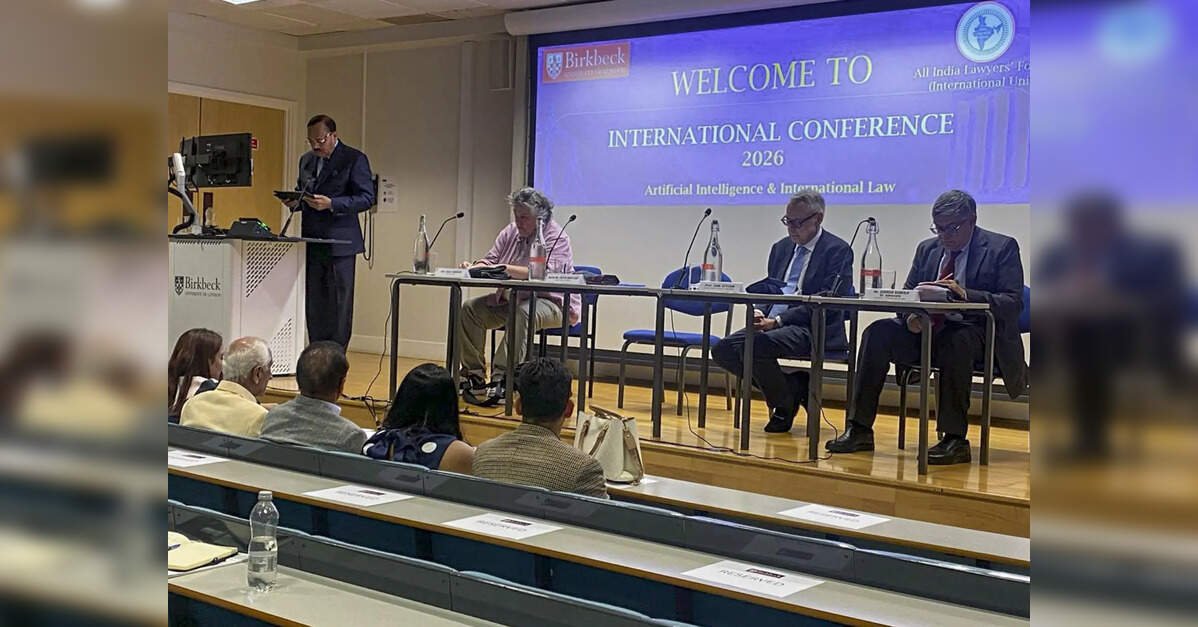
Justice Kant, who visited the Queen Mary University of London on Friday to take part in an event organised by the Centre for Commercial Law, had a wide-ranging discussion and students posed a variety of questions to him on issues, including the judiciary, access to justice and the future of the legal profession.
On a query regarding the judiciary’s role in maintaining public trust in a constitutional democracy, Justice Kant said public trust is never simply given to an institution and it is earned, continuously, through transparency, consistency and the courage to be self-correcting.
“I have said openly that judicial strength does not come from the appearance of infallibility. Institutions grow stronger when they remain open to learning and correction,” he said.
The CJI said in a constitutional democracy, the judiciary is the last line of accountability, but it must itself be accountable to the Constitution and the people it serves.
“That is why I have pressed for a uniform national judicial policy, for predictability and coherence ultimately breed trust. When courts speak with one voice on fundamental questions, citizens can plan their lives around the law. That is what the rule of law actually requires,” he said.
On being asked about the most important role of the judiciary in a modern democracy, Justice Kant said the judiciary’s foremost duty is to ensure that the principles enshrined in the Constitution are not mere words on parchment, but living guarantees that uphold liberty for every citizen.
He said the judiciary is entrusted with the sacred responsibility to secure the rights of people, particularly the marginalised and voiceless, against any excesses or encroachments.
“But I would add something that is often overlooked, and has been on my personal agenda since day one — that the judiciary must not only be the guardian of rights, it must be accessible enough for that guardianship to be real. A court that protects rights only for those who can afford to litigate is not fulfilling its constitutional function. It is merely performing it,” he said.
Responding to a query on how technology is changing the future of courts and access to justice, the CJI said one of the most important contributions of technology has been in expanding access to justice.
“Ultimately, I envision a future in which technology serves as an enabler of justice — making courts more accessible, proceedings more efficient and institutions more transparent — while preserving the fundamental human values that underpin the rule of law,” he said.
Justice Kant said the challenge before the judiciary is to embrace innovation without losing sight of the constitutional commitment to fairness, accessibility and equal justice for all.
Responding to a question as to what does justice mean to him personally, he said it is indeed a profound question and one to which there can never be a single or definitive answer.
“What is justice? Is it retribution — an eye for an eye? Is it the mechanical application of legal rules exactly as they appear in statute books? Or is it something more nuanced, akin to the wisdom often associated with King Solomon’s judgment, where the law is applied with an understanding of human realities?” he said.
The CJI said in his view, justice lies somewhere between these extremes.
“A judge must remain anchored in the law, while exercising the degree of discretion that the law permits,” he said.
Justice Kant said the challenge lies in striking the right balance between consistency and flexibility, between principle and pragmatism, between objectivity and human considerations that every case inevitably presents.
“For me, that is the essence of justice. It is the ability to walk the fine line between objectivity and subjectivity,” he said.
The CJI also answered a question about the challenges the society presents to the legal system today.
“There are several, but I will name the three I consider the most consequential for our times. The first, and this is true for the Indian subcontinent especially, is the crisis of volume,” he said, adding that the second challenge is speed against the claims of justice.
“There is enormous pressure on legal systems to deliver quick outcomes and that pressure is not always wrong, for justice delayed is justice denied. But speed that sacrifices careful reasoning produces its own damage and that trade-off must be navigated with honesty,” he said.
The CJI said technology is reshaping how disputes arise, how evidence is generated and how courts must function.
He said seeing litigants leave the courtroom with a genuine sense that they have been heard and that justice has been done is, for him, the most rewarding aspect of being a judge.
The CJI said India’s jurisprudence has evolved significantly since independence and while the country has retained many of the strengths of the common law system, “we have also developed a distinctly Indian constitutional and legal identity”.
“Increasingly, our courts have sought to interpret and apply legal principles in a manner that reflects India’s unique social realities, cultural diversity and constitutional aspirations, which we refer to as swadeshi jurisprudence,” he said.


