



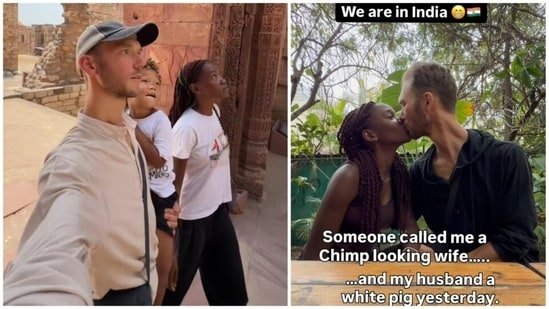
Madina and Sebastian, travel content creators behind the joint Instagram account, The Freidank Family, have opened up about the bittersweet realities of documenting their journey across India. Also read | Singapore woman says ‘India gets so much bad publicity online’, documents ‘honest experience travelling in north India’
While exploring the country with their three-year-old child, the interracial couple — hailing from Tanzania and Germany — recently encountered online abuse, sparking a wider conversation about, culture, racism and digital empathy.
‘Referring to us as cheap, pig and chimp’
In a May 31 Instagram post, the family shared a serene video of themselves seated together in India, contrasted sharply by the text overlaying the clip: “We are in India. Someone called me a chimp-looking wife… and my husband a white pig yesterday. It made us think…”
The hostile remarks reportedly surfaced after the couple uploaded a video of their toddler reacting fearfully to a street performer dressed as the ‘Laughing Buddha’. According to the couple, the innocent depiction of a child’s natural hesitation was misconstrued by some people as disrespect toward Indian culture.
Instead of responding with anger, Madina and Sebastian used the moment to offer a heartfelt, proper introduction to their community. “Someone somehow got offended and commented names referring to us as cheap, pig and chimp,” the couple explained in the caption, adding, “It made us think: maybe people don’t really know who we are. Maybe that’s why comments like this appear, because they don’t know our names, our story, or our purpose.”
The Freidank Family has been nomadic for several months, recently traversing Sri Lanka and Nepal after exploring diverse regions like Indonesia, Ecuador, South Africa, Malaysia, Cyprus, and Mauritius. They say that for them, travel isn’t just about sightseeing — it is an ongoing search for a place to eventually call home. “Right now, we’re in India, and this is home for us because it’s where we eat, sleep, and share our family moments,” they wrote.
Addressing misconceptions and stereotypes
Beyond the racist slurs, the content creators highlighted the persistent financial stereotypes and xenophobic rhetoric directed at them, noting they frequently receive comments telling them to ‘go back to your country’ or accusing them of travelling on ‘US aid funds’. The couple countered these assumptions by highlighting that they travel transparently on a budget to provide representation for other global, multicultural families.
They said, “Before leaving negative comments, please consider yourself in our position. If you heard or saw something like this about your family, how would it feel? Not every experience we share is intended to offend, criticise, or bring down a country. We share our experiences honestly, so other travellers, parents, interracial families, or families travelling on a budget can learn, relate, or simply enjoy our journey.”
They dismissed the notion that they are utilising controversial engagement tactics, adding, “And guys, we are not in India for views. It just happens that we love India, and you guys don’t even have to reciprocate the love… it’s unconditional.”
‘Ashamed and disappointed’
The couple’s vulnerability prompted an influx of messages, primarily from Indians eager to distance their culture from the toxic behaviour of online trolls. “I’m sorry on behalf of the people who treated you like this!” wrote one Instagram user.
Another added: “I am so so sorry!!!!!!! I can guarantee you this is not who we are! That’s not the thought the majority of Indians hold!! Again, I am ashamed and disappointed!! Please don’t hold this thought for all of us!!!”
However, the comments section also mirrored the cynical side of internet culture, where some Instagram users accused the vloggers of fabricating or inflating the negative experiences to capitalise on high-engagement ‘rage-bait’ algorithms. One skeptical Instagram user commented, “Things that never happened. If views aren’t coming in, just put India down and voila. The account starts getting views and engagement.”
Despite the friction, Madina and Sebastian’s response underscores a growing challenge for modern travel creators: navigating the thin line between documenting authentic cross-cultural experiences and managing the volatile, sometimes prejudiced reactions of a global digital audience.
Note to readers: This report is based on user-generated content from social media. HT.com has not independently verified the claims and does not endorse them.
This article is for informational purposes only.


