






A 40% increase in common area maintenance (CAM) charges at Noida’s Cleo County housing society has triggered multiple protests by its residents since September 5, putting the spotlight on a wider problem that has surfaced repeatedly in India’s large gated communities about what happens to maintenance, common funds and shared facilities after homebuyers take possession.

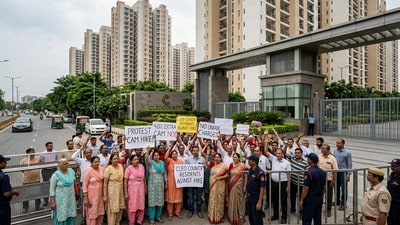
A similar dispute has been running for weeks in Gurugram’s Sector 37D. HT reported on August 24 that residents of BPTP’s Park Serene, Park Generation and Park Spacio said CAM charges had risen from ₹3.57 to ₹4.27 per sq ft, a roughly 20% increase. They also alleged that the builder charged a 20% management fee on top of another 5% levied by a private maintenance agency. Residents have sought handover of management to their residential welfare associations (RWAs).
BPTP’s maintenance arm, Business Park Maintenance Service, has, however, rejected the allegations. It said the agencies managing the condominiums had shared supporting documents and expense details with residents, and that it had been engaging with the RWAs on handover for more than four years.
Cleo’s dispute is, however, a little different. Close to 58% of unit owners are opposing the formation of an Apartment Owners’ Association (AOA), citing many of the residents being senior citizens, but are seeking a third-party forensic audit, disclosure of the Interest Free Maintenance Security (IFMS), safeguards for the sinking fund and greater resident involvement in maintenance decisions.
A builder spokesperson said the CAM increase was unavoidable because of higher minimum wages and material costs, including some linked to the West Asia crisis. More than 70% of CAM costs in such complexes typically comprise salaries, the spokesperson said.
“There were no maintenance fee hikes for the first seven years despite 14 statutory minimum wage increase cycles,” the spokesperson said, adding that audited books had been furnished to residents through open fora, rejecting the allegation of lack of transparency.”
Central law and state versions
The RERA act 2016, introduced by Parliament and adopted by states with their modifications, governs India’s real estate sector with a focus on consumer protection and compliance, mandating formation of an association and eventual handover, but maintenance charges remain largely under state-specific laws.
In Uttar Pradesh, the regulator’s position is that apartment owners cannot simply opt out of forming an AOA once the statutory conditions are met.
“It is the joint responsibility of the developer and the home buyers to get AOA registered,” said Sanjay R Bhoosreddy, chairman of the Uttar Pradesh Real Estate Regulatory Authority (UP RERA). He said formation is mandatory under the rules framed in 2011 under the Uttar Pradesh Apartment Ownership Act, 2010, once the prescribed completion formalities are over.
Where either side fails to act, Bhoosreddy said, the other can approach the vice-chairperson of the development authority or the district magistrate over non-compliance.
Once formed, the association also has a role in determining maintenance charges. Bhoosreddy said its general body would decide the rates by majority and the decision would bind the owners. On the IFMS issue, regarding how it is being managed, raised by Cleo residents, he said UP RERA’s 12th amendment to its General Regulations, notified in July 2026, has now laid down how the fund is to be collected, invested in fixed deposits and transferred to the residents’ association at handover.
A pan-India problem
Not only these two cases, there have been multiple instances this year alone.
Recent RERA orders also show how disputes over maintenance, funds and common facilities are reaching regulators. In Karnataka, residents of New Haven Bengaluru Phase 1 complained, among other things, that the promoter had retained corpus and maintenance funds and common project assets and had not rendered the relevant accounts. In its June 3, 2026, order, K-RERA directed the promoter to transfer the land khata, utility meters, corpus fund and balance escrow account to the authorised association and render maintenance accounts.
In Telangana, residents of Balaji Elegancia approached TG-RERA over promised common amenities that remained incomplete despite the project’s declared completion date. In its May 4, 2026, order, the authority relied on an Engineering Staff College of India inspection and directed the promoter to complete the pending works, with lapsed deadlines to be met within 60 days.
The legal framework places obligations on the developer while maintenance remains under its control, said advocate Mayanka Dhawan, who handles such cases before the Delhi High Court, the National Consumer Disputes Redressal Commission and other tribunals. Under Section 11(4)(d) of the Real Estate (Regulation and Development) Act, 2016, a promoter must maintain essential services “on reasonable charges” until an association of allottees takes over, she said. Section 11(4)(e) requires the promoter to enable formation of the association, while Section 17 deals with handover of common areas and documents.
Also Read: UP RERA mandates transfer of IFMS corpus to RWAs at project handover; new rules explained
Dhawan said, “Any substantial revision in maintenance charges should ordinarily be supported by the underlying expenditure and transparent accounts”. At the same time, residents are obliged under Section 19(6) of RERA to pay legitimate maintenance charges, she said.
Need for national standards
But these obligations do not currently translate into one uniform system for maintenance charges across the country, said a member of the Union government’s central advisory council on RERA, speaking on condition of anonymity. The council, headed by Union minister for housing and urban affairs Manohar Lal Khattar, has discussed the issue, the member said.
“Deliberations are on how to make the RERA framework more standardised across the country to reduce such disputes, as currently maintenance-charge issues are primarily governed by state-specific apartment laws,” the member said.
Also Read: ₹4 lakh maintenance dues”>Mohali: RERA directs flat owner to pay ₹4 lakh maintenance dues


