



New Delhi


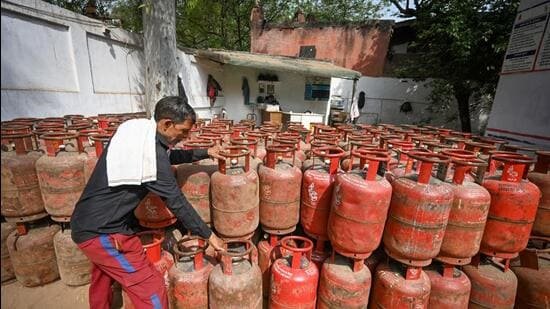
The Delhi government on Thursday increased the allocation of 19kg commercial cylinders from 20% to 50% of the regular supply—from 1,800 to 4,500 cylinders, in effect—officials said, after the ministry of petroleum and natural gas directed uninterrupted availability for key sectors across the national capital.
The food and supplies department said that the enhanced allocation is effective immediately and is designed to meet demand from essential services, commercial establishments and vulnerable groups.
Similar to the initial order on March 14 that started a 20% allocation, the revised distribution framework divides the total daily allocation into seven priority categories, with the hospitality and food sector receiving the largest share.
Hotels, restaurants, dhabas, food processing units and dairies have been allocated 3,375 cylinders per day, accounting for 75%of the total supply, up from a previous allocation of 762 cylinders or 42% share.
Essential services, including educational and healthcare institutions, transport hubs ,such as bus stands, railways and airports, will continue to receive their full requirement of 225 cylinders, which is 5% of the total supply. Government institutions, public-sector undertakings, industrial canteens, community kitchens, caterers and banquet services will get a 5% allocation, amounting to 225 cylinders per day, which is down from 236 cylinders under previous orders.
Meanwhile, industrial units such as dry-cleaning, packaging and pharmaceutical facilities will receive 45 cylinders a day, accounting for 1% of the total, while another 5%, or 225 cylinders a day, has been earmarked for sports facilities, stadiums and other categories.
In addition, a protected social allocation has been introduced for migrant labourers. Under this category, 18 commercial cylinders—equivalent to 684 5kg cylinders—will be supplied daily, accounting for 4% of the total allocation. Officials said this measure is intended to provide relief to migrant workers who rely on smaller cylinders for daily use.
The government said the distribution is based on average consumption recorded over the past three months, in line with central guidelines, with priority given to critical and high-demand sectors.
Food and supplies minister Manjinder Singh Sirsa said the increase would help stabilise supply and address concerns regarding availability. “The situation is fully under control. Supplies are normal and flowing smoothly. I request people not to believe or spread baseless rumours. Consumers will face no issues,” he said.
To prevent hoarding and black-marketing, the government has deployed 70 joint enforcement teams, comprising officials from the weights and measures department, and the food and supplies department. Violations will attract action under the Essential Commodities Act, 1955, the LPG Distribution Order, 2000, and the Bharatiya Nyaya Sanhita, 2024, Sirsa said.
Officials said that the department is maintaining regular coordination with oil marketing companies to monitor supply levels. Indraprastha Gas Limited (IGL) is also submitting weekly progress reports on piped natural gas (PNG) supply, which complements LPG distribution in the city.
The public works department (PWD) has waived road restoration charges for IGL to lay pipelines for PNG connections until June 30, according to an official order on Wednesday. The order aims to expedite PNG roll-out across Delhi.
It directs authorities to grant road-cutting permission within 24 hours of receiving complete requests and ensure timely restoration of affected stretches. “Road Restoration Charges applicable for laying of IGL pipelines for PNG connections are hereby waived for a period of three (03) months,” the order read.
Officials have been instructed to ensure strict compliance with the directions with immediate effect.


