


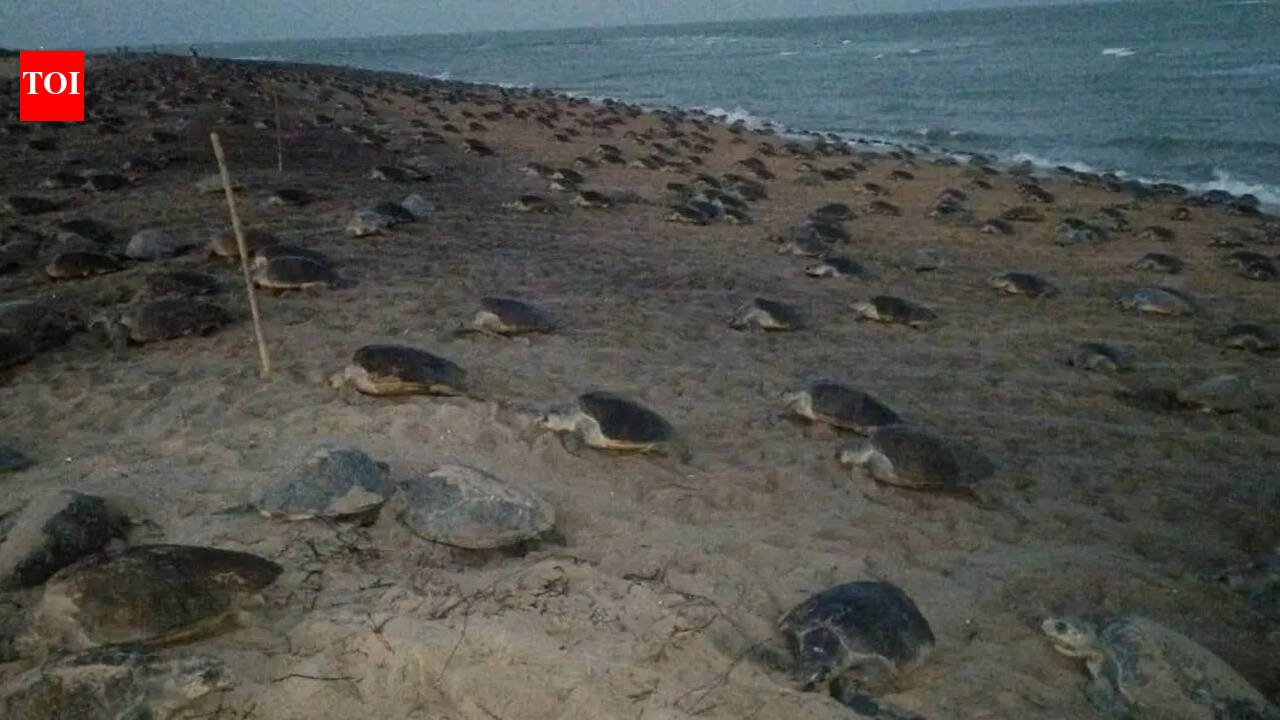
Kendrapada: Large stretches of beach on Nasi-1 and Nasi-2 islands within the Gahirmatha Marine Sanctuary have been lost to severe coastal erosion, delaying the much-awaited mass nesting of Olive Ridley sea turtles at the world’s largest rookery.While over 2 lakh turtles nested at Rushikulya beach in Ganjam between March 14 and 17, the absence of nesting activity at Gahirmatha has baffled researchers and environmentalists. Last year, more than 6 lakh turtles had laid eggs between March 5 and 10 across Nasi-1, Nasi-2 and Eakakulanasi.“Both the uninhabited islands of Nasi-1 and Nasi-2 in the Bay of Bengal were famous for nesting of the sea turtles and islands have been facing coastal erosion problems for more than two decades. Forest officials noticed submergence of large areas of both islands recently,” said Kapilendra Pradhan, forest range officer of Gahirmatha Marine Sanctuary.“Both Nasi-1 and Nasi-2 have been facing erosion for over two decades, with significant submergence observed recently,” said range officer Kapilendra Pradhan. The beaches have also become steep, making it difficult for turtles to access nesting grounds.A decade ago, Nasi-1 stretched 1.5 km but has now shrunk to just 100m. Similarly, Nasi-2 has reduced from 2 km to 300m. Due to constant erosion, both Nasi-1 and Nasi-2 beaches are now vertically steep of 90-degree, as a result of which it becomes difficult for Olive Ridley sea turtles to reach the beach for laying eggs.“Five years ago, 1.5-km-long Agranasi island, another nesting site of sea turtles, completely vanished in the sea due to erosion. However, last year, Eakakulanasi beach within the sanctuary witnessed significant accretion, resulting in a wider, stable sandy beach covering 5km long for which turtles will lay eggs on Eakakulanasi beach soon,” Pradhan added.The 12-km long Gahirmatha beach had faced major obstacles due to changing patterns of the beach. “The beach extending into the sea in the north of Eakakulanasi in Gahirmatha has been split into several parts in the 1982 cyclone. Therefore, the higher rate of congregation of the Olive Ridley sea turtles has been shifted to two tiny Nasi-1 and Nasi-11 islands,” said Hemant Rout, an environmentalist.“National Centre for Coastal Research under Ministry of Earth Sciences has undertaken a comprehensive scientific study on National Assessment of Shoreline Changes along Indian Coast, analysing multi-spectral satellite images along with the field-surveyed data. As per this study 128.77kms (23.4 %) of Odisha’s shoreline is stable and 140.72 kms (25.6 %) has faced erosion between 1990 and 2018,” said the minister of environment, forest and climate change, Kirti Vardhan Singh in Rajya Sabha on Aug 22, 2025.
