


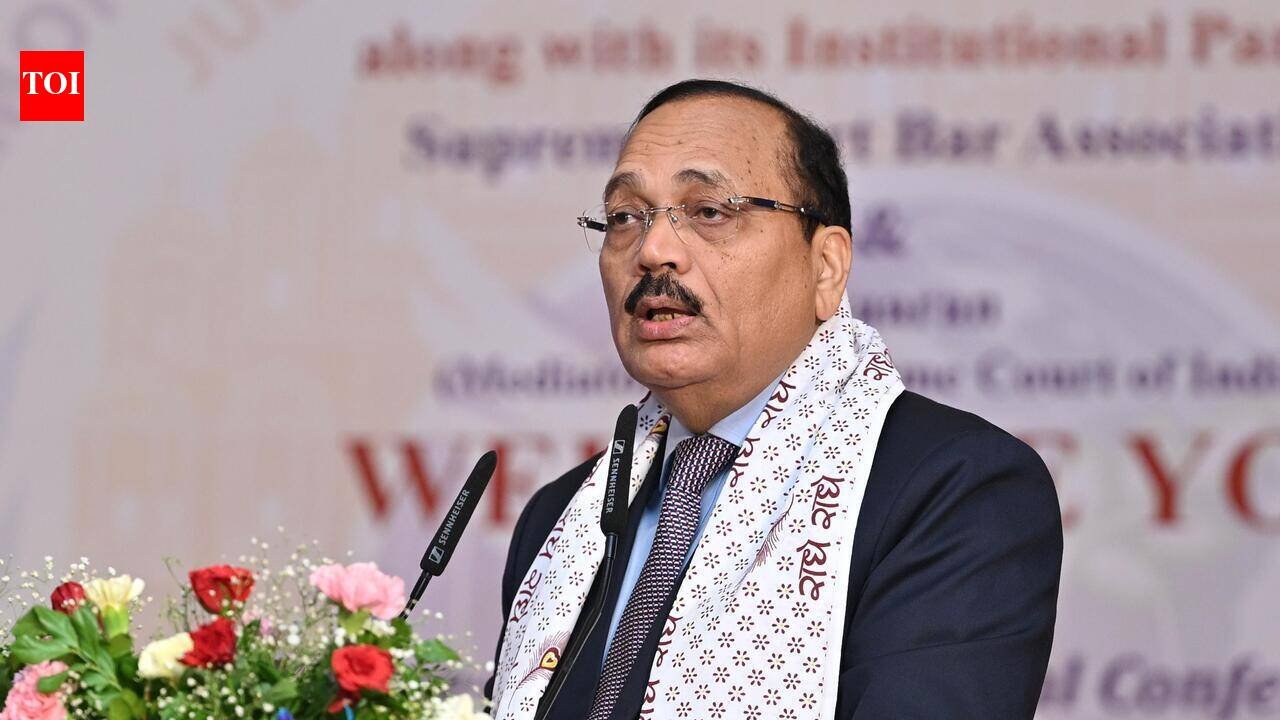
Jaipur: Chief Justice of India Justice Surya Kant said Saturday mediation is rooted in India’s civilisational ethos and legal traditions, and is “in the veins and history of India”, not a concept introduced by modern law.Addressing the second day of the three-day Commonwealth Peace Mediation Conference in Jaipur, Justice Kant said rule of law does not require every dispute to end in court. Its real purpose, he said, is to ensure accessible, dignified, affordable and meaningful justice for every citizen.Justice Kant said litigation usually focuses on the legal “positions” of parties, while mediation identifies their underlying “interests” and works towards a mutually acceptable solution.He illustrated the point with the “orange story”, in which two sisters fought over an orange and their mother cut it into two equal halves. It later emerged that one sister needed only the peel to bake a cake, while the other wanted only the juice. “Litigation decides who owns the orange, while mediation tries to understand who actually needs what,” he said, adding that both could have received exactly what they wanted had their real interests been identified early.The CJI said the philosophy of mediation is reflected in ancient Indian texts and traditions, including the Ramayana, the Mahabharata and Kautilya’s Arthashastra, where dialogue and consensus were preferred over confrontation. Citing Kautilya’s four principles of governance — Saam, Daam, Dand and Bhed — he said Saam, or persuasion through dialogue, was placed first, showing India’s preference for reconciliation before coercion.He also referred to ancient institutions such as Kul, Shreni and Gan, where communities resolved disputes through consensus before approaching the ruler.Recalling Mahatma Gandhi’s reflections on his legal career, the CJI said Gandhi considered helping parties reach amicable settlements the most satisfying part of his practice. “Mediation was flowing in our veins long before Mediation Act, 2023 came into existence,” he said.The CJI also said confidentiality remains central to mediation, especially in commercial disputes, where parties must feel safe to speak openly. He said the Mediation Act, 2023 had, for the first time, created a comprehensive legal framework for mediation in India.He added that mediation centres set up by the Supreme Court, high courts and district courts have strengthened the institutional ecosystem. He also referred to the “Mediation for the Nation” campaign launched during his tenure as executive chairman of the National Legal Services Authority, saying it was aimed at turning mediation into a people’s movement.Speaking at the inaugural session earlier in the day, Supreme Court judge Justice Vijay Bishnoi said mediation had long been part of India’s social fabric through village panchayats, community elders and traditional dispute-resolution systems. “Litigation creates a win-lose situation, whereas mediation creates a win-win solution,” he said.
