



Heavy rainfall has once again exposed gaps in coordination between civic agencies and raised questions over how the city manages stormwater.

The immediate problem is not merely clogged drains. In several parts of the state capital, drains carrying rainwater have been connected to sewer lines, even though the sewer network is designed primarily to carry sewage.
A private agency involved in sewer-related works in Lucknow has identified 1,383 such points, where drain connections to sewer lines are contributing to blockages.
The agency’s data shows that Zone 2 has the highest number of such points at 434, followed by Zone 6 with 360, Zone 3 with 205, Zone 1 with 228, Zone 4 with 100 and Zone 7 with 56.
The agency said these connections allow rainwater, plastic waste and other debris to enter the sewer network. This increases the load on sewer lines and contributes to repeated choking, it said.
The agency said authorities should connect residential stormwater drains to major drainage channels instead of sewer lines so that rainwater can move through a designated network and eventually be discharged safely.
The problem affects areas including parts of Mahatma Gandhi Ward, Hazratganj, Nazarbagh, Ram Mohan Rai Ward and Vikramaditya Marg.
In Lalbagh, Bhuhar and Vrindavan Colony, residents face another problem: drains exist but do not have proper connections to pipelines or a larger drainage network. As a result, rainwater accumulates on roads and remains there.
The agency claimed it had repeatedly written to the Jalkal department about the faulty connections but alleged that no effective corrective action had followed.
The problem becomes more acute in commercial areas such as Charbagh. The agency said sewer-cleaning teams have found plastic waste and oil in clogged lines, particularly around hotels and restaurants, where waste can enter the drainage network along with rainwater.
Jal Kal general manager Kuldeep Singh remained unavailable for comment despite repeated attempts by HT to contact him.
Heavy rainfall, heavier waterlogging
Several parts of Lucknow witnessed heavy waterlogging after the city experienced hours of rainfall.
The stretch from Power House to Kanpur Road was severely waterlogged, while Sector K in the Ashiana area also witnessed significant accumulation of rainwater.
Similarly, several lanes in Jankipuram Extension remained waterlogged after rainwater accumulated following the rainfall. Chinhat, another key residential locality, also witnessed heavy waterlogging, with several routes filled with rainwater.
Mayor oblivious to problems
Mayor Sushma Kharkwal said she was unaware of the number of locations where the drains were connected to sewer lines. After HT raised the issue, she sought the data and said she would convene a meeting if the connections were found to exist.
However, she did not respond to questions on the agency’s claim that it had repeatedly written to the Jalkal department or why the alleged problem had remained unresolved.
Cave-ins, road cracks surface
The rainfall also exposed weaknesses in infrastructure where sewer-related work is underway.
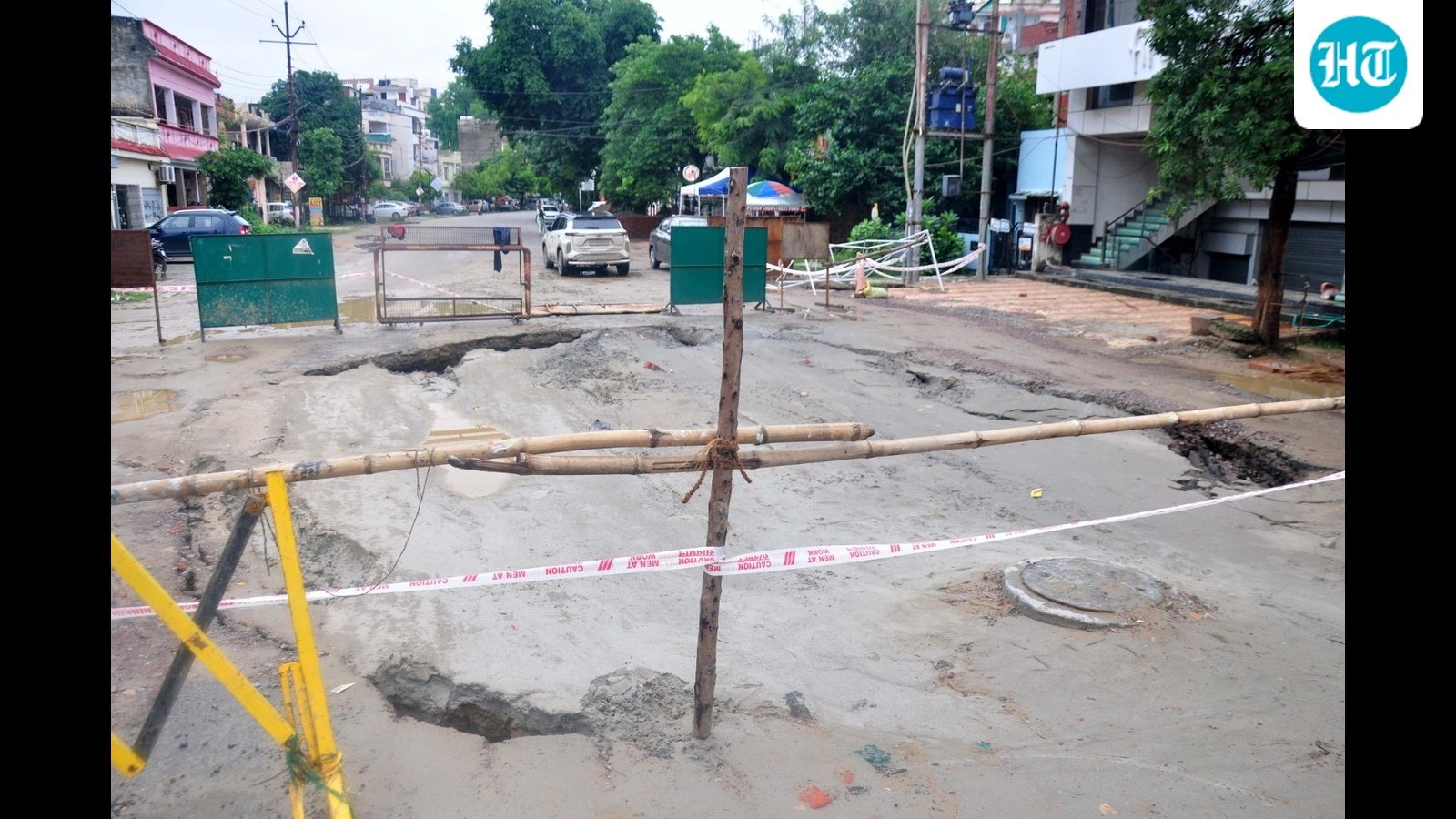
Road-depression and cave-in-like conditions emerged at two prominent locations, including a route near the divisional commissioner’s office and another road leading towards Chowk where the stretch caved-in.
PWD executive engineer Satyendra Nath clarified that the incident near the divisional commissioner’s office should not be described as road subsidence or a road cave-in. He said the upper crust/layer of the road had come off two days ago, following which the damaged portion was filled to make the stretch motorable as the chief minister’s fleet was scheduled to pass through the area.
“We decided not to take any chances and undertook a proper repair by digging up the affected portion with a JCB,” Nath said.
In Vikas Nagar, a road depression measuring around 9 metres in width and 9 metres in length developed on a stretch where sewer-related work is underway.
The incident assumes significance because Vikas Nagar had witnessed a major sinkhole on December 15, 2024, when a cavity measuring around 20 feet by 27 feet severely disrupted movement and created safety concerns.
Cracks developed on a third location on the main road close to Urmila Van, leading to the Kukrail flyover.
₹8 lakh repair washed away
The rain also exposed the failure of a recently completed repair project at the Lucknow Municipal Corporation’s Zone 2 office.
The civic body spent nearly ₹8 lakh repairing the building about four months ago, but rainfall caused water to leak through the roof. Rainwater reportedly reached the city engineer’s room, disrupting office work.
A video showing water leaking inside the building was circulated on social media. HT could not independently verify the video.


