






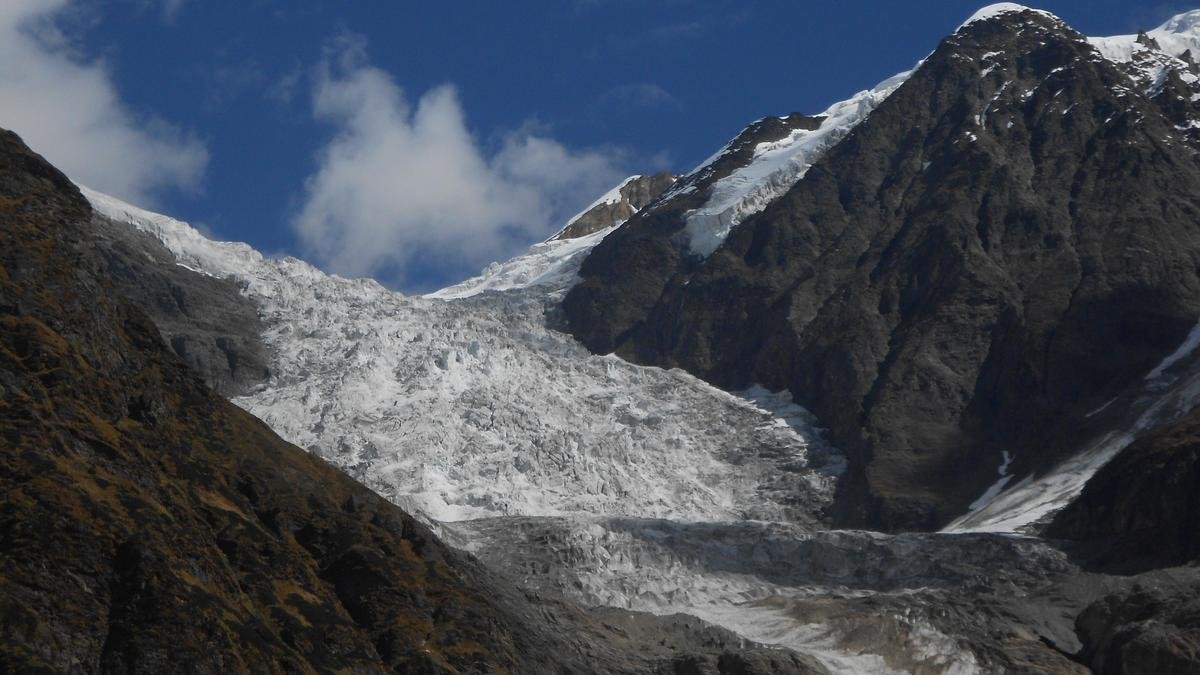
Chinese experts have pointed to a clear link between rising temperatures, which have led to significant glacial retreat on the Tibetan Plateau, and the deadly August 26 glacial collapse on the Nepal-China border, warning of growing risks from more glacial flood outbursts, with more than 14,000 glacial lakes mapped on the plateau.
| Photo Credit: WIKIMEDIA COMMONS
Chinese experts have pointed to a clear link between rising temperatures, which have led to significant glacial retreat on the Tibetan Plateau, and the deadly August 26 glacial collapse on the Nepal-China border, warning of growing risks from more glacial flood outbursts, with more than 14,000 glacial lakes mapped on the plateau.
According to the most recent inventory of glaciers measured by Chinese researchers on the Tibetan Plateau, the plateau’s glacier area had fallen to 39,000 square kilometres, down from 44,000 square kilometres and 51,000 square kilometres in two previous studies conducted over a period of six decades.
“The retreat has been particularly pronounced in the southern part of the plateau. In areas including the Gangdise Mountains [Transhimalayan range that includes Mount Kailash], Nyenchen Tanglha Mountains, and Himalayas, glaciers have shrunk by about 40 percent over the past 60 years,” Kang Shichang, director and researcher at the Institute of Mountain Hazards and Environment of the Chinese Academy of Sciences in Chengdu, in the southwestern province of Sichuan, was quoted as saying by the official People’s Daily on Monday (September 7, 2026).
Across the entire plateau, he said, glaciers had shrunk by 24%. The melting of glaciers had “directly led to a substantial increase in both the number and size of glacial lakes across the plateau.”
“The main driver of this dramatic change is global warming,” he said.
The report said this retreat had “greatly heightened the risk of glacial lake outburst floods, landslides, and other disasters”. “There are now more than 14,000 glacial lakes on the Qinghai-Tibet Plateau, covering a combined area of over 1,100 square kilometers. Overall, these lakes continue to expand rapidly, with associated disaster risks steadily accumulating,” the report noted, adding that “climate change is continuously reshaping the cryosphere and its ecosystems, environment, and disaster patterns worldwide.”
What will be of particular concern to India and Nepal is that researchers found the “most pronounced growth” in glacial lakes was observed in the part of the Himalayas close to China’s “southern borders”, according to Nie Yong, another researcher at the Institute of Mountain Hazards and Environment, with the area of glacial lakes in the region expanding by an average of 1% annually.
Experts say the rising risks have further underlined the need for both closer mapping of glacial lakes and sharing of data, given the likely significant impact from flooding on downstream regions.
Published – September 08, 2026 07:37 am IST


