


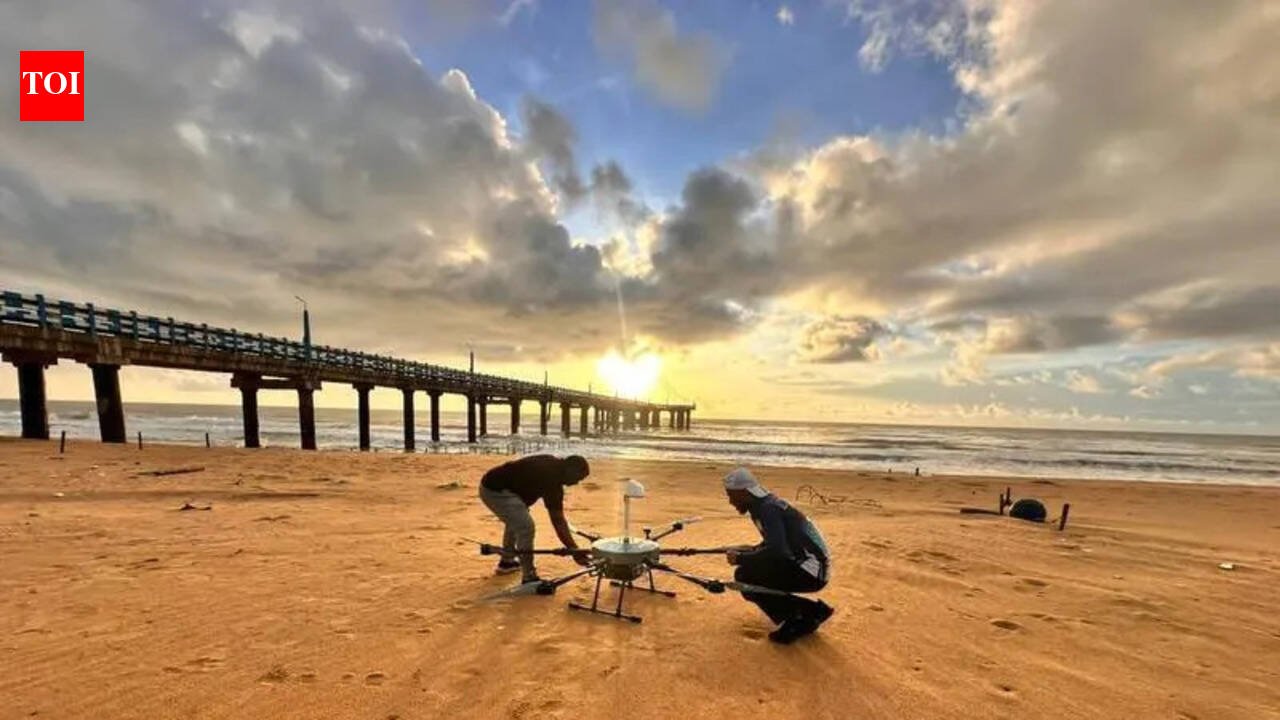
Chennai: Researchers in the city have developed and tested a high-altitude hexacopter drone that could improve atmospheric observations for weather forecasting and climate studies, including research on heatwaves, and cyclonic systems, and monitor air pollution.Developed by National Institute of Ocean Technology (NIOT), the unmanned aerial vehicle is designed to collect atmospheric and air-quality data from altitudes of up to 5km. The lightweight 16kg drone was specially engineered to withstand low-pressure, thin-air conditions and wind speeds of up to 50kmph at high altitudes.The drone recently completed field trials at NIOT’s seafront campus along the Pamanji coast, where it collected atmospheric and pollution data up to 4km above ground level. The project was developed under the Centre’s Mission Mausam programme aimed at strengthening India’s weather observation systems.“This drone is mainly meant for high-altitude vertical measurements of the atmosphere at a fixed location. With this, we can simultaneously study both meteorological and pollution parameters with more accuracy and precision,” said R Srinivasan, senior scientist, ocean electronics group, NIOT.Built using carbon composite material, the drone uses customised propellers as conventional systems cannot efficiently operate in low-density air at high altitudes. Researchers also replaced conventional lithium-ion batteries with solid-state batteries to reduce weight and improve endurance. The payload includes sensors to monitor particulate matter (PM2.5), carbon dioxide, carbon monoxide, ozone, nitrogen oxides and sulphur dioxide, besides weather parameters such as air pressure and relative humidity. Srinivasan said the drone is not designed to directly enter cyclones because it cannot withstand intense winds, but can be used to study less intense systems, and for pre- and post-cyclone observations.At present, India Meteorological Department (IMD) relies on expendable radiosonde weather balloons launched twice a day from stations across the country to study atmospheric parameters. Unlike radiosondes that drift with wind direction and eventually burst at high altitudes, the reusable drone can repeatedly carry out vertical atmospheric measurements over the same location. “The drone is not meant to replace radiosonde systems but complement them,” Srinivasan said. “Once the technology is refined and costs are reduced, it can support regular monitoring,” he added.
