



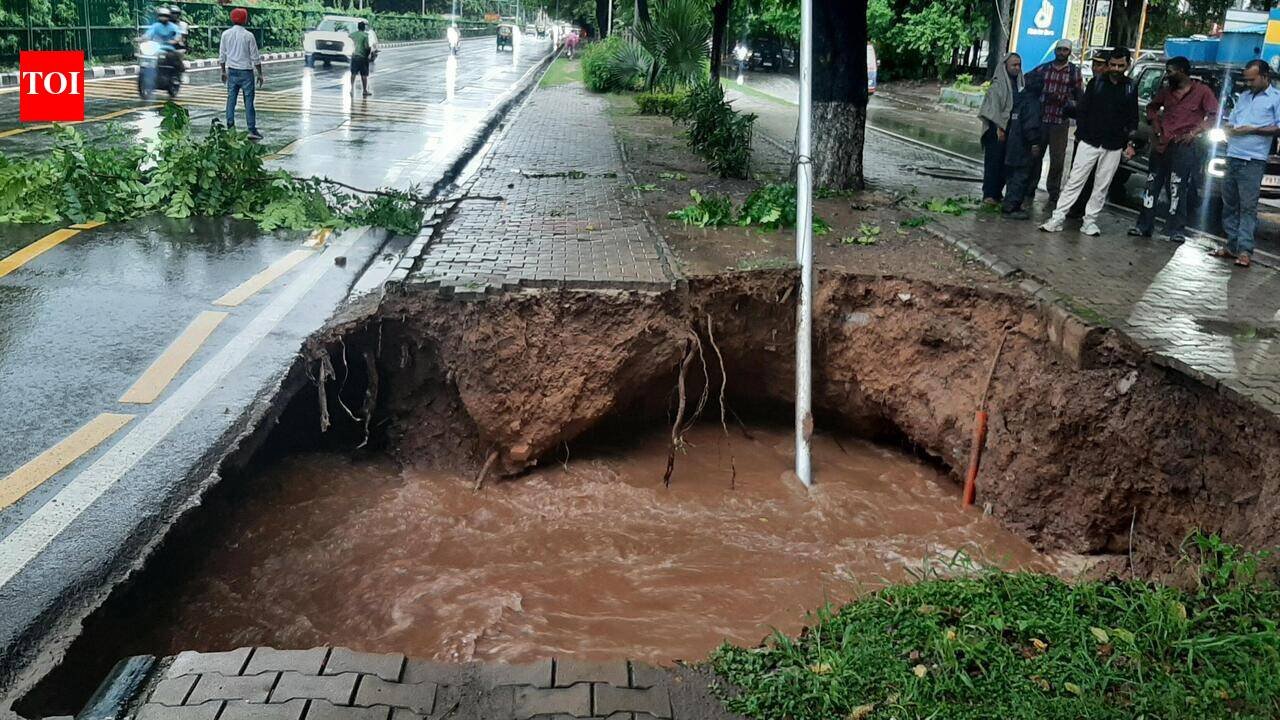
Chandigarh: An evening downpour quickly turned into a citywide ordeal on Tuesday, with roads turning into streams, vehicles crawling through knee-deep water and thousands of commuters stranded in massive traffic snarls. From Sector 17 and 22 to Hallomajra and the city’s peripheral pockets, Chandigarh’s infrastructure buckled under the weight of two hours of intense rain, exposing once again the city’s chronic struggle with waterlogging.Even hours after the rain stopped, several roads, parking lots, parks and residential areas remained submerged, while water entered homes, shops and basements in many localities.The disruption extended across Chandigarh, affecting major roads, markets and residential sectors. In some areas, SUVs stood partially submerged, while elsewhere residents were forced to wade through waterlogged streets to reach their homes.The situation was particularly serious on Madhya Marg near Sector 26, where a portion of the road reportedly caved in. Uprooted trees and snapped branches at several locations, including Sector 22, further narrowed roads and compounded traffic chaos.Commuters trapped for hoursThe flooding soon spiralled into a traffic nightmare during peak evening hours. Vehicles crawled through submerged stretches as motorists struggled to navigate roads hidden under water, while two-wheeler riders faced the risk of potholes and open manholes.Residents questioned the absence of effective traffic management at several vulnerable junctions.“This is not a surprise rain. This is the monsoon. Every year the authorities know which roads and junctions get flooded, yet there is no proper traffic management when the crisis actually happens. We were stuck in traffic with water all around us and hardly any police personnel were visible,” said Yashpal Mehta, a resident of Sector 22.Rajesh Ahuja, a Haryana govt employee and resident of Panchkula, said commuters were left helpless. “We were stuck in traffic for hours. The roads were flooded, vehicles were barely moving and there was hardly any traffic police visible at several places. If this is how the city manages peak-hour traffic during rain, commuters are simply left to fend for themselves,” he said.Neha Sharma, another commuter, said waterlogging at multiple junctions made it nearly impossible to identify alternative routes.Homes, shops and markets bear the bruntThe downpour disrupted business activity and daily life in both residential and commercial areas. In Sector 22, one of the city’s busiest markets, water accumulated around shops and parking areas, while several basements were flooded.Parks across multiple sectors remained inundated and residents in several localities reported water entering their homes.“We pay market fees, taxes and other charges, but every heavy spell of rain leaves the market flooded. Water enters shops and parking areas, and customers stop coming. The same problem returns year after year,” said a shopkeeper in Sector 22.Arvind Khurana, who was stranded in the market area, said, “The parking lot is flooded and the roads outside are under water. This is supposed to be Chandigarh, not a city that comes to a standstill after a heavy shower.”The impact was not limited to the city’s central sectors. Streets in Hallomajra were submerged, making movement difficult for residents attempting to return home from work.Fallen trees worsen the chaosFallen trees and heavy branches at several locations blocked roads and created additional hazards for motorists and pedestrians.Residents expressed concern that congested and blocked stretches could hamper emergency services.“A severely congested road can delay ambulances, fire tenders and other emergency vehicles when every minute counts,” said Pankaj Singla, a resident of Sector 42.Annual monsoon test, familiar resultThe flooding has once again brought the Municipal Corporation’s pre-monsoon preparedness under scrutiny. Every year, the civic body undertakes cleaning and desilting of road gullies and storm-water drains, yet several known waterlogging hotspots continue to flood after heavy rain.Residents argued that cleaning alone cannot compensate for limitations in the ageing drainage network.“Every year there is a pre-monsoon drain-cleaning drive and every year the MC claims it is fully prepared. Then one heavy spell of rain is enough to flood the city. If this is preparedness, what exactly does failure look like?” said Kuljinder Sra, general secretary of the 38-B Residents Welfare Association.He added: “The authorities know the chronic waterlogging points. They know which junctions flood, which markets flood and where traffic comes to a standstill. Yet the same story repeats every monsoon.”‘Heavy rain is no longer an excuse’Residents said heavy rainfall can no longer be viewed as an unforeseen event.“The authorities cannot keep treating every heavy spell of rain as unexpected. The vulnerable locations are known, the drainage shortcomings are known and the traffic bottlenecks are known. What is missing is accountability,” said Rajender Sharma, a resident of Sector 33.A Municipal Corporation official acknowledged that exceptionally heavy rainfall could overwhelm the city’s ageing drainage infrastructure, but maintained that routine maintenance helped water recede more quickly.“In such intense rainfall, any drainage system, particularly an old one, can come under stress. However, regular cleaning and maintenance ensure that roads do not remain waterlogged for long. Work on upgrading the storm-water drainage network is also underway,” the official said.Despite the assurances, several parts of Chandigarh remained waterlogged till late evening, leaving residents to navigate flooded roads and disrupted access long after the rain had stopped.Chandigarh’s core sectors drown, traffic collapsesAn hour-long downpour paralysed Chandigarh’s central Sectors 17 and 22 on Tuesday evening, with rainwater inundating ISBT Chowk to a depth of two feet, entering showrooms in Sector 22 and leaving several vehicles stranded.PGIMER-bound ambulances were stuck along Madhya Marg, including on stretches connecting the city with Panchkula and New Chandigarh.Even as pedestrians and motorists struggled in a city long known for its infrastructure and police patrolling, there was a complete absence of personnel during the crucial period. It rained between 4.30pm and 5.30pm, when several offices close for the day.Choked manholes, meanwhile, made it difficult for the water to drain.The situation was similar on Madhya Marg, with not a single police personnel visible on the stretch from Transport Lights to the IAF Museum light point. Barricades had been placed on the road dividing Sectors 10 and 16, but there was no cop to divert traffic.Shyam, a Sector 45 resident whose motorcycle broke down on the road dividing Sectors 17 and 18, said it was the first time he had seen the city’s infrastructure in such disarray. “MC toh soi padi hai (the MC is sleeping). My motorcycle has broken down. I was coming from PGI. Our expenses are just rising,” he said.Shyam added that police personnel were absent even at the busy IAF Museum light point, at the crossroads of Sectors 8, 9, 17 and 18.The mobile market in Sector 22 saw its worst rainy day of the year. Within half an hour of the rain, water began entering the corridor and basements. The entire parking lot was inundated, with water flowing into corridors and then the shops.In several places, shopkeepers used flex boards, mops and rags to keep the water out. Many people left their cars in parking lots and walked to their destinations. On the roads, motorists were left waiting for the water to recede. Several vehicles attempting to cross ISBT Chowk broke down. In many instances, people were seen trying to manage traffic, helping others and just standing on the road, waiting for help to arrive and the water to recede.


