


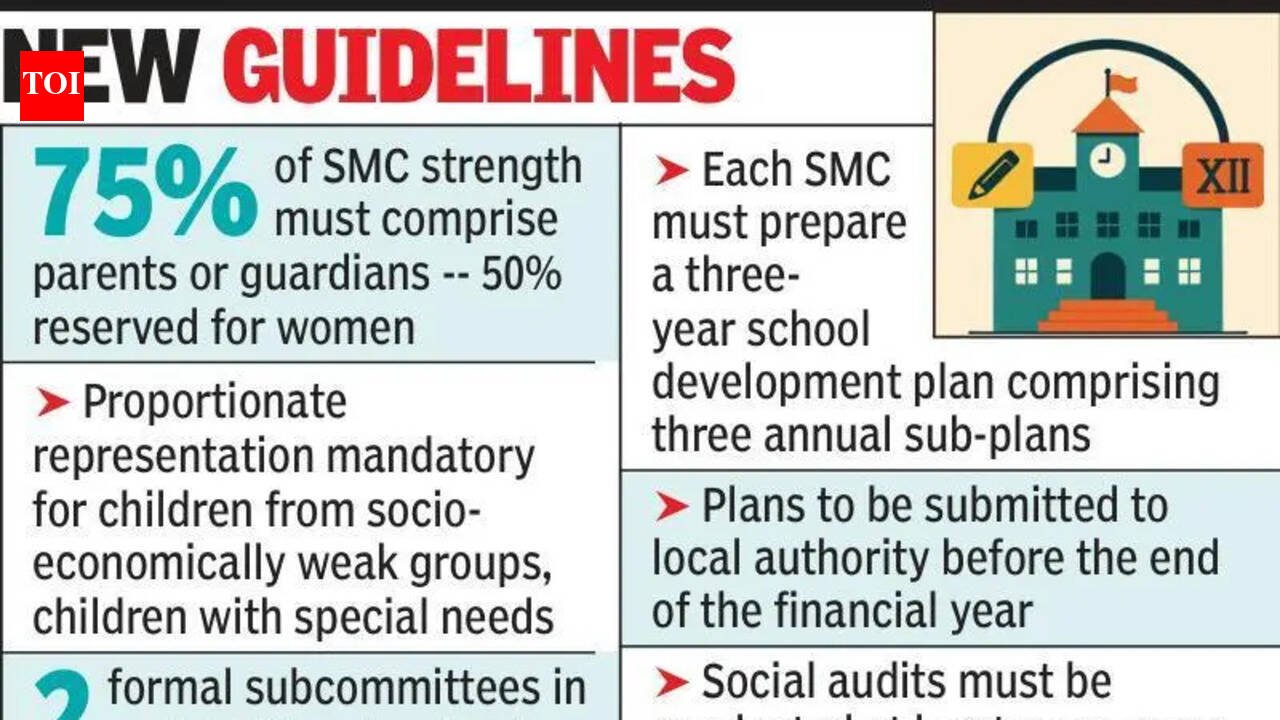
Union govt has issued comprehensive new guidelines for School Management Committees (SMCs), replacing all earlier frameworks with a single unified structure that will now cover every grade from Balvatika to Class 12 — a significant departure from the previous system, where primary and secondary schools operated under separate bodies.The guidelines, issued by the department of school education and literacy (DoSEL) under the ministry of education this month, supersede all earlier SMC and School Management Development Committee (SMDC) guidelines issued under Sarva Shiksha Abhiyan, Rashtriya Madhyamik Shiksha Abhiyan, and Samagra Shiksha frameworks.The most consequential structural change is merger of two-body system into one. Earlier, primary schools had SMCs, while secondary and senior secondary schools operated under SMDCs. Under the new framework, a single SMC will govern all grades, with its size calibrated to enrolment — 12 to 15 members for schools with up to 100 students, 15 to 20 members for schools with 100 to 500 students, and 20 to 25 members for schools with over 500 students.The guidelines mandate that 75% of SMC strength must comprise parents or guardians of enrolled children, with 50% of total membership reserved for women. Proportionate representation has also been made mandatory for children from socio-economically disadvantaged groups and children with special needs.Each SMC will now have two formal subcommittees — an Academic Committee and a School Building Committee — with clearly defined responsibilities. The Academic Committee will oversee learning outcomes, teacher attendance, student progress, and foundational literacy and numeracy goals, while School Building Committee will handle infrastructure planning, civil works, and safety compliance.On financial powers, the guidelines authorise SMCs to directly execute all civil works costing up to Rs30 lakh. Works above this threshold must go through public tender as per central public works department norms, with the SMC participating in all stages of tender finalisation. Each SMC must now prepare a three-year school development plan comprising three annual sub-plans, to be submitted to local authority before the end of the relevant financial year. Social audits must be conducted at least once every academic year.The guidelines also introduce several new compliance requirements. Schools must display information related to Protection of Children from Sexual Offences (POCSO) Act and Internal Complaint Committee prominently. Safety and evacuation drills must be held at least twice a year. SMCs must use PRASHAST app (Pre-Assessment Holistic Screening Tool) to identify children with special needs and facilitate their inclusion.Member tenure has been fixed at two years, with a cap of two consecutive terms. The SMC must be constituted within one month of the start of the academic year, with the first meeting to be held within one week of constitution.
