



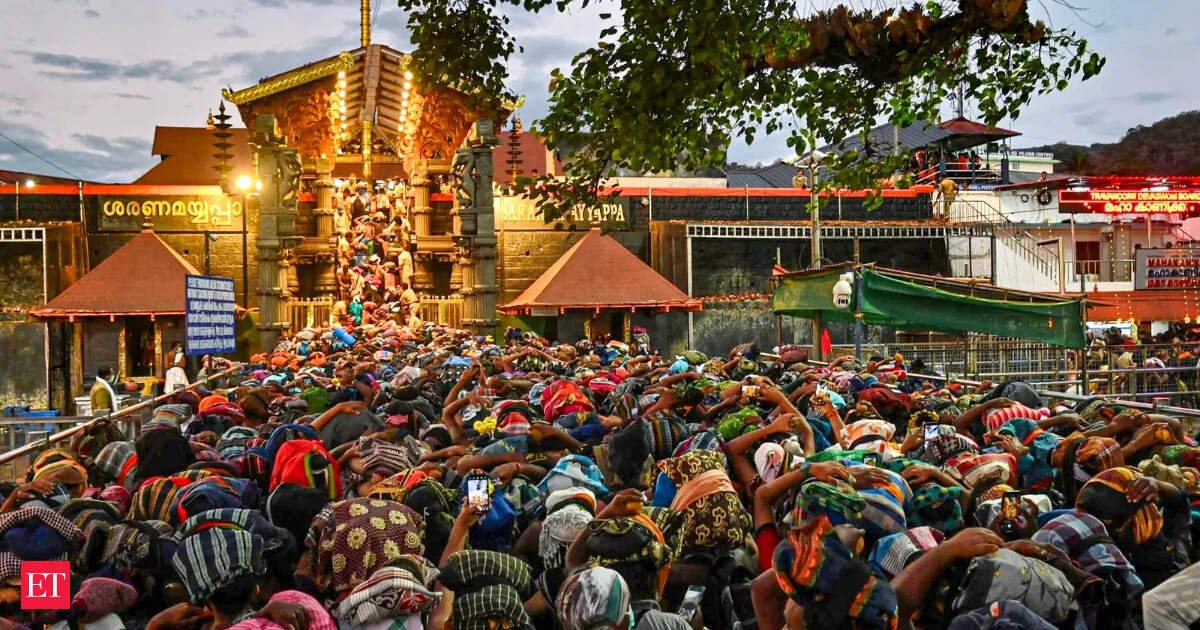
The bench headed by CJI Surya Kant commenced the final hearing on pleas linked to discrimination against women at religious places, including Sabarimala, and on the ambit and scope of religious freedom practised by multiple faiths.
Also Read: Woman can’t be treated as ‘untouchable’ for 3 days: Justice Nagarathna in Sabarimala case
The ruling will have a bearing on the question of whether women of menstruating ages should be permitted entry into the Sabarimala despite a customary bar on such entry.
Mehta argued that the 2018 judgement permitting entry of women of all age groups into the Sabarimala temple was wrongly decided and deserves to be declared a wrong law. He contended that the 2018 ruling requires reconsideration and reversal on legal grounds.
Mehta questioned why those advocating for the entry of women into the Sabarimala temple cite “patriarchy” in their contentions as he submitted that the notion was alien to India. “India has always not only treated females equally, but they have always been treated at a higher pedestal. There are several judgements of the recent past where there is a concept of ‘patriarchal society’ or there are some ‘gender stereotypes’, etc. They were never there. In Indian society, we worship females. The President of India to the Prime Minister of India to the judges of the Supreme Court, we bow down before our female deities. So let us not introduce those concepts of ‘patriarchy’ and ‘gender stereotypes’,” Mehta argued. He objected to an observation made in SC’s 2018 Sabarimala verdict, which equated the bar on women’s entry into the Sabarimala temple to a form of untouchability.
Also Read: Supreme Court of India reopens Sabarimala Temple case ahead of Kerala pollsJustice BV Nagarathna, the sole woman judge on the bench, commented on the “untouchability” observation in the 2018 judgement. “Speaking as a woman, I can say there cannot be three days of untouchability (for a menstruating woman) every month and then on the fourth day (when a period ends), there is no untouchability. Let us go by the hard realities. Speaking as a woman, Article 17 (which forbids untouchability) cannot apply for three days and on the fourth day, there is no untouchability,” Justice Nagarathna orally remarked.
Mehta submitted that restricting a particular gender within a specific age group from entering a place of worship is not discrimination.


