



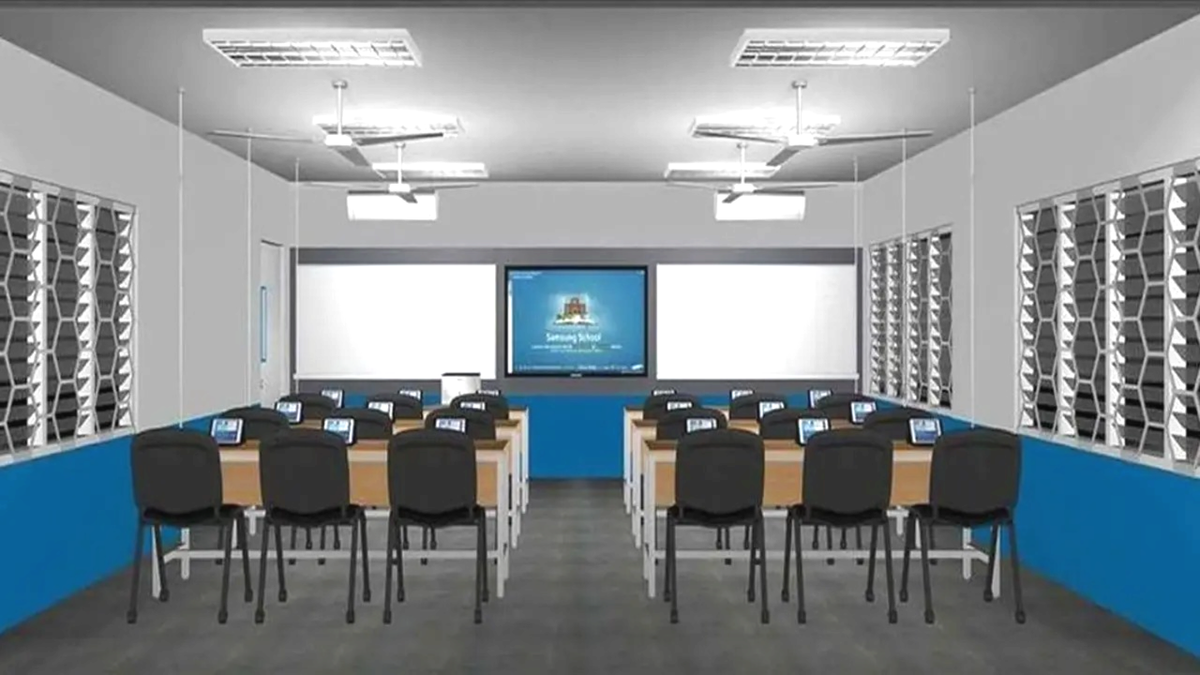
Srinagar, Jul 27: The Union Government has approved 1,915 Information and Communication Technology (ICT) labs and 3,910 smart classrooms for government schools across J&K under the Samagra Shiksha scheme during the five financial years from 2021 to 2026.
The information was shared by Minister of State for Education Jayant Chaudhary in a written reply to a question raised by Members of Parliament Kadiyam Kavya and Appalanaidu Kalisetti, and answered on July 27.
According to the ministry, J&K received approval for 408 ICT labs during 2021 to 22, 203 in 2022 to 23, 172 in 2023 to 24, 598 in 2024 to 25 and 534 in 2025 to 26, taking the five-year total to 1,915.
Approvals for smart classrooms stood at zero in 2021 to 22, 834 in 2022 to 23, 372 in 2023 to 24, 1,703 in 2024 to 25 and 1,001 in 2025 to 26, bringing the total to 3,910.
The Centre also approved financial assistance of Rs 15,475.6 lakh for ICT labs and smart classrooms in J&K during the five-year period. The annual allocation included Rs 1,321.9 lakh in 2021 to 22, Rs 3,300.8 lakh in 2022 to 23, Rs 1,330.7 lakh in 2023 to 24, Rs 5,573.9 lakh in 2024 to 25 and Rs 3,948.3 lakh in 2025 to 26.
For Ladakh, the ministry approved 141 ICT labs and 127 smart classrooms during the same period. Financial assistance of Rs 890.4 lakh was sanctioned, including Rs 313.6 lakh in 2021 to 22, Rs 112 lakh in 2022 to 23, Rs 163 lakh in 2023 to 24, Rs 190.1 lakh in 2024 to 25 and Rs 111.7 lakh in 2025 to 26.
At the national level, the Ministry of Education approved 73,308 ICT labs and 1,36,382 smart classrooms between 2021 to 22 and 2025 to 26. Of these, 37,511 ICT labs and 82,856 smart classrooms had been completed, according to Annexure 5 of the parliamentary reply.
The figures show that J&K accounted for about 2.6 percent of the country’s approved ICT labs and around 2.9 percent of sanctioned smart classrooms. Ladakh’s share stood at nearly 0.2 percent in both categories.
Across the country, financial approval for digital learning infrastructure under the scheme reached Rs 6,49,727.8 lakh over the five year period. J&K received around 2.4 percent of the total allocation, while Ladakh accounted for about 0.14 percent.
The ministry’s data further showed that approvals under Samagra Shiksha during the period included 42,319 additional classrooms, 11,791 biology laboratories, 11,331 chemistry laboratories, 11,266 physics laboratories, 4,796 science laboratories, 15,494 drinking water facilities, 42,057 girls’ toilets, 41,635 boys’ toilets, 20,885 toilets for children with special needs and 2,910 library rooms.
Completion figures released by the ministry showed that 21,775 additional classrooms, 978 biology laboratories, 910 chemistry laboratories, 916 physics laboratories, 3,118 science laboratories, 13,878 drinking water facilities, 29,679 girls’ toilets, 27,968 boys’ toilets, 14,025 toilets for children with special needs and 2,004 library rooms had been completed.
The Centre informed Parliament that technology based education initiatives, including PM eVidya and DIKSHA, are being implemented under Samagra Shiksha to strengthen digital learning in government schools. It said ICT labs and smart classrooms are sanctioned on the basis of proposals submitted by States and Union Territories through their Annual Work Plan and Budget.
The reply stated that PM eVidya, launched on May 17, 2020, integrates digital, online and on air education initiatives. Its major components include 200 DTH television channels and 400 radio channels providing supplementary educational content for students from Classes 1 to 12 in different Indian languages.
The ministry also highlighted DIKSHA, the national digital platform for school education, which offers digital learning material, QR-coded Energised Textbooks and supports both online and offline access. According to the reply, the platform had recorded 579.41 crore learning sessions involving 2.29 crore users. More than 3.67 lakh digital learning resources had been developed and contributed by States, Union Territories and autonomous bodies in mother, local and regional languages.
The parliamentary reply, however, did not provide separate J&K or Ladakh wise expenditure details or completion status for broader infrastructure categories such as classrooms, laboratories, libraries, drinking water and sanitation facilities. While Annexure 5 contained national level data, a separate district wise progress table was furnished only for Warangal district in Telangana.
The ministry also reiterated that education falls under the Concurrent List of the Constitution and that government schools are primarily administered by State Governments and their respective agencies.


