



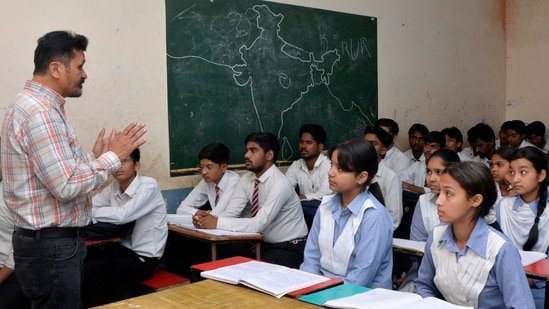
The Central Board of Secondary Education (CBSE) on Thursday directed schools to start teaching third languages (R3) from Class 6 “immediately” using locally available books and materials in line with its latest scheme of studies.


This comes a week after CBSE on April 2 rolled out major reforms in its scheme of studies, making the third language compulsory in class 6 from the ongoing 2026-27 academic session onwards. Students of Class 6 in the current academic session will be the first cohort that will study a compulsory third language when they will be in class 10 in 2030-31. However, the assessment of the third language (R3) will involve a school-based internal assessment in 2031, and not a board examination, according to CBSE’s curriculum document.
In a circular dated April 8, CBSE has asked schools to finalise and notify their respective regional offices of their chosen third language(s), and update the same in its digital Online Affiliated School Information System (OASIS) portal. The respective regional officers will maintain a record of the implementation of R3 in schools under their jurisdiction and will be approaching schools shortly to collect the details of R3 options being offered in Class 6.
“It is further informed that only those R3 languages which are introduced in Class 6 by a school will be available as options in Classes 9 and 10 for that school,” the circular signed by Dr Praggya M. Singh, professor and director (Academics) reads.
Under the new CBSE secondary school curriculum released on April 2, language subjects will be organised into three levels—R1, R2 and R3—as part of a structured three-language model. R1 (Language 1) will be the student’s main or strongest language, studied at a higher level, R2 (Language 2) is a different language, studied at a slightly different level. The third language (R3) will be compulsory from Class 6 starting this academic session 2026-27 and extended progressively to Class 10 by 2030-31.
The languages chosen at R1 and R2 levels will be different; the same language cannot be offered simultaneously at more than one level. According to the curriculum document, even when the same textbook is used until the availability of separate language textbooks for different levels, “the syllabus will be different for R1 and R2 levels and the assessment will also be different.”
Also Read: CBSE Board Exam 2026: Board issues advisory on misinterpretation of QR codes in question papers
CBSE’s changes operationalise ideas first mooted as part of the National Curriculum Framework for School Education (NCF-SE) 2023 and are aligned with the National Education Policy (NEP) 2020. The NCFSE recommends that school students learn three languages from class 6 all the way up to class 10, different from the previous system where the third language was only taught from classes 6 to 8. “As per the recommendations of NCFSE-2023, two out of these three languages must be languages native to India,” CBSE curriculum states.
During the April 2 webinar for launch of CBSE scheme of studies, CBSE’s academic director Singh said that the scheme will be implemented in full scale by 2030-31. “We will have Language one at R1 and R2 levels, language two at R1 and R2 levels. So the students can choose only one subject or one language at either R1 or at R2 and they can not choose the same subject at R1 or R2 level. Language 3 would be at the R3 level which will have school-based internal assessment.”
Explaining how the three-language formula will be implemented, Sudha Acharya, principal of Delhi-based ITL Public school said there are 44 languages in the CBSE’s list of language subjects including two official languages of India – English and Hindi.
Also Read: CBSE introduces AI learning from Class 3
“So if my school is opting English as a first language at R1 level, then it will opt Hindi as a second language at R2 levels. So, if English is at R1 level, Hindi has to be at R2 level only and vice-versa as we can not offer two subjects at the same level. We have opted for four languages from various parts of India: Marathi, Punjabi, Bengali, Tamil and Sanskrit as R3 (third language), so the children are not forced to take Sanskrit, they can choose any language they opt for. While R1 and R2 will be tested in board examinations, R3 will be assessed through school-based examinations and CBSE will provide rubrics for the same. NCERT will also provide textbooks for the same shortly,” she said.
Clarifying confusion over English being dubbed as “foreign language,” Acharya said, “If a school is offering Urdu at R1 level and Hindi, Tamil or any other native language at R2 level, students can opt for foreign languages like French or German as the third language, since two languages are already native to India. If English is taken at R1 or R2, a foreign language cannot be chosen as R3. English is not a foreign language but is also not native to India. Schools can offer foreign languages as a fourth language through reading clubs.”
“We already had 3 language formulas from 6 to 8 and earlier we could offer foreign languages alongwith English, Hindi or Sanskrit. But now, I have to offer at least two languages native to India,” she added.
CBSE will release learning material for R3 languages for Class 6 online this month.


