



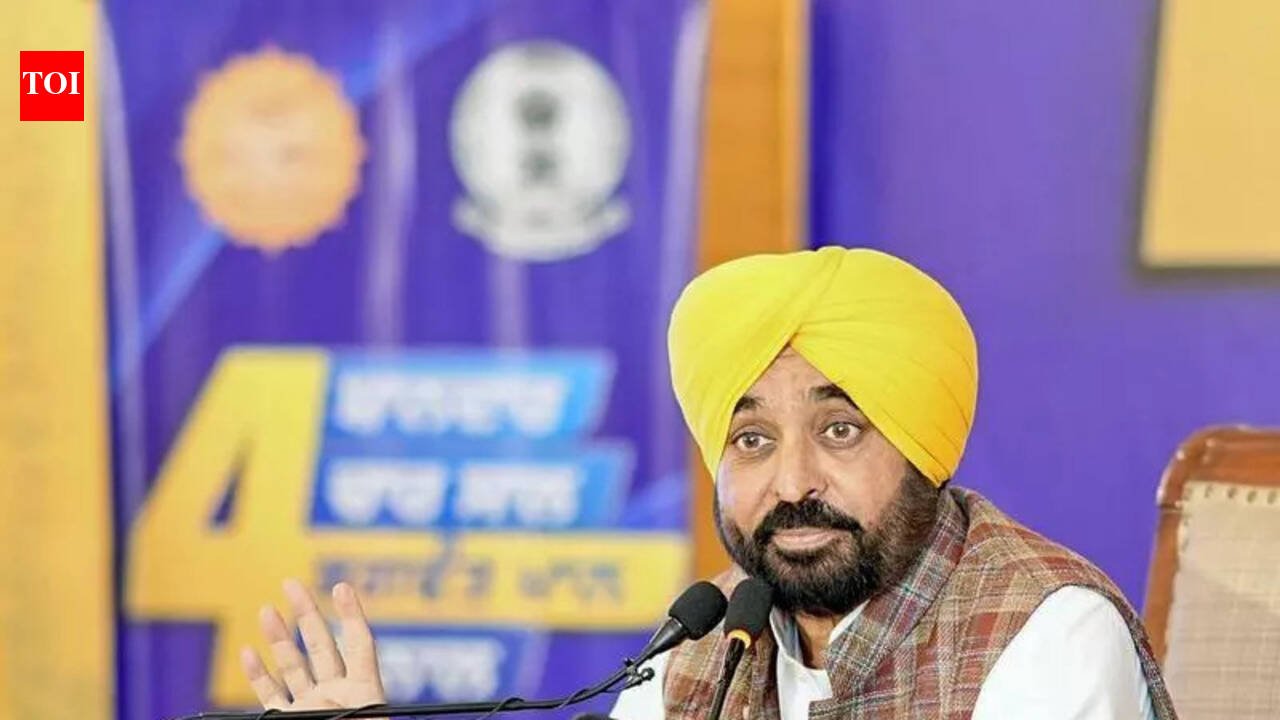
Chandigarh: Punjab chief minister Bhagwant Mann on Wednesday claimed a turnaround in the state’s irrigation system, noting that the AAP govt, in four years, ensured water supply to fields equivalent to the Bhakra canal by unlocking 10,000 cusecs from seasonal rivers and reviving a collapsing canal network.He said canal irrigation coverage had surged from just 26.50% in 2022 to 78% today, with long-defunct systems like the 22-km Sarhali canal brought back to life, round-the-clock water supply ensured through the Ferozepur-Sirhind feeder, and canal water reaching 1,446 villages for the first time since Independence.Speaking to mediapersons, Mann said: “Rs 6,700 crore has been spent on canal lining, repair, modernisation and strengthening of infrastructure from April 2022 till now, which is the highest ever in Punjab‘s history.”He emphasised that Punjab had a total canal irrigation potential of around 75.90 lakh acres, but until March 2022, only 20.89 lakh acres, which was merely 26.5%, were actually receiving canal water.“Today, we have increased this coverage to nearly 58 lakh acres, taking utilisation to around 78%. This is almost three times the earlier figure,” the CM said, adding that the Punjab govt had ensured maximum utilisation of canal water available in the state.Mann further said: “We have spent around Rs 2,000 crore to construct and restore nearly 13,000 km of canals, due to which canal water is now reaching 58 lakh acres. Along with this, around 7,000 water channels have been restored. A total of 15,539 canals have been cleaned, and 18,349 watercourses have been revived, ensuring that even tail-end agricultural fields now receive canal water.”“For the first time in Punjab’s history, 101 abandoned canals spanning 545 km have been revived. Many of these canals were closed for 30 to 40 years and even filled up with soil. We restored these without acquiring even a single inch of land,” he informed.The CM said revival of rainwater channels alone had helped bring an additional 2.75 lakh acres under irrigation. “By restoring old canal systems, we have ensured that an additional 10,000 cusecs of water is now reaching fields. In effect, we have created a new ‘Bhakra canal’ without acquiring any land,” he added.On strengthening major canal systems, the CM said: “The Ferozepur Feeder Canal, originally constructed in 1952, was upgraded in a record 35 days, increasing its capacity by 2,682 cusecs. Similarly, the Sirhind Canal, considered the lifeline of Malwa and built around 1950, has been upgraded after 75 years, increasing its capacity by 2,844 cusecs. Through lining of major canals like Sirhind and Patiala, we have increased water availability by around 1.5 MAF and ensured that even tail-end areas no longer face shortages.“Addressing the issues faced by farmers, Mann said: “Earlier, water in canals used to be supplied on a rotational basis, forcing farmers to wait for their turn. For the first time, we have ended this system and ensured that farmers get water every day.”He further highlighted that the govt even ran canals in the reverse direction towards Harike Pattan when required to ensure equitable distribution of water.Speaking about the Kandi region, Mann said: “The Kandi Canal in Hoshiarpur, which remained non-functional for nearly 40 years, has now been revived. People in this region understand the true value of water, and its return has brought immense relief. Due to expansion of canal infrastructure, around 1,400 villages are now receiving canal water for the first time since Independence. Many of these villages had not seen canal water for 20 to 50 years.“He also noted that new canal systems such as Cheema Minor, Phillaur Minor, Karamgarh Link, Rajpura, Patran, Ghaggar and Kotla had contributed to expanding irrigation reach across regions. “We have constructed eight new canals and made 18 pump systems operational to strengthen irrigation coverage in multiple districts.”Mann added: “To improve efficiency, we have created dedicated canal water and groundwater divisions such as Fatehgarh Canal Division and Tarn Taran Canal Division, with permanent officers posted there to ensure accountability and faster execution.”On disaster management and environmental restoration, he said: “Rs 477 crore has been utilised from the State Disaster Mitigation Fund for 195 works aimed at flood prevention and water management. We have identified 199 desilting sites and deployed new chain-mounted machines to clean drains on a war footing.”He further said: “Desilting of rivers like Sutlej, Ravi and Ghaggar is underway with a target of removing 245 million cubic feet of silt, of which significant progress has already been made. Additionally, 206 km of river embankments are being strengthened to prevent flood damage.”“Under the Punjab Canal and Drainage Act, 2023, 849 out of 850 drains have been notified to prevent encroachments and safeguard life and property,” said Mann.Taking a strong position, the CM said: “Those who claimed to be saviours of Punjab’s waters ended up destroying these. We have revived both our waters and our systems.”“Canal water carries essential minerals, and its increased availability will significantly improve crop productivity. Farmers are happy as many are receiving canal water in their fields for the first time,” he said.“We have developed 26 tourist sites, including boating facilities, rest houses, headworks and other infrastructure, to promote tourism and generate revenue,” he added.Sarhali Canal Revived (BOX)Sharing a striking example from Tarn Taran district, the CM Mann said: “The 22-km-long Sarhali Minor canal had completely disappeared due to the negligence of previous govts. When our engineers began work, they discovered the canal buried underground. Even local people had forgotten about its existence. Today, we have revived it and made it fully operational.”Stopping Water To Pakistan (BOX)“The Shahpur Kandi Dam project, which was pending for over 25 years, has now been completed at a cost of Rs 3,394.49 crore. This will enhance the efficiency of the Ranjit Sagar Dam and stop water from flowing into Pakistan,” said the CM.Groundwater Usage Dips (BOX)On groundwater conservation, CM Mann said: “Our efforts have significantly reduced dependence on groundwater. In one village in Gurdaspur, groundwater extraction has come down from 61.48% to around 31%, which is a remarkable achievement. This will benefit future generations.”MSID:: 129655132 413 |


