





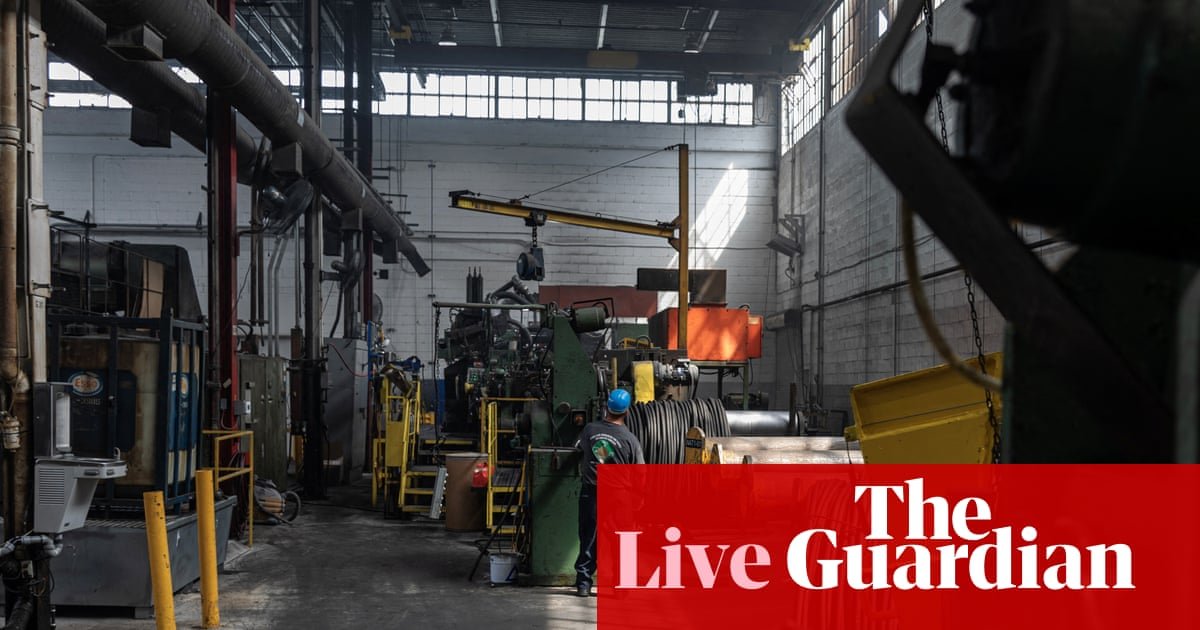
Canada launches 50% retaliatory tariffs on hundreds of US imports
Canada has said it will implement 50% retaliatory tariffs on $20bn worth of US goods, following through on prime minister Mark Carney’s vow to match Donald Trump’s duties “dollar for dollar”.
The new tariffs will take effect from 8 September and will impose duties of 15%, 25% and 50% across 700 products, the Canadian government said in a statement.
Key events
Here’s Canada’s minister of finance and national revenue François-Philippe Champagne’s announcement of tariffs on $20bn worth of US goods, following through on PM Mark Carney’s vow to match US tariffs “dollar for dollar”.
Trump claims US has demined strait of Hormuz and warns Iran not to plant any more
Donald Trump has claimed in a post on his Truth Social platform that the US Navy has informed him that “all mines have been removed and/or detonated from within the International Waters of the Strait of Hormuz”.
“Iran has been notified that any ship or boat placing new mines will be immediately and systematically destroyed,” Trump claimed, adding that the US Space Force is monitoring the critical waterway and Iranian nuclear sites.
“There is a Zero Tolerance policy on mine placement in full force and effect,” he said.
The US and Iran have not exchanged air strikes for weeks, but attacks on vessels in the strait of Hormuz have continued as the two sides vie for control of the key maritime passage. It remains unclear how or when talks on ending the war between the two sides will resume.
Oil transits through the strait were at 5m barrels per day on Monday, provisional data from ship-tracker Vortexa showed, down from more than 20m per day – or about one of every five barrels consumed worldwide – before the US and Israel launched the war in late February.
As I reported on Monday, we’re seeing a wave of Trump-friendly Republicans issuing rare rebukes of the administration – namely the decision to pause tariffs on up to 300,000 metric tons of foreign beef imported to the US.
The president has said the move, announced on Friday, would “reduce prices for Americans while giving space for our Great American Beef Herd to grow again”.
Most recently, Republican Senator John Barasso of Wyoming lamented the policy.
“Americans want US beef on the table – not foreign imports,” he wrote in a post on X. “Wyoming ranchers produce the highest quality beef in the world. Our ranchers don’t ask for special treatment. They simply want a fair marketplace. It needs to be easier – not harder – for Wyoming ranchers to feed America.”
Edward Helmore
A federal judge has rejected Ghislaine Maxwell’s legal effort to throw out her 2021 conviction on sex-trafficking charges and 20-year prison sentence, calling her claims “demonstrably meritless, and generally based on speculation, distortions, and/or outright falsehoods”.
In a 67-page decision filed on Tuesday, US district judge Paul Engelmayer for New York’s southern district denied the former British socialite’s petition for relief, finding that Maxwell had failed to make a substantial showing that her constitutional rights were denied when she was convicted for her role in crimes linked to late sex trafficker Jeffrey Epstein.
Maxwell, who is serving out her punishment at a minimum-security prison camp in Bryan, Texas, had petitioned the court to vacate her conviction on grounds that there were issues at her trial, including a juror who later revealed he was a sexual abuse victim and evidence she alleged was not made available to her defense team.
Her petition, which came before the massive Epstein-related document dump by the federal government, also raised the 2007 non-prosecution agreement between federal prosecutors in Miami and Epstein, which she claimed protected her from prosecution. Maxwell was not named in that agreement.
In the decision denying the petition, Engelmayer wrote that the “vast majority” of grounds on which Maxwell made her appeal “are procedurally barred – either because Maxwell made and lost the same arguments on direct appeal, or because she could have made such arguments on appeal but elected not to do so”.
Maxwell previously lost an attempt to overturn her conviction, centered on the government’s non-prosecution agreement with Epstein, in the US supreme court when the justices declined to hear her appeal.
The list of products affected by Canada’s retaliatory tariffs includes a 50% duty on American steel and aluminum. There is also a 25% tariff on cheese, fresh and frozen fish and seafood, as well as several wood products.
Canada is also implementing a 25% tariff on household appliances, such as washing machines, hairdryers and stoves. There is also set to be a 50% tariff on video games consoles.
Canada launches 50% retaliatory tariffs on hundreds of US imports
Canada has said it will implement 50% retaliatory tariffs on $20bn worth of US goods, following through on prime minister Mark Carney’s vow to match Donald Trump’s duties “dollar for dollar”.
The new tariffs will take effect from 8 September and will impose duties of 15%, 25% and 50% across 700 products, the Canadian government said in a statement.
On Monday, we reported that the supreme court lifted one of the injunctions blocking Donald Trump’s executive order aimed at curbing mail‑in voting.
As we’ve reported, the justices did not rule on the legality of the order itself – which directs the Department of Homeland Security to assemble a “state citizenship list” and instructs the US Postal Service to accept mail ballots only from people on that list.
Instead, in a 6–3 emergency decision with the liberal justices dissenting, the court said the injunction should be paused because the challengers sued prematurely. At the time, USPS had not yet detailed how it would decline to deliver ballots mailed by voters who are not on the federally approved list.
That changed last week, when USPS issued a final rule spelling out those steps – opening the door to fresh legal challenges.
“Please don’t overreact to the Roberts Court decision on the contemplated USPS ballot moves,” said Norm Eisen, co‑founder and executive chair of Democracy Defenders Fund, which is leading one of the challenges. “They simply held that the injunction came too early, before a final rule.”
A second nationwide block from a federal judge still blocks USPS from implementing the order, and the supreme court did not address that one on Monday.
Trump blasts Canada as ‘most difficult and unreasonable’ country he deals with
Meanwhile, Donald Trump has continued to blast Canada for “ripping off” the US “for decades”.
“They have been charging our Farmers 400% Tariffs, and more. They have driven many wonderful U.S. companies out of business. For 10 years they wouldn’t certify Gulfstream Jets, until I got involved. They wanted 100% of the market for Gulfstream’s Canadian competitor,” the president wrote on Truth Social. “I deal with many countries, and Canada is easily the most difficult and unreasonable. They feel entitled, but they are not a State, and will be entitled no longer!”
Canada prepares for retaliatory tariffs: ‘We’re not waiting by the phone’
Dominic LeBlanc, Canada’s trade minister, said that Canada will likely unveil its retaliatory tariffs today on US imports after trade talks collapsed over the weekend – and 50% duties on $20bn worth of Canadian goods took effect.
“Our preference was to find a deal that benefits both countries,” LeBlanch said in an interview with CNBC on Tuesday. “We still believe that’s possible. But in the meantime, we’re not waiting by the phone.”
We’ll bring you the latest from Ottawa as the latest duties are announced.
Tom Perkins
A new rule proposed by the Trump administration aims to kill public notification for datacenter air pollution, public health advocates warn, and allow emission permits to be issued behind closed doors.
The datacenters are often sources of nitrogen oxide, which helps form ozone, carbon monoxide and heavy metals, among other pollutants.
The Clean Air Act requires “minor” air polluters to disclose to the public via state agencies how much pollution their proposed project will release, but the proposed new rule from Donald Trump’s Environmental Protection Agency (EPA) would dismantle that protection for datacenter proposals. Instead, it would make disclosure voluntary at state and some local officials’ discretion.
Many state political establishments support datacenters, and observers say it is unlikely most would voluntarily require big tech to disclose the information. The move is likely intended to curb criticism and public oversight of datacenters, said Joe Goffman, a former assistant administrator for the EPA’s office of air and radiation.
Without this data, communities won’t know what they’re breathing once a datacenter is built, and will have less ability to fight back in court or in public relations battles. Goffman said the Clean Air Act is supposed to offer “an ironclad promise” to give the entire US public a voice on these issues.
“The administration is basically saying: ‘You all may have thought this was an ironclad promise, but it no longer is,’” Goffman added. He co-authored comments on the proposed rule submitted by the Environmental Protection Network. The EPA just closed the public comment period, and the rule could face a legal challenge if finalized.
Trump also noted claimed today that the Iranian regime is “not paying large segments of their military while at the same time killing protesters, even when they are not protesting”.
This comes after the treasury secretary, Scott Bessent, announced “unprecedented” sanctions against countries that continue to do business with Iran.
“Our objective is to sever every economic lifeline that sustains this tyrannical regime until Tehran stands alone,” Bessent said on Monday.
While Iran’s currency, the rial, dropped to a new low on Monday, it’s unclear how the US plans to roll out new secondary sanctions to target those trading with Iran. This week, Bessent evaded reporters’ questions about a timeline or whether China – the largest importer of Iranian oil – would be targeted.
“We are level-setting with every country to tell them our expectations. We know who they are. They know who they are,” he said.


