


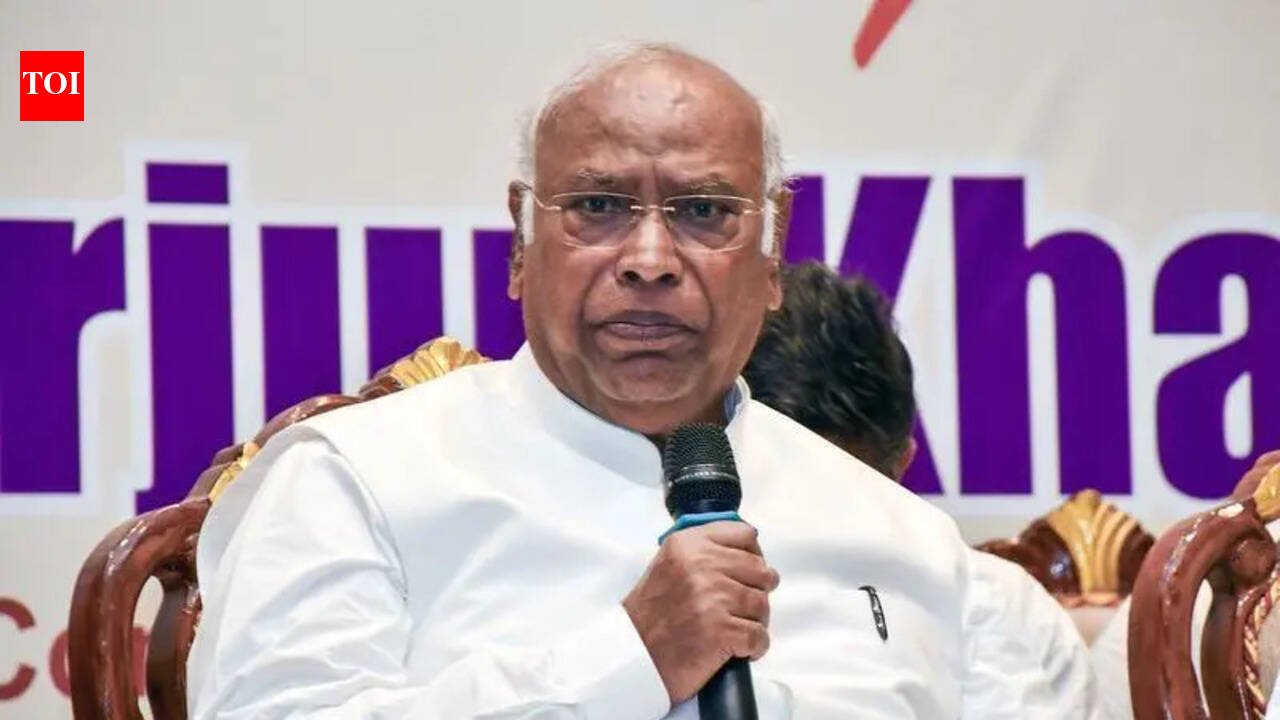
Bengaluru: All India Congress Committee president Mallikarjun Kharge Thursday ruled out an “immediate” change in chief minister in the state, even as his name continues to circulate within party circles as a potential consensus candidate if the high command moves to resolve the tussle between Siddaramaiah and DK Shivakumar. “You (reporters), he (G Parameshwara) and people at the top say that it is better if I become (the chief minister), but more than fate, as per my ideology and going by my service to the party, Sonia Gandhi takes decisions regarding me,” Kharge said. Despite a long career, Kharge has not held the CM post. He was a strong contender in 1999, but the position went to SM Krishna. That decision marked a turning point in his state-level politics, though he later went on to hold key roles at both state and national levels. Kharge is described as a neutral figure unaligned to any camp, and his acceptability across factions is seen as a key factor. Unlike Siddaramaiah and Shivakumar, his role as national party president places him above state-level rivalries, giving him institutional weight and distance from the conflict. The makes him an ideal bridge candidate if party brass opt for a reset without resistance. Kharge’s experience adds to this perception. With over five decades in public life across Karnataka and at the Centre, he is seen as having the administrative depth to manage a complex state unit. At the same time, internal discussions tend to factor in his age. At 83, and with periodic health concerns, there is speculation that a shift to state politics could reduce demands for extensive national travel. His possible elevation is also being assessed through a social and electoral lens. If he is picked, he would be Karnataka’s first Dalit CM, a move that could carry symbolic weight and expand the party’s social outreach. Some believe it would counter any anti-incumbency ahead of the 2028 assembly elections. Kharge’s record at the Centre is being cited to support his credentials. As Union labour and employment minister from 2009 to 2013 in the UPA govt, he was associated with labour welfare measures and social security initiatives, especially for workers in the unorganised sector. He later served as railway minister in 2013, focusing on operational continuity and infrastructure projects and won accolades. As opposition leader in the Lok Sabha from 2014 to 2019, he led Congress despite the party lacking the numbers for formal recognition, remaining active in debates and legislative scrutiny. As opposition leader in the Rajya Sabha, he played a role in coordination and floor management. Members also highlight his role in securing special constitutional status for the Hyderabad-Karnataka region under Article 371J, which enabled targeted development and reservation in education and public employment for the backward region.
