



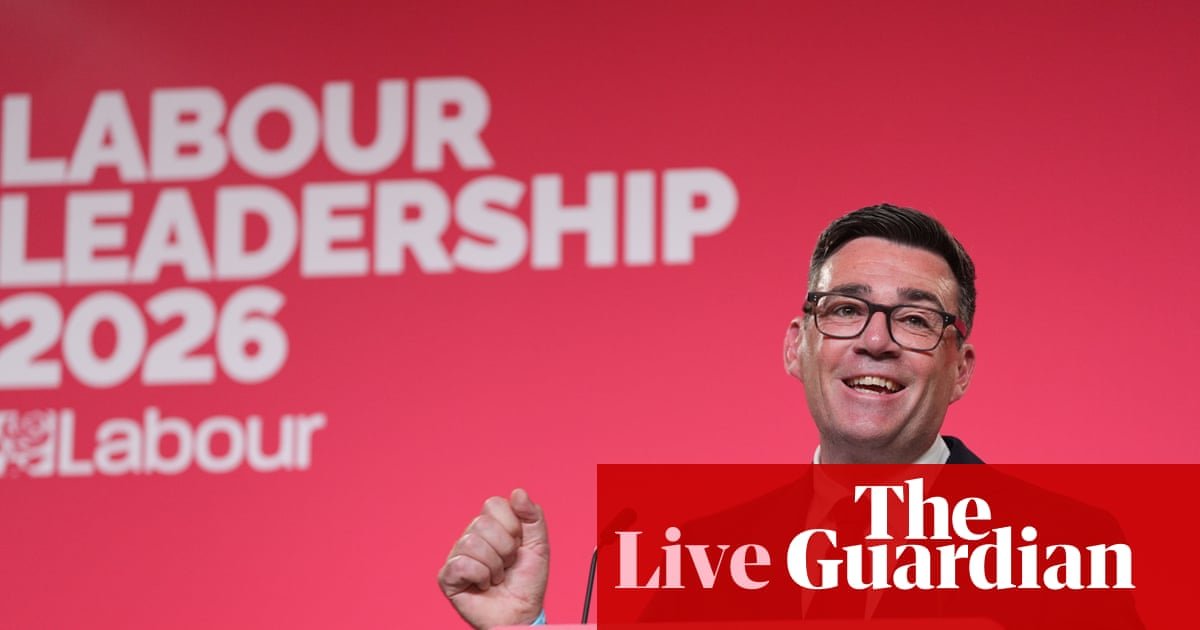
Burnham’s speech – snap verdict
It has become fashionable this week to say that all Andy Burnham has been offering recently has been “vibes”. And, if “vibes” means emotional connection, optimism and generalities rather than specifics, then that’s fair. This speech was a vibes masterclass.
But it’s a ghastly term because it’s pejorative and sneery, and it misses what politics is about. When Winston Churchill delivered his brilliant speeches during the second world war, and promised to “fight them on the beaches”, that was just vibes too. You could say the same about Martin Luther King, or Bill Clinton or Barack Obama – or almost anyone else. There was not much policy detail in “I have a dream”.
Burnham is not in that class as an orator, but this speech was in better than anything that Keir Starmer has delivered, and really very, very good indeed. There were two passages that particularly stood out.
The first was the one where he cleverly appropriated and inverted the ‘Andy Burnham walks into a bar” joke. (See 12.31pm.) The self-deprecating joke, “a Burnhamite walks into a bar, as many Burnhamites are known to do”, was particularly nicely phrased, but overall it worked because he was using a joke to shore up a proper argument.
And the second was his line:
The right use the phrase “take back control”, but they are the ones who gave it away in the first place.
This was neat because it linked his argument about Thatcherism and the past 40 years (see 12.40pm) with the need to offer a policy response to the crisis in left-behind areas illustrated by the Brexit vote.
The narrative arc of progressive politics is, almost always, disappointment. Leaders who are best at inspiring hope are also those most likely to hear people saying a few years down the line they have not lived up to expectations.
But hope is always a good starting point; vibes on their own won’t deliver change, but it easier to get things done with them than without them. Burnham’s leadership has got off to a good start.
Key events
Andrew Sparrow
Andy Burnham has posted this on social media.
It’s the honour of my life to be Leader of the Labour Party.
I will be a leader for every region and nation in this great country, and this Party will be unashamedly Labour in our priorities and in the decisions we take.
Together, we will set Britain on a new path.
That is all from me for today. Tom Ambrose is taking over now.
Burnham’s speech – snap verdict
It has become fashionable this week to say that all Andy Burnham has been offering recently has been “vibes”. And, if “vibes” means emotional connection, optimism and generalities rather than specifics, then that’s fair. This speech was a vibes masterclass.
But it’s a ghastly term because it’s pejorative and sneery, and it misses what politics is about. When Winston Churchill delivered his brilliant speeches during the second world war, and promised to “fight them on the beaches”, that was just vibes too. You could say the same about Martin Luther King, or Bill Clinton or Barack Obama – or almost anyone else. There was not much policy detail in “I have a dream”.
Burnham is not in that class as an orator, but this speech was in better than anything that Keir Starmer has delivered, and really very, very good indeed. There were two passages that particularly stood out.
The first was the one where he cleverly appropriated and inverted the ‘Andy Burnham walks into a bar” joke. (See 12.31pm.) The self-deprecating joke, “a Burnhamite walks into a bar, as many Burnhamites are known to do”, was particularly nicely phrased, but overall it worked because he was using a joke to shore up a proper argument.
And the second was his line:
The right use the phrase “take back control”, but they are the ones who gave it away in the first place.
This was neat because it linked his argument about Thatcherism and the past 40 years (see 12.40pm) with the need to offer a policy response to the crisis in left-behind areas illustrated by the Brexit vote.
The narrative arc of progressive politics is, almost always, disappointment. Leaders who are best at inspiring hope are also those most likely to hear people saying a few years down the line they have not lived up to expectations.
But hope is always a good starting point; vibes on their own won’t deliver change, but it easier to get things done with them than without them. Burnham’s leadership has got off to a good start.
Burnham claims he has not yet made any decisions about who will be in his ‘top team’
Earlier in the speech Burnham claimed he had not yet decided on key cabinet appointments. He said:
Contrary to what you may keep on reading, I haven’t made any decisions yet about who will be in that top team, but I will soon. And when I have, you will see it reflects all parts of our party, all communities.
Burnham says his style is about listening to people, and that won’t change
Burnham said as PM he wanted to continue going to football, and being close to people.
Also want you to know is that I won’t change.
I have a style, it’s my style, I will always stay close to the ground, close to the people. Hopefully still in my season ticket [seat].
He said it was brilliant meeting people in Cardiff this week. (See 8.25am.)
He said, as mayor of Greater Manchester, he used to bring in ideas for his chief of staff, Kevin Lee, that he had picked up in Greggs, or at the pub.
That’s how we did it, just to be close and listen. And that’s what I’ll do.
I’ll be out and about in August in all parts of the UK, definitely in the south that I’m off to Gravesend later to show I’m for the south too.
Burnham thanks David Blunkett, Margaret Beckett and Neil Kinnock in particular for their help as mentors
Burnham singled out three people for particular thanks.
First, David Blunkett, the former home secretary. Burnham served as his PPS when he entered parliament.
He said:
I would say he taught me everything I know but certainly not about football.
Next, Margaret Beckett, the former Labour deputy leader.
Can I also say to Dame Margaret Beckett, you were a wonderful friend to me and guide throughout my my time in the cabinet.
You were always there for me to give me that nudge that I needed.
And, finally, Neil Kinnock.
He is the man that fired up a young Andy Burnham in the north-west of England in the mid 1980s with rhetoric of the kind that remains unmatched.
I would say, in modern politics, it has always been something that I treasure to get a message from him, with his advice and the care and the thought he puts in to those messages. They they mean everything to me.
I would not be standing here, I would have not have joined this great party of ours in 1985, had it not been for the legend that is Neil Kinnock.
Burnham says he will be a pro-business Labour leader
Burnham said he would be pro-business.
I will be a pro-business leader of the Labour party as I was a pro-business mayor of Greater Manchester.
We turned places round together and that is the way we run in Manchester and we will take to the whole country.
And as part of that, more power to reindustrialise and to build an education system based on parity between academic and technical education, to give every young person growing up in different parts of the country a path in life to university or to a work placement, to apprenticeship and into a good job.
Burnham says his fifth pledge is about devolution.
We will take power back from Westminster and Whitehall and give it to the place where you live.
As an example, he says Steve Rotheram, the Liverpool city region mayor, has been at a meeting today discussing “a plan to put the entire Merseyrail network back in public ownership by 2028”.
Burnham says he will be PM for ‘all places’
Burnham says his fourth commitment is about being a PM for all parts of Britain.
This is my fourth commitment to you. I mean it when I say all places.
I will be a leader for the north, the south, the east and the west, for Scotland, Wales and for Northern Ireland.
Burnham says the right say ‘take back control’ even though ‘they gave it away in first place’
Burnham talks about where he thinks Britain has gone wrong.
I am clear Britain took a series of wrong turns in the 1980s.
Political power was centralised and economic power was privatised.
The country surrendered control of the essentials – housing, water, energy, transport -and left people exposed to higher costs.
That in turn led to the concentration of more wealth and power in the hands of fewer people and fewer places.
Large parts of Britain were industrialised without the power to set new ambitions for themselves.
Proud British towns, now a shadow of what they once were, and high streets in decline, so common up and down the country.
Slowly, at times imperceptibly, over four decades, political and economic power drained away out of our communities in every region and nation of the UK.
He goes on to develop the control theme.
If local places don’t control something as basic as a bus service, how can they connect people to opportunity and turn things around?
If the sell off of council homes leave country chasing rents in the private rented sector through the benefits system and paying for temporary accommodation for thousands of families, as they have to do here in London and elsewhere across the country, how then will we find the money to invest in prevention and improve people’s lives?
The truth is, we can’t.
And if we don’t have sufficient public control over the cost of the essentials, how can we have control over inflation, public spending and the rest of the economy?
The right use the phrase take back control, but they are the ones who gave it away in the first place.
Burnham says his party will win by being ‘boldly, confidently, authentically Labour’
Burnham says his third change is about setting a new direction.
My third change is our political direction. Yes, we will work with other parties where we can, but doing so from the clarity of knowing exactly where we stand.
As your leader, I will set a direction that is distinctively Labour.
We won’t try to out-Green the Greens or out-Reform Reform or doing what we’ve done in the past – wearing too many Tory clothes.
Let me tell you, I’m quite happy that Kemi doesn’t approve of my wardrobe choices because I’m not keen on theirs either.
From here we do it differently.
We win by being us boldly, confidently, authentically us – Labour.
Burnham says he wants politics to be less toxic.
We may find our political discourse in this country becomes that little bit less toxic, and we should be working to achieve that too.
And the turbulence of the last decade may not quite feel as so inevitable as it does today.
Burnham says he wants a ‘new politics’, based on problem-solving not point-scoring
Burnham moves on to the second change he is proposing – a move to a new politics.
I will work to build a new politics. The country is crying out for it.
We might enjoy the point-scoring against others. The public don’t.
How can politicians point fingers when living standards are falling?
And politics as a whole isn’t working for them. It infuriates them and makes them switch off.
In Makerfield, I decided to make a break with this. I said we hadn’t been good enough. I told people what I would do to fix it.
You know what? People started to listen again. They gave us a fair hearing. As the great British public always do. And then another chance.
Burnham says this is the last chance to change.
But let’s be honest, everybody, this is a last chance to change.
And we must take it together. Unite it together. Tell people what we will do rather than always going on about others.
And if we do more of of that, let’s see if we can get the ear of the country as well.
Let’s take a problem-solving rather than a point-scoring approach.
Let’s have the courage to fix the big things that politics has neglected, like social care, and have the conviction to go out there together and argue for our plans.
Burnham vows to end Labour’s ‘insidious briefing culture’
Burnham says his first change is about changing Labour’s culture.
First, I will work relentlessly to build a culture of one Labour team because change starts with us.
We won’t beat Britain’s new right if we are consumed by infighting and pulling in different directions. That is and always has been, an indulgence that falls heaviest on the people who need Labour most.
Fighting to eradicate it, and the insidious briefing culture that goes along with it, will characterise my leadership in future.
He goes on to invert the famous joke used against him.
When a Burnhamite walks into a bar, as many Burnhamites are known to do – talking about you, Kevin [Kevin Lee, his long-serving chief of staff] – in future, when a Burnhamite walks into a bar, I want the barman to say, ‘Great to see you, we don’t like factional politics in here.’


