



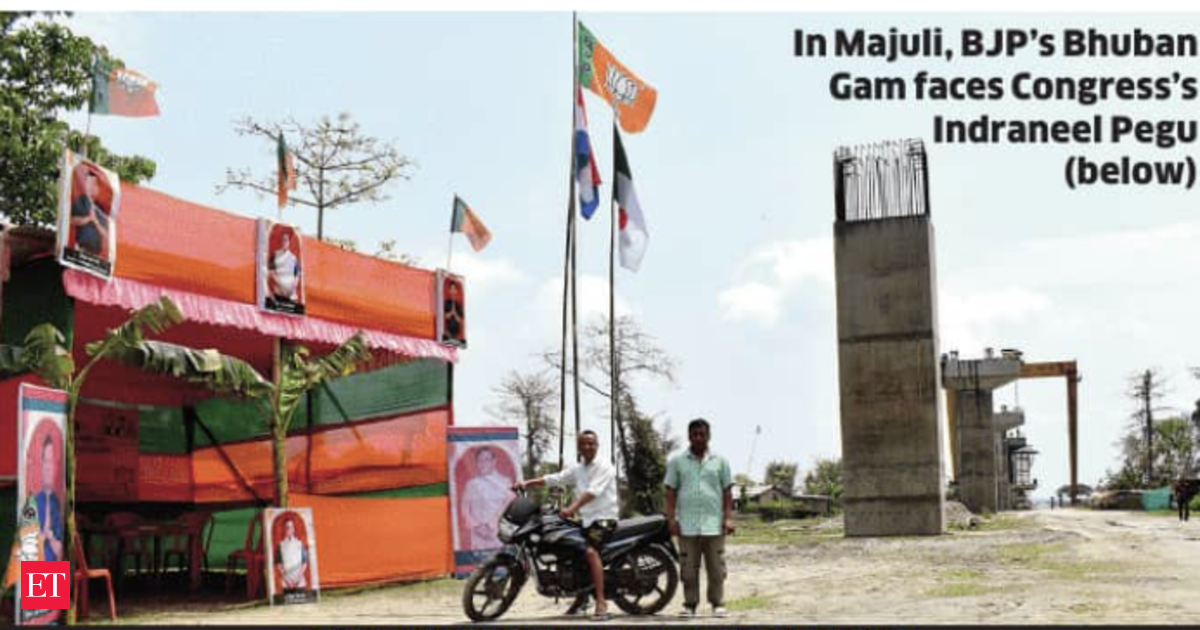
As MV Jahnavi glides past the pillars of the unfinished bridge, passengers on the deck slip into an animated debate. Some say the 8.25-km-long bridge should have been completed last year as planned; others take solace in the fact that work—which had been stalled after a change of contractors—resumed two months ago. The differing voices mirror the political divide in the ongoing campaign for the assembly election.
At a monastery called the Dakhinpat Satra, a few miles from the Aphalamukh ghat where the ferry docks, monk Dipen Pujari sums up the mood: it’s like a coin with two sides.
Also read: CM Himanta Biswa offers 2 free LPG cylinders in poll-bound Assam
“We welcome the new bridges on Majuli. The one under construction will make travel to cities like Jorhat and Dibrugarh easier,” he says. “But greater access also raises concerns about our security, as everyone arriving by ferry currently has to register their name and phone number.”
Multiple new bridges — including this mega one — are set to improve connectivity to Majuli, a 483 sq km island. Electors, like Payeng, welcome that. But many, like Pujari, are also concerned about an influx of outsiders.
The bridge under construction will eventually connect Majuli seamlessly to the south of Assam, while a new bridge at Dhunaguri, inaugurated just ahead of the election, has improved access to the north. Even so, people still have to take a ferry ride to reach the highway on the northern bank as a bridge project over the Subansiri river that would connect Majuli to Lakhimpur is delayed.
Majuli, a district in Assam and an assembly constituency reserved for scheduled tribes (STs), will vote on April 9. The BJP candidate and incumbent MLA Bhuban Gam faces a challenge from Congress’s Indraneel Pegu, a professor. Spread across nearly 1,250 sq km in 1950, Majuli—the world’s largest inhabited river island—has now shrunk to about a third of its size due to floods and erosion.
While the new infrastructure brings hope, the anxiety about outsiders—from migrant labourers to prospective settlers—bubbles to the surface.
“There is hardly any robbery on Majuli. I don’t even pull down the shutters of my restaurant. That may change if outsiders crowd in,” says Bipul Das of Kamalabari, the island’s business and spiritual hub. As his waiters serve Assamese thalis with fried fish and a local lemon called kaji nemu, he quickly adds that he supports the bridge projects—and their speedy completion. Better connectivity, he says, will ultimately make life and business easier for the islanders.
FARAWAY ISLAND
For decades, Majuli remained a distant and somewhat enigmatic place where dozens of Vaishnavite monasteries flourished, turning the island into a vibrant cultural and spiritual hub. Even as outsiders and the politics of identity dominated Assam’s political landscape, the island largely remained untouched by migrants, be it East Pakistan-origin Muslims, often called Miyas in the state, or Bangladeshi Hindus.
Until about a decade ago, many prominent elders of the island had opposed the construction of bridges, fearing that greater connectivity would dilute Majuli’s uniqueness and disrupt its spiritual life.
The tide began to turn in 2016, when the island became the home constituency of the then chief minister Sarbananda Sonowal. He declared Majuli a district and sanctioned a series of new roads, bridges and educational institutions, which supporters of the ruling BJP now highlight in their campaign.
“The main problem we face is healthcare,” says Manoj Das, a resident of Dakhinpat, close to the stretch where the bridge’s first few pillars are coming up. “There have been instances where patients died because of lack of healthcare and transportation facilities. After all, ferry services end by evening,” he says, adding that completing the bridge should be the government’s utmost priority.
Safety, too, remains a constant concern, particularly due to the overcrowded ferries. Missing a ferry to or from the island often means waiting for nearly an hour on the riverbank, with little in the way of permanent shade.
Also read: Bridging the Brahmaputra: Bogibeel reshapes Assam-Arunachal link ahead of polls
The risks became starkly evident in 2021, when a private ferry carrying nearly 100 passengers capsized and sank, forcing many to jump into the river and swim to safety. Three people lost their lives in the accident.
Since then, government officials have been stationed at the ghats to record the details of every passenger and ensure that boats are not overcrowded. A signboard of Do’s & Don’ts cautions passengers against taking selfies on the edge of a ferry and advises, in Assamese, “Nawat kazia ba thela hesa nakariba” — Don’t fight or push while on board.
While most boats can transport only three cars, a larger ferry like MV Jahnavi can accommodate up to 10 cars, along with 25-30 motorcycles and about 85 passengers. A passenger ticket costs ₹20, while motorcycles and cars are charged ₹40 and ₹600 each respectively.
Just as new roads, development projects, lack of medical facilities and demand for a speedy trial in the case of singer Zubeen Garg’s death have featured prominently in the island’s campaign, the upcoming bridges too have become a talking point in political rallies.
Addressing a large rally, Chief Minister Himanta Biswa Sarma said the state government would expand its Orunodoi Scheme in Majuli and extend monthly benefits to more women as new bridges improve connectivity. Striking a lighter note, he added, “Dalang hoi jowar pisat Jorhat aru Lakhimpurar parao bowari ahibo (Once the bridges are built, daughters-in-law will start coming from places like Jorhat and Lakhimpur too),” drawing peals of laughter from the crowd.


