


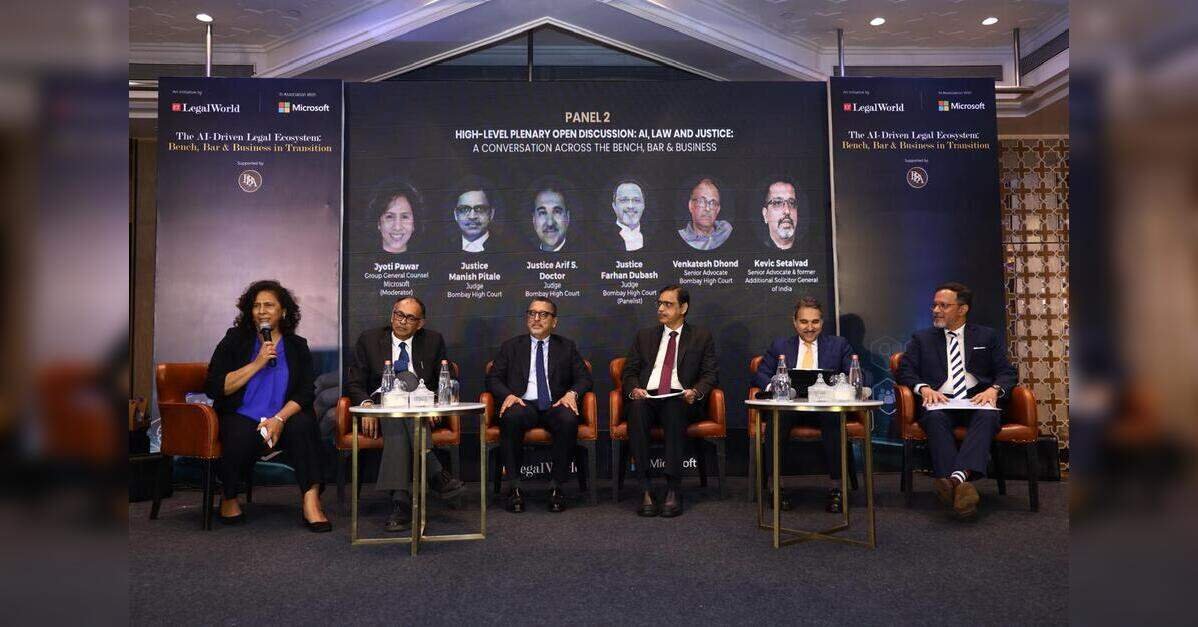
Artificial intelligence is ready to take over the administrative grind of Indian courts with case scheduling, backlog categorisation, real-time transcription, but must stay outside the actual process of judicial reasoning, a panel of Bombay High Court judges and senior advocates said at The AI-Driven Legal Ecosystem: Bench, Bar & Business in Transition, organised by ETLegalWorld in association with Microsoft and supported by the Bombay Bar Association.
The plenary, titled “AI, Law and Justice: A Conversation Across the Bench, Bar & Business,” was moderated by Jyoti Pawar, Group General Counsel at Microsoft, and featured Justices Manish Pitale, Arif S. Doctor and Farhan Dubash of the Bombay High Court, along with Venkatesh Dhond senior advocate, Bombay High Court and senior advocate and former Additional Solicitor General Kevic Setalvad.
Justice Pitale said AI could be useful on the administrative side, especially in managing boards, allocating time across different kinds of matters and reducing delays, but stressed that adjudication must remain anchored in human primacy and judicial independence.
Justice Doctor said AI should be introduced in “baby steps,” and the safest immediate use case would be a chronological summation of a case brief, rather than substantive analysis. Justice Dubash said he would welcome AI-powered translation, particularly for vernacular documents that now require time-consuming manual translation.
Dhond suggested AI could help courts categorise the pending backlog by identifying matters already covered by binding precedent, allowing registries and judges to dispose of such cases in bulk. Setalvad added that AI could be used to assess whether a case’s core issues are already settled by earlier judgments, potentially reducing pendency in one sweep, but both lawyers cautioned that such use must remain limited to identifying settled questions and not making fresh determinations.
On the question of whether AI could assist in drafting or reasoning in judgments, Dhond said the profession should not become comfortable with outsourcing “thinking or analysis” to machines, warning that courts must avoid any perception that a judicial decision is not truly the judge’s own. The panel also endorsed Regulation 20 of the Supreme Court’s draft framework, which requires a human in the loop and bars AI-only judicial disposal.
Setalvad said the draft regulations were more proactive than the EU’s approach, but flagged practical concerns around internal audit requirements, noting that LLM providers are unlikely to share proprietary training data. Dhond warned that disclosure norms may remain largely formal unless there is a cultural shift, since many lawyers may be reluctant to admit AI use even as they rely on it in practice.
The panelists also said both bar and bench will need training to detect fabricated citations and other AI-generated errors, while deepfakes and synthetic evidence will increasingly require dedicated digital forensic expertise in courtrooms.
On bridging the digital divide, Justice Dubash said AI literacy should begin at the college level and continue through bar associations and judicial academies, including for district court judges.
The summit was an initiative of ETLegalWorld, in association with Microsoft and supported by the Bombay Bar Association which brought together top legal minds and technology experts to discuss how AI is redefining legal work from courtrooms to corporate legal departments.
